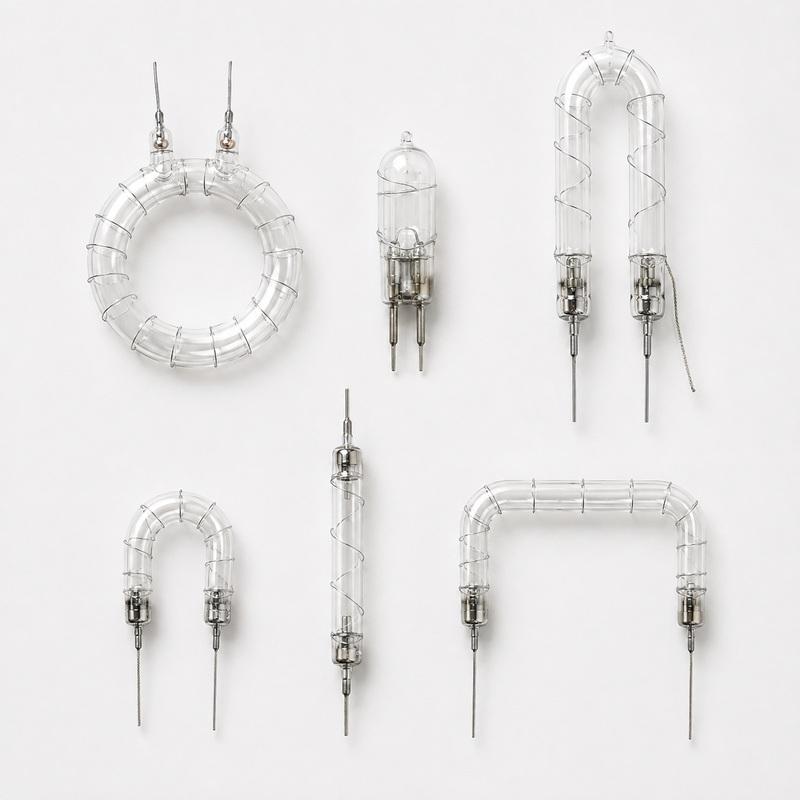
This is a Heavy-Duty Warning-Beacon Xenon Engineering Reference Center for forklift, mining, construction, port and airport fleets, flash-pattern visibility and long-term spare control- not a catalog listing.
Heavy-Duty Xenon Flash Tube Replacement for Forklift, Mining Truck and Construction Vehicle Warning Beacons
SOWIN GXEC heavy-duty warning-beacon flashlamp review is built for forklifts and material-handling fleets, mining and quarry trucks, construction and recovery vehicles, port and airport ground equipment and mixed-fleet beacon repair where warning visibility is a safety function rather than a decorative effect. A serious replacement must work with the original capacitor, trigger circuit, reflector and lens while maintaining the intended flash pattern under vibration, shock, contamination, temperature variation and long operating shifts.
Search coverage priority: heavy-duty warning beacon xenon flash tube/forklift warning beacon xenon tube/mining truck xenon beacon flash tube/construction vehicle strobe lamp replacement/haul truck warning beacon replacement/heavy-equipment amber beacon flashlamp.
Brand-neutral search context: ECCO service context, Heimann / EG&G / PerkinElmer / Excelitas-era supply, North American fleet repair, European industrial vehicles, Middle Eastern mining and construction fleets, and Asian OEM warning-beacon production. These names identify equipment or historical service context only.
Cross-industry proof appears later as supporting authority only: SOWIN GXEC also supports Traffic Enforcement, Industrial Stroboscopes, Professional Photography, IPL, Aviation Systems, Solar Simulation and UV Systems without weakening this page's heavy-duty beacon focus.
Fastest path to the correct tube: Send the original tube, beacon housing, reflector and lens photographs, voltage, capacitor value, trigger method, flash pattern, vehicle type, daily operating time, environmental conditions and annual quantity.
Fleet-visibility review route: Approval should evaluate the complete warning field through the real lens, not bare-tube brightness, and should include vibration, long-shift heat, mounting height and viewing angles.
Key Engineering Targets
|
Target
|
Engineering Meaning
|
|
Warning-Field Visibility
|
Protects conspicuity through the actual reflector, lens color, mounting height and viewing angles.
|
|
Flash-Pattern Stability
|
Verifies single-, double- or multi-flash timing under the approved electrical window.
|
|
Vibration and Shock
|
Reviews leads, seals, supports, connectors, clips and housing durability.
|
|
Long-Shift Thermal Duty
|
Covers pattern frequency, enclosure heat, airflow, ambient temperature and continuous use.
|
|
Fleet Spare Control
|
Links beacon models, approved samples, batch identity and annual maintenance planning.
|
Spec PDF and RoHS Review Center
PDF DOWNLOAD CENTER
Download SOWIN Xenon Flash Tube Spec PDF for Heavy-Duty Warning-Beacon Review
This PDF supports beacon-family comparison, flash-pattern discussion, electrical matching, reflector and lens review, legacy lamp identification and fleet spare-part planning.
|
Review Use
|
Why It Matters
|
|
Beacon-Family Review
|
Compare tube geometry, trigger route, capacitor energy, flash pattern, reflector and housing fit.
|
|
Warning-Field Approval
|
Combine technical data with lens color, mounting height, viewing angles and daylight visibility.
|
|
Environmental Review
|
Record vibration, shock, dust, mud, moisture, corrosion, temperature and long-shift heat.
|
|
Fleet Spare Planning
|
Retain the approved beacon map, sample, batch identity and annual quantity.
|
Note: PDF parameters support engineering and procurement review. Complete-beacon visibility, pattern and environmental testing remain necessary.
Decision Trap - Heavy-Duty Beacon Buyers Who Skip Complete-Housing Verification Pay Twice
A Bright Bare Tube Is Not Warning-Field Approval
The trap: approving a beacon tube because it flashes brightly outside the housing. A serious replacement must be checked by geometry, pulse energy, trigger route, flash pattern, reflector, lens, mounting position and vehicle environment.
The bill: weak visibility + pattern complaints + repeat repairs + fleet downtime + emergency spares + safety exposure.
The fix: verify tube fit + pulse energy + trigger route + flash pattern + reflector + lens + environment, then map the approved replacement to identified beacon models and controlled fleet batches.
Non-negotiable rule: if the flash pattern, reflector, lens and environmental duty are undefined, the heavy-duty beacon replacement window is undefined.
20-Year Xenon Engineering Verdict
20-YEAR XENON ENGINEERING VERDICT
Why Xenon Remains Valuable for Legacy Heavy-Duty Warning Beacons.
Many installed vehicle beacons were designed around a Xenon capacitor, trigger transformer, reflector and colored lens. LED beacons can provide strong visibility when the optics, driver, electronics and thermal path are designed as a complete system, but a tube-only service requirement often calls for preserving the existing Xenon architecture. The correct choice depends on the complete beacon, flash pattern and fleet environment.
Xenon vs LED - Xenon Remains Valuable for Legacy Heavy-Duty Warning Beacons
|
Parameter
|
Xenon Flash Tube
|
LED Flash / Semiconductor Alternative
|
|
Pulse Visibility
|
High peak pulse can work with legacy reflector and lens optics
|
Array area, driver current and optics dependent
|
|
Legacy Beacon Repair
|
Can preserve the original capacitor, trigger, reflector and lens
|
Usually requires a compatible driver and optical redesign
|
|
Flash Pattern
|
Single-, double- and multi-flash duty can be matched within limits
|
Electronically programmable but driver and heat limited
|
|
Replacement Risk
|
Main risks are energy, trigger, pattern, reflector and environment
|
Main risks are driver compatibility, heat, optics and EMC
|
Validated for Heavy-Duty Beacon Pattern and Long-Shift Consistency - Without Empty Lifetime Claims
|
Validation Path
|
Engineering Meaning
|
|
Defined pattern program
|
1100+ hour cycles can be used under stated pulse sequence, energy, temperature and cooling conditions.
|
|
Visibility monitoring
|
Track ignition, flash-pattern consistency, lens output, heat and warning-field behavior.
|
|
Fleet introduction path
|
Engineering sample, representative beacon tests, model-mapped pilot batch and repeat supply reduce mixed-fleet risk.
|
Controlled Heavy-Duty Beacon Service Programs - Governance Model
What serious programs protect: warning-field visibility, flash-pattern consistency, long-shift uptime, model mapping, traceability and planned spare continuity.
What they forbid: bare-tube brightness approval, one-spare-fits-all assumptions, unrecorded pattern changes and unsupported warning-light brand claims.
Heavy-Duty Warning-Beacon Brand-Neutral Engineering Search Map
|
Route
|
Search Coverage
|
|
Material-Handling Route
|
forklift amber beacon flash tube, reach-stacker warning lamp and warehouse vehicle beacon repair.
|
|
Mining and Quarry Route
|
mining truck xenon beacon tube, haul-truck warning light and quarry equipment strobe replacement.
|
|
Construction Fleet Route
|
excavator, crane, tow truck, road-maintenance and utility-vehicle beacon service.
|
|
Legacy Supply Route
|
ECCO service context and Heimann, EG&G, PerkinElmer or Excelitas-era lamp review by sample or part number.
|
|
Global Fleet Route
|
North American, European, Middle Eastern and Asian vehicle OEM, distributor and repair-market searches.
|
Compliance boundary: brand and model names identify equipment or service context only. Buyers must still verify tube geometry, capacitor energy, trigger route, flash pattern, reflector, lens and environmental duty.
Heavy-Duty Warning-Beacon Application Route Selector
Forklift Fleets
For warehouses, logistics centers and material-handling equipment.
Mining Trucks
For haul trucks, loaders, excavators and quarry equipment.
Construction Vehicles
For cranes, tow trucks, road maintenance and utility fleets.
Port and Airport Equipment
For terminal tractors and ground-service vehicles.
Legacy Beacon Repair
For obsolete models, mixed fleets and incomplete spare-part records.
One-Minute Matching Checklist
|
Item
|
Buyer Input
|
Why It Matters
|
|
1) Tube and beacon photos
|
Tube, ruler, housing, reflector and lens
|
Confirms fit and optical route
|
|
2) Electrical and trigger data
|
Voltage, capacitance, trigger and recharge
|
Defines the discharge window
|
|
3) Flash pattern
|
Single, double, multi-flash and timing
|
Defines pattern and thermal duty
|
|
4) Vehicle environment
|
Vibration, shock, dust, moisture and temperature
|
Defines mechanical and field stress
|
|
5) Fleet and quantity
|
Beacon models, annual use and spare plan
|
Controls introduction and continuity
|
Urgency: If these five evidence groups are missing, the buyer is accepting unknown visibility, pattern and fleet-duty risk. Send them together to avoid repeated repairs.
Heavy-Duty Warning-Beacon Flash Tube Review Table
|
Review Item
|
Why It Matters
|
|
Tube Geometry and Housing Fit
|
Prevents interference, insulation problems and assembly stress.
|
|
Arc Position and Reflector Focus
|
Protects warning-field intensity and viewing-angle coverage.
|
|
Trigger Coupling
|
Controls intermittent or delayed flashing.
|
|
Pulse Energy and Flash Pattern
|
Defines visibility, electrode load and heat.
|
|
Lens Color and Optical Condition
|
Connects the pulse with the real warning output.
|
|
Vibration, Shock and Connectors
|
Exposes mechanical weaknesses hidden by bench testing.
|
|
Long-Shift Thermal Review
|
Reduces heat-related pattern drift and premature failure.
|
|
Model Mapping and Documents
|
Supports mixed-fleet spares, procurement and repeat supply.
|
CORE A/B/C Endurance Classification
|
CORE Level
|
Recommended Use
|
|
CORE A
|
Recommended for mining, construction, port, airport and long-shift fleets where visibility loss or downtime is expensive.
|
|
CORE B
|
Recommended for standard heavy-duty beacon replacement after circuit, pattern, reflector, lens and environment are checked.
|
|
CORE C
|
Use only for lower-duty screening or identified beacon service with a narrow operating window.
|
Cross-Industry Xenon Platform Proof
This page remains focused on Heavy-Duty Vehicle Warning Beacons.
SOWIN GXEC also supports Traffic Enforcement, Industrial Stroboscopes, Professional Photography, IPL, Aviation Systems, Solar Simulation and UV Systems. These fields are shown only as cross-industry Xenon engineering proof.
Cross-Application Boundary Note: Cross-industry references support pulsed-light, materials and lifecycle expertise. The replacement review remains centered on the complete beacon, vehicle environment and fleet-service data.Heavy-Duty Vehicle Warning Beacons
Engineering Q&A
|
Question
|
Answer
|
|
What information should be sent for heavy-duty beacon review?
|
Send the original tube, housing, reflector and lens photographs, dimensions, voltage, capacitance, trigger method, flash pattern, vehicle type, daily hours and environmental conditions.
|
|
Why can a similar-looking beacon tube fail?
|
A similar shape does not guarantee the same arc position, energy window, trigger behavior, flash pattern, lens output or vibration resistance.
|
|
Does a bright bench flash prove adequate warning visibility?
|
No. Warning visibility also depends on the reflector, lens, pattern, mounting height, viewing angle and ambient light.
|
|
Can several beacon models share one spare tube?
|
Sometimes, but only after the circuit, pattern, geometry, optics and duty of each beacon family are compared.
|
|
How should ECCO or other warning-light brands be mentioned?
|
Use brand-neutral service wording for equipment identification. Do not claim original status, authorization or universal compatibility.
|
|
Where should PDF and RoHS documents be used?
|
Use the specification PDF for engineering review and RoHS for procurement or import screening. Complete-beacon testing remains separate.
|
|
What makes this page different from a fixed industrial alarm page?
|
It focuses on moving vehicles, vibration, shock, mixed fleets, long shifts and warning-field visibility.
|
|
When should CORE A be considered?
|
Use CORE A for high-use fleets where visibility, safety, downtime and repeat repair carry a high operational cost.
|
Inquiry / RFQ Template
1) Vehicle or equipment: Forklift / mining truck / excavator / crane / tow truck / port / airport / other
2) Beacon brand and model:________________________________
3) Tube geometry: Arc length ___mm / Overall length ___mm / OD ___mm
4) Trigger and wiring: External / Internal / Wire / Unknown (attach photo)
5) Beacon, reflector and lens photos: Attached / Not available
6) Voltage and capacitor:________________________________
7) Flash pattern and daily duty: Single / double / multiple / hours per day
8) Failure symptoms: No flash / delay / weak visibility / pattern drift / heat / breakage / other
9) Compliance required: Spec PDF / RoHS / fleet approval / import review / other
10) Attachments: tube + ruler + housing + reflector + lens + pattern video
Final Engineering Check - Before You Leave
Unverified heavy-duty beacon replacement increases downstream risk: weak visibility, pattern instability, repeat repairs, fleet downtime and safety exposure.
Liability note: A mismatched tube can cause intermittent flashing, reduced warning field, heat or connector stress. Verify tube fit + pulse energy + trigger route + flash pattern + reflector + lens + environment before purchase.
Typical "looks fine" - "fails later" chain:
- Correct-looking tube - wrong reflector or lens relationship - reduced warning field
- Bench pattern looks normal - vibration and long shifts expose weakness
- One spare assigned to mixed beacons - repeat repairs and fleet downtime
Fast prevention: send tube + ruler + housing + reflector + lens photographs, plus your electrical data + flash pattern + vehicle environment. We return a heavy-duty beacon replacement recommendation+ guidance.
Final review point: if flash pattern, reflector, lens and environmental duty are undefined, the heavy-duty beacon replacement window is undefined.
The real test of a heavy-duty beacon replacement starts through the real lens.
A bare tube proves ignition; long-shift fleet use proves the replacement.
© SOWIN GXEC. All rights reserved.