




Interconnected Municipal Hybrid Solar Street Light EPC Kit with Factory and Site Tests and Lifecycle Energy Proof
Package municipal hybrid solar lighting as an EPC-ready system with factory tests, site acceptance, blackout validation, lifecycle energy records and role-based handover. A municipal hybrid solar street light EPC kit should define hardware, controller logic, factory acceptance, site acceptance, blackout validation, battery reserve, platform records and lifecycle maintenance. It is strongest when the owner needs a project package, not only individual lamps. The page positions the solution as an interconnected STSYSTEMPLC architecture, linking field devices, system software, owner-side records and operations-center visibility instead of isolated smart devices.
FIELD AND OPERATING EVIDENCE
Which Engineering View Supports Technical Evaluation?
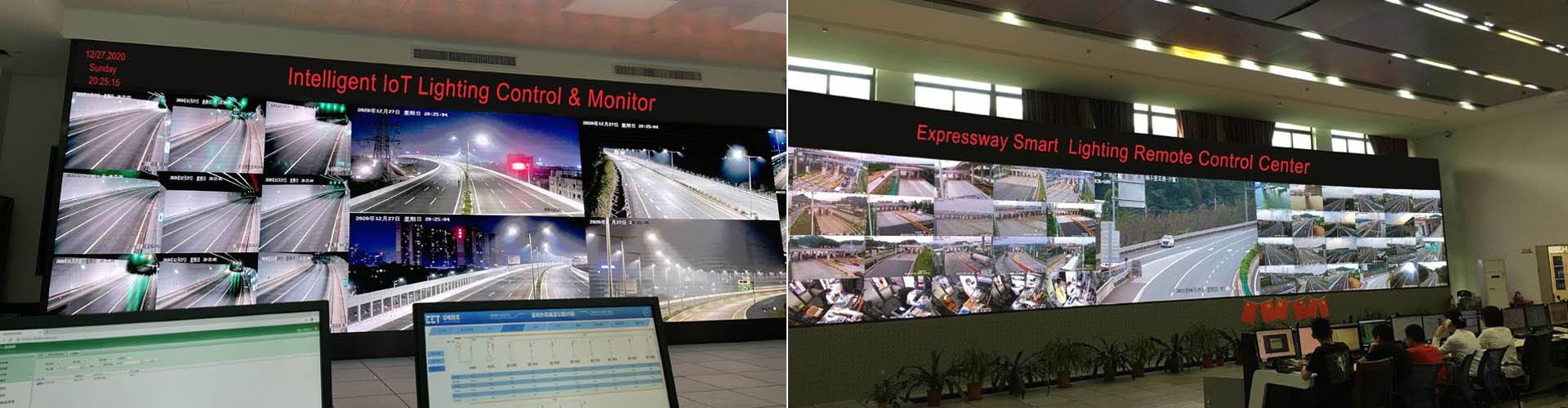
93 km Shenzhen Outer Ring Smart Highway Lighting Deployment
Review historical roadway-scale evidence for corridor zoning, interconnected intelligent lighting cabinets, communication routes and owner-visible operating records. Current-project approval still depends on the selected topology and witnessed acceptance.
SYSTEM DEMONSTRATION
How Can a Hybrid Solar-Grid Lighting Platform Be Demonstrated?
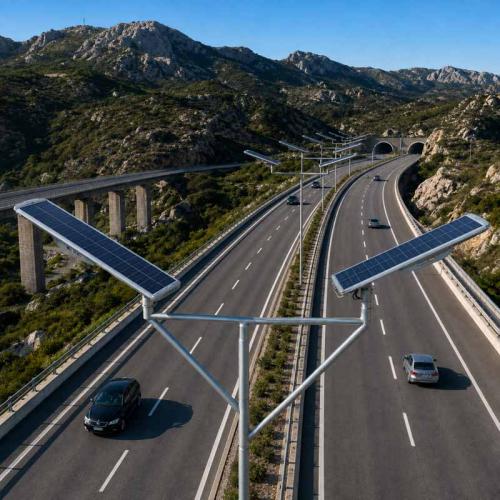
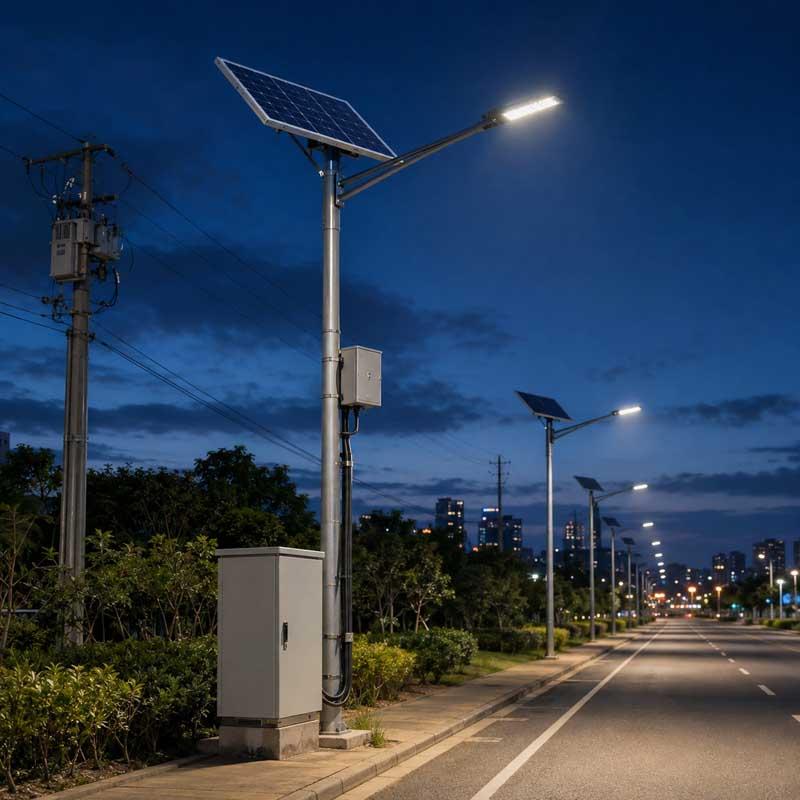
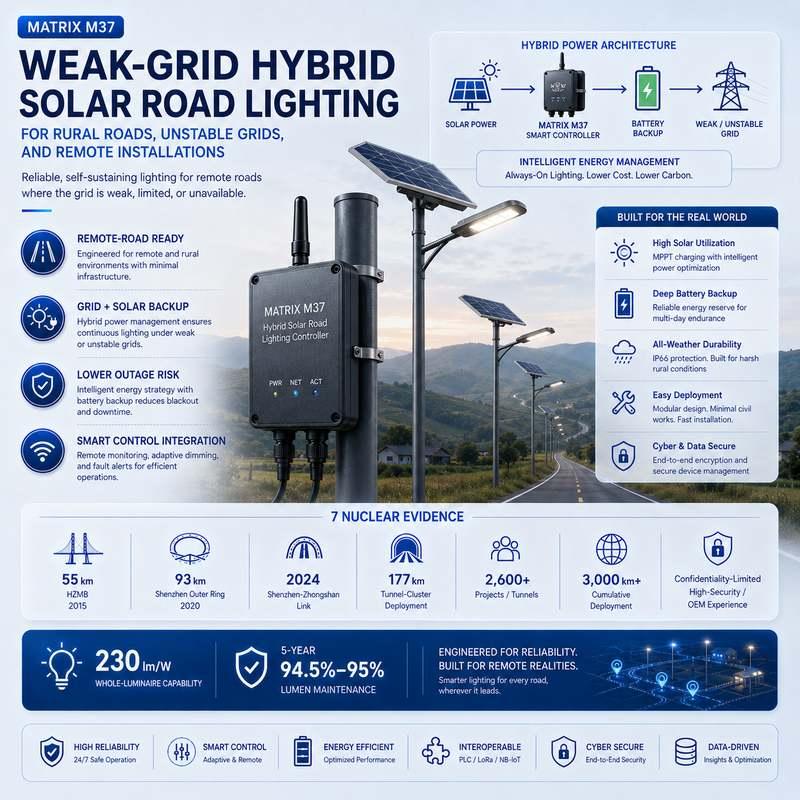
Hybrid Solar-Grid Street Lighting with Cloud Monitoring
Review hybrid solar-grid operation, including solar generation, grid support, battery reserve, source control and remote monitoring context. The demonstration is supporting evidence only; current-project topology, configured limits and acceptance results remain project-specific.
DIRECT ANSWER
What Should Buyers Understand First about municipal EPC hybrid solar delivery?
A municipal hybrid solar street light EPC kit should define hardware, controller logic, factory acceptance, site acceptance, blackout validation, battery reserve, platform records and lifecycle maintenance. It is strongest when the owner needs a project package, not only individual lamps. The buyer is procuring a municipal EPC package with lifecycle proof, not a pile of lamps and controllers.
ENGINEERING SUMMARY
What Makes municipal EPC hybrid solar delivery Different from Ordinary Catalogue Lighting?
An EPC project package is ready for municipal use only when the hybrid LED street light functions can be tested, witnessed and recorded. EPC contractors, PPP developers and long-term service operators should not accept a project only because the lamp lights under normal power. They need to test AC failure response, battery-supported lighting, solar charging, AC charging, charging schedule, MPPT status, battery reserve protection, safe lighting mode, platform records and maintenance boundaries. The delivery process should include configuration review, factory testing, site testing and lifecycle service planning. In unstable-grid cities, the team should simulate AC failure and confirm that the battery supplies the lamp immediately. In full-night outage scenarios, the team should test safe lighting mode and reserve logic. In tropical solar-first projects, it should confirm solar charging and battery night operation. In seasonal low-solar projects, it should confirm off-peak AC charging, low-temperature protection and reserve safety. In high-risk asset regions, it should check cabinet or gateway coordinates, disconnection alarms and protected installation. This direction is for buyers who need project certainty. A hybrid system must be measurable before and after handover. The approved package should include controller parameters, battery sizing basis, panel selection, wiring boundary, communication plan, platform setup, test records, spare parts, training and service response. This makes the system easier to accept, operate and maintain. The handover package should include the test method, parameter record and response process for each hybrid function. This makes the solution easier to operate after installation crews leave the site. For EPC delivery, the technical dossier should connect each promised function to one factory acceptance item, one site acceptance item, one parameter record and one service responsibility.
Procurement Boundary
An EPC project package is ready for municipal use only when the hybrid LED street light functions can be tested, witnessed and recorded.
Operating Context
EPC contractors, PPP developers and long-term service operators should not accept a project only because the lamp lights under normal power.
Engineering Basis
They need to test AC failure response, battery-supported lighting, solar charging, AC charging, charging schedule, MPPT status, battery reserve protection, safe lighting mode, platform records and maintenance boundaries.
Field Condition
The delivery process should include configuration review, factory testing, site testing and lifecycle service planning.
Decision Focus
In unstable-grid cities, the team should simulate AC failure and confirm that the battery supplies the lamp immediately.
PROJECT FIT, INTEGRATION AND LONG-TERM RESPONSIBILITY
Where Does municipal EPC hybrid solar delivery Fit Best?
Buyer Profile
Municipal buyers and EPC teams that need one deliverable covering hardware, testing, roles and lifecycle records.
Best-Fit Projects
City projects where factory acceptance, site acceptance, blackout validation, energy optimization and handover files must be accepted together.
Pause Condition
Do not buy project quantity before roles, tests, records and service ownership are written.
Integration Route
Package luminaire, battery, controller, platform records and service responsibilities into one EPC file.
Coexistence Logic
Multiple contractors can work together only when responsibility boundaries are visible to the owner.
Maintenance Readiness
The maintenance team should inherit test results, parameter files and lifecycle energy records.
| Buyer Question | Engineering Answer | Approval Records |
|---|---|---|
| What makes municipal EPC hybrid solar delivery different? | Municipal buyers and EPC teams that need one deliverable covering hardware, testing, roles and lifecycle records. | Keep project role map, factory acceptance result, site acceptance result, energy trend, blackout validation and lifecycle service file. |
| Is the claim measurable? | Witness factory configuration, site installation, blackout behavior, energy optimization, fault alarm route and owner export. | Acceptance should connect factory configuration, site acceptance, blackout test, role map and lifecycle service records. |
| Can the owner maintain it after handover? | The maintenance team should inherit test results, parameter files and lifecycle energy records. | Owner files should include role map, factory and site acceptance, blackout test, energy trend and service file. |
SYSTEM ARCHITECTURE
Which Layers Must Be Defined for municipal EPC hybrid solar delivery?
Energy Layer
Energy optimization must be shown as operating records, not only as a promised saving.
Control Layer
Controller rules should be frozen before shipment and verified again at site acceptance.
Communication Layer
Platform access and export rights should be part of handover, not negotiated after faults appear.
Owner Layer
Owner files should include role map, factory and site acceptance, blackout test, energy trend and service file.
Protection Layer
Do not freeze quantity before the factory and site acceptance sheet, project roles, blackout validation, energy records and handover ownership are written.
Service Layer
Preserve project role map, factory acceptance result, site acceptance result, energy trend, blackout validation and lifecycle service file in the owner handover file.
USE SCENARIOS
Which Field Conditions Matter Most for municipal EPC hybrid solar delivery?
Factory Test
Verify configuration before equipment leaves the factory.
Site Commissioning
Prove installed behavior under the owner's actual road conditions.
Lifecycle Review
Use operating records to support warranty, service and energy decisions over time.
Owner Risk Review
Do not freeze quantity before the factory and site acceptance sheet, project roles, blackout validation, energy records and handover ownership are written.
Field Service Context
The maintenance team should inherit test results, parameter files and lifecycle energy records.
Lifecycle Handover
Owner files should include role map, factory and site acceptance, blackout test, energy trend and service file.
PROCUREMENT DECISION MATRIX
Which Decisions Must Be Frozen for municipal EPC hybrid solar delivery?
| Decision Layer | Freeze Before Purchase | Risk If Missing |
|---|---|---|
| Lighting output | Match road output to municipal EPC hybrid solar delivery before quantity approval. | If roles and records are not frozen, EPC handover can look complete while service responsibility remains unclear. |
| Energy reserve | Energy optimization must be shown as operating records, not only as a promised saving. | municipal EPC hybrid solar delivery may fail in the first difficult season if reserve is undersized. |
| Communication | Platform access and export rights should be part of handover, not negotiated after faults appear. | Platform access is useful only when export rights and maintenance roles are included in the handover package. |
| Service ownership | The maintenance team should inherit test results, parameter files and lifecycle energy records. | Fault response for municipal EPC hybrid solar delivery becomes unclear when responsibility is not mapped. |
| Owner Decision | Municipal Engineering Requirement | Record to Keep |
|---|---|---|
| Primary buying intent | The buyer is procuring a municipal EPC package with lifecycle proof, not a pile of lamps and controllers. | The service record should retain project role map, factory acceptance result, site acceptance result, energy trend, blackout validation and lifecycle service file for later review. |
| Reject or pause condition | Do not freeze quantity before the factory and site acceptance sheet, project roles, blackout validation, energy records and handover ownership are written. | Delay approval until municipal EPC hybrid solar delivery has a corrected technical boundary. |
| Acceptance proof | Witness factory configuration, site installation, blackout behavior, energy optimization, fault alarm route and owner export. | Keep the witnessed municipal EPC hybrid solar delivery result with the accepted parameter file. |
| Lifecycle continuity | The maintenance team should inherit test results, parameter files and lifecycle energy records. | Make project role map, factory acceptance result, site acceptance result, energy trend, blackout validation and lifecycle service file available during acceptance and maintenance transfer. |
Buying Intent
The buyer is procuring a municipal EPC package with lifecycle proof, not a pile of lamps and controllers.
Technical Boundary
Do not freeze quantity before the factory and site acceptance sheet, project roles, blackout validation, energy records and handover ownership are written.
Controller Behavior
Controller rules should be frozen before shipment and verified again at site acceptance.
Energy Proof
Energy optimization must be shown as operating records, not only as a promised saving.
Field Acceptance
Witness factory configuration, site installation, blackout behavior, energy optimization, fault alarm route and owner export.
Owner Record
Make project role map, factory acceptance result, site acceptance result, energy trend, blackout validation and lifecycle service file available during acceptance and maintenance transfer.
Service Transfer
The maintenance team should inherit test results, parameter files and lifecycle energy records.
Claim Boundary
Do not buy project quantity before roles, tests, records and service ownership are written.
CONTROL ROUTES
How Should Control Routes Be Separated for municipal EPC hybrid solar delivery?
| Route | Procurement Meaning | Risk Control |
|---|---|---|
| Local controller | Controller rules should be frozen before shipment and verified again at site acceptance. | Test local behavior for municipal EPC hybrid solar delivery before handover. |
| Energy path | Energy optimization must be shown as operating records, not only as a promised saving. | Record the source, threshold, schedule and recovery behavior for municipal EPC hybrid solar delivery. |
| Communication path | Platform access and export rights should be part of handover, not negotiated after faults appear. | Confirm coverage, credentials, data export and service responsibility for municipal EPC hybrid solar delivery. |
| Owner export path | Owner files should include role map, factory and site acceptance, blackout test, energy trend and service file. | Define export format, account ownership and backup cadence for municipal EPC hybrid solar delivery. |
OWNER RECORDS
Which Records Should Stay Readable for municipal EPC hybrid solar delivery?
Municipal Hybrid Solar Street Light
Municipal Hybrid Solar Street Light should be defined with a clear project scope, acceptance condition and handover record.
EPC Project Kit
EPC Project Kit belongs in the owner file only when the tested function and operating boundary are written down.
Factory and Site Testing
Factory and Site Testing should connect the selected hardware, control rule and service responsibility before purchase.
Lifecycle Energy Proof
Lifecycle Energy Proof needs a measurable field condition, not a catalogue phrase or unqualified autonomy promise.
Blackout Validation
Blackout Validation should remain exportable with configuration, acceptance and maintenance history after handover.
Energy Optimization Records
Energy Optimization Records should help the buyer separate required functions from optional monitoring or service features.
Make project role map, factory acceptance result, site acceptance result, energy trend, blackout validation and lifecycle service file available during acceptance and maintenance transfer.
| Owner Record | Why It Matters | Minimum Field |
|---|---|---|
| Energy record | Energy optimization must be shown as operating records, not only as a promised saving. | Accepted energy source, output state and municipal EPC hybrid solar delivery timestamp. |
| Asset record | Owner files should include role map, factory and site acceptance, blackout test, energy trend and service file. | Pole, device, configuration and service fields agreed for municipal EPC hybrid solar delivery. |
| Service record | The maintenance team should inherit test results, parameter files and lifecycle energy records. | Reviewer, field action and recovery note for municipal EPC hybrid solar delivery. |
| Change record | Make project role map, factory acceptance result, site acceptance result, energy trend, blackout validation and lifecycle service file available during acceptance and maintenance transfer. | Previous component, new component, approval and parameter restore for municipal EPC hybrid solar delivery. |
FAILURE AND RECOVERY
How Should Abnormal Operation Be Handled for municipal EPC hybrid solar delivery?
Reserve Response
Energy optimization must be shown as operating records, not only as a promised saving.
Communication Response
Platform access and export rights should be part of handover, not negotiated after faults appear.
Service Response
The maintenance team should inherit test results, parameter files and lifecycle energy records.
Control Recovery
Controller rules should be frozen before shipment and verified again at site acceptance.
Owner Review
Owner files should include role map, factory and site acceptance, blackout test, energy trend and service file.
Claim Boundary
Do not freeze quantity before the factory and site acceptance sheet, project roles, blackout validation, energy records and handover ownership are written.
| Recovery Topic | Immediate Behavior | Owner Record |
|---|---|---|
| Energy reserve | Energy optimization must be shown as operating records, not only as a promised saving. | Lifecycle energy trend, reserve behavior, blackout recovery and maintenance decision note. |
| Communication | Platform access and export rights should be part of handover, not negotiated after faults appear. | Site-return timestamp, uploaded EPC records and local acceptance comparison. |
| Controller rule | Controller rules should be frozen before shipment and verified again at site acceptance. | Project parameter file, role-based operating sequence and recovered state. |
| Service action | The maintenance team should inherit test results, parameter files and lifecycle energy records. | Named role, corrective action, restored status and lifecycle closure note. |
FACTORY AND SITE TESTS
What Should Factory Test and Site Commissioning Prove for municipal EPC hybrid solar delivery?
For municipal EPC hybrid solar delivery, factory and site acceptance tests must prove the exact operating behavior promised to the owner: Witness factory configuration, site installation, blackout behavior, energy optimization, fault alarm route and owner export.
| Test Stage | What to Prove | Owner Record |
|---|---|---|
| Factory test | Controller rules should be frozen before shipment and verified again at site acceptance. | Factory setting file, factory and site acceptance result and serial-linked configuration. |
| Site test | Witness factory configuration, site installation, blackout behavior, energy optimization, fault alarm route and owner export. | Site acceptance record, owner asset file and accepted state for municipal EPC hybrid solar delivery. |
| Recovery test | The maintenance team should inherit test results, parameter files and lifecycle energy records. | Acceptance recovery timestamp, event sequence and assigned-role closure note. |
| Season review | Energy optimization must be shown as operating records, not only as a promised saving. | Lifecycle energy trend, reserve update and maintenance decision history. |
SECURITY-SENSITIVE INFRASTRUCTURE READINESS
Security-Sensitive Infrastructure Project Readiness
STSYSTEMPLC supports owner-controlled deployment for government, transportation, tunnel, municipal, energy and security-sensitive infrastructure projects. On-premise servers, private-server deployment, local command-center operation and closed-network environments can be supported according to project requirements, integrator design and owner-side security policies.
RFQ QUESTIONS
Which Buyer Questions Should Be Answered for municipal EPC hybrid solar delivery?
Why is normal lamp brightness not enough to accept a Hybrid Grid + Solar project?
Brightness under normal power does not prove that a hybrid system is ready. The team must test AC failure response, battery-supported lighting, solar charging, AC charging, battery reserve thresholds, safe lighting mode and platform records. These functions decide whether the road stays lit when the grid becomes unstable. A hybrid project fails if the light works only under perfect power; acceptance should prove behavior under weak-grid conditions.
Which factory acceptance items prove Solar-Battery-AC logic before shipment rather than only proving the lamp turns on?
Factory testing should include controller setting, MPPT solar charging, AC charging input, charging schedule, battery reserve thresholds, dimming output, low-voltage protection, communication status and platform data. The goal is to confirm that the system logic works before shipment or site installation. Factory checks should confirm the logic before shipment, so site teams are not discovering basic controller errors on the road.
Which site acceptance scenes must be repeated on the real road to verify outage and safe-lighting behavior?
Site testing should simulate AC failure, confirm battery lighting response, check solar charging under real installation conditions, verify cabinet or gateway communication, review platform events and confirm road-section naming. Site conditions often reveal wiring, communication or configuration issues that factory checks cannot show. Site testing should use the actual cabinet, wiring, communication path and road-section naming, not only a bench simulation.
How should full-night outage testing use safe lighting mode instead of a full-power promise?
The team should define reserve mode, safe-brightness level, battery reserve threshold and expected duration before testing. A full-night outage should be evaluated against planned safe lighting, not an unlimited full-power promise. The test should show whether the system can hold about 30% safe brightness during low-traffic periods and still boost priority scenes if required. Records should show battery reserve movement, output level and platform events so the reserve claim is measurable.
How should a sun-rich Solar-first project prove daytime charging and battery-led night operation?
Tropical solar-first projects should verify daytime solar charging, battery-first night operation, AC backup trigger level, rainy-season reserve and platform records of solar contribution. The acceptance focus is whether the project uses abundant sunlight first while keeping AC available only when needed. For tropical projects, proof means showing solar-first use and correct AC backup trigger, not copying a winter charging routine.
Data Sovereignty, Cybersecurity & Open Integration
How Are EPC Test Records, Energy Proof and Owner Platform Interfaces Governed?
Owner-Controlled Hosting
The owner can host the project on a government- or customer-controlled on-premises server, private cloud, or an approved third-party platform. STSYSTEMPLC does not require a proprietary cloud when the approved project architecture assigns hosting elsewhere. For municipal hybrid-solar EPC delivery and lifecycle proof, the final hosting and data-residency choice should be recorded in the approved architecture.
Open Platform Integration
The integration boundary can be opened to the owner's existing platform or software team. Interface protocol, addressing, data mapping, command authority and exception handling are agreed before deployment and proven in factory or site testing for the selected project. The interface test should use the actual municipal hybrid-solar EPC delivery and lifecycle proof data and command set. Open-protocol compatibility is verified against the project's actual interface schedule.
Cybersecurity Scope
Access and network protection should be frozen alongside the control logic. Named administrator roles, remote-support windows, network boundaries, configuration backup, event logging and project-required secure communication measures are documented so responsibility remains clear at handover.
No Mandatory Vendor Lock-In
Local controller logic, protection limits and accepted fallback behavior should continue according to the selected architecture when the central server or WAN is unavailable. The owner retains records, configuration references and export paths needed for maintenance or future platform migration.
PUBLIC CLAIM BOUNDARIES
Which Claims Should Stay Controlled for municipal EPC hybrid solar delivery?
| Claim Type | Acceptable Public Wording | Wording to Avoid |
|---|---|---|
| Operating claim | Witness factory configuration, site installation, blackout behavior, energy optimization, fault alarm route and owner export. | Unverified performance language copied from a catalogue. |
| Data claim | Owner files should include role map, factory and site acceptance, blackout test, energy trend and service file. | Lifecycle records that cannot move from contractor account to owner account. |
| Recovery claim | The maintenance team should inherit test results, parameter files and lifecycle energy records. | A vague service promise is not enough for municipal EPC hybrid solar delivery. |
| Compatibility claim | Do not buy project quantity before roles, tests, records and service ownership are written. | EPC wording that ignores role map, factory and site acceptance files, export rights or service ownership. |
Battery Boundary
Energy optimization must be shown as operating records, not only as a promised saving.
Communication Boundary
Platform access and export rights should be part of handover, not negotiated after faults appear.
Data Boundary
Owner files should include role map, factory and site acceptance, blackout test, energy trend and service file.
Compatibility Boundary
Do not buy project quantity before roles, tests, records and service ownership are written.
OWNER DECISION CHECKLIST
What Should the Owner Freeze before Purchasing municipal EPC hybrid solar delivery?
STSYSTEMPLC supports EPC delivery by connecting product configuration, controller logic, platform records and site tests. The solution can include solar panels, LiFePO4 batteries, MPPT controllers, AC charging input, time schedule, dimming strategy, gateway or cabinet monitoring, platform records and service planning. Each function should be linked to a test item. Our delivery logic starts with the buyer's real questions. What happens when AC fails? Can the battery charge from AC? Can charging be scheduled from 23:00 to 05:00? Does the controller protect battery reserve? Does the platform record outage events? Does the design change between tropical solar-first markets and seasonal low-solar markets? These questions should be answered during factory and site acceptance, not left for field complaints. STSYSTEMPLC helps define configuration, test points and lifecycle responsibilities. The project can include factory checks for charging and controller logic, site checks for outage switching and platform records, and operation guidance for battery care, alarm handling and spare parts. This practical process gives EPC teams and owners a clearer path from quotation to long-term operation. factory acceptance and site acceptance items should remain connected to lifecycle maintenance, not only one-time acceptance. The service plan should keep controller parameters, platform access, alarm response rules and spare-part responsibilities available after handover. factory acceptance and site acceptance records should stay linked to lifecycle service, parameter responsibility and spare-part planning, otherwise acceptance records can disappear after installation crews leave. This gives EPC teams and owners a cleaner path from acceptance to long-term operation. The delivery file should link each promised function to a test item and a later service responsibility.
Freeze Energy Strategy
Energy optimization must be shown as operating records, not only as a promised saving.
Freeze Acceptance Method
Witness factory configuration, site installation, blackout behavior, energy optimization, fault alarm route and owner export.
Freeze Data Rights
Owner files should include role map, factory and site acceptance, blackout test, energy trend and service file.
Freeze Service Response
The maintenance team should inherit test results, parameter files and lifecycle energy records.
RELATED ENGINEERING ENTRY POINTS
Which Search Paths Should Support municipal EPC hybrid solar delivery?
STRATEGIC PARTNER-BRANDED TECHNOLOGY SUPPORT
Strategic Partner-Branded Technology Support
STSYSTEMPLC supports long-term strategic partners with partner-branded solution packaging, technical documentation, system integration support and owner-controlled deployment options for government, transportation, tunnel, energy and security-sensitive infrastructure projects.
Send Project Inputs for STSYSTEMPLC Engineering Review
Share the road layout, pole height, spacing, target lighting level and operating constraints that define municipal EPC hybrid solar delivery.