


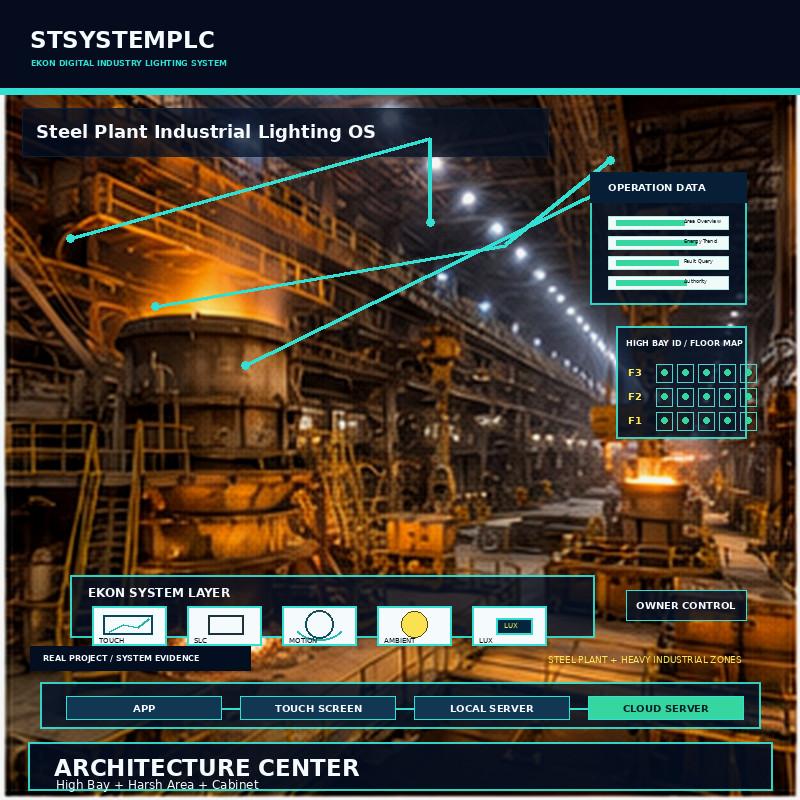
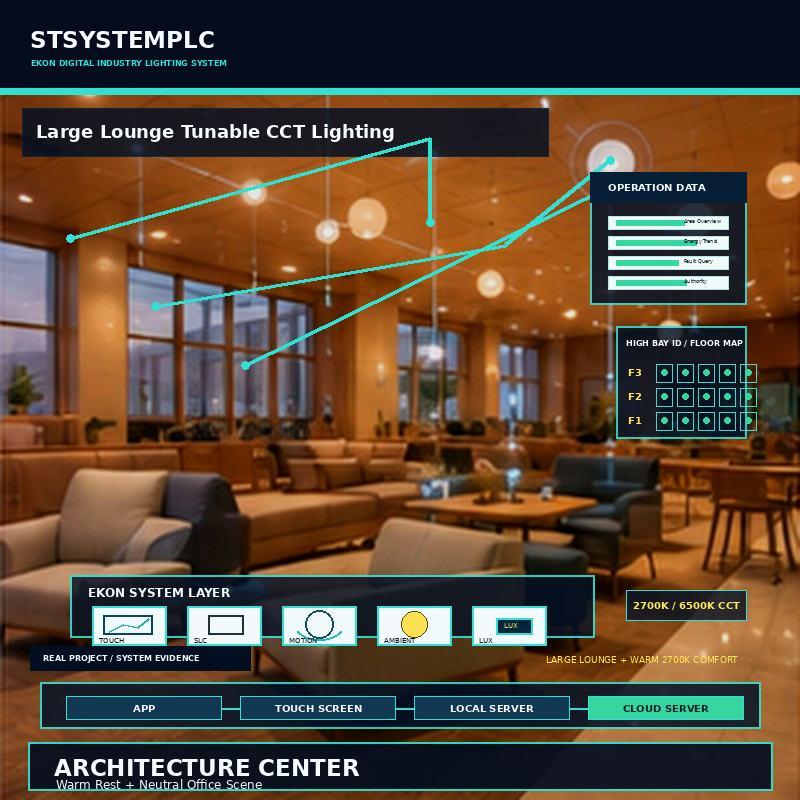
Industrial Workshop Tunable CCT Lighting
6000K to 2700K Industrial Workshop Lighting System for Task, Shift and Comfort Modes
This is a project decision page for factory owners, plant engineers, workshop contractors, maintenance teams, OEM partners and safety-focused industrial buyers. It explains how 6000K, 4000K and 2700K can be used as controlled lighting modes instead of one fixed color temperature for every operating condition.
The STSYSTEMPLC route combines tunable CCT luminaires, scene schedules, sensors, gateway control and EKON lighting operation visibility for owner-controlled deployment.
Tunable CCT Terminal -> Control System -> EKON Operations Center
Direct Answer for Search and Project Buyers
01. System Overview
6000K to 2700K Industrial Workshop Lighting System for Task, Shift and Comfort Modes is designed for buyers who do not want one fixed light color to serve every operating state. It connects tunable CCT luminaires, gateway communication, scene logic and EKON operation visibility into a project-defined lighting system.
Controlled positioning: this page defines lighting control scenes and acceptance evidence. It does not promise medical, productivity or health outcomes.
| System Overview Review Point | What Must Be Confirmed |
|---|---|
| Project Input | workshop layout, task zones, mounting height, shift schedule, CCT modes and cabinet location. |
| Handover Evidence | Verify 6000K / 4000K / 2700K switching, dimming response, gateway communication, EKON visibility and task mode, shift scene, comfort mode, manual override and owner training record; avoid guaranteed productivity or universal saving percentage. |
Why Fixed-CCT Lighting Leaves Value on the Table
02. Buyer Problem
This section supports project review, buyer qualification and system-level presentation for tunable CCT lighting decisions.
For Buyer Problem, confirm whether factory owners, workshop contractors and production managers need controllable CCT scenes for assembly lines, inspection benches, maintenance zones and shift-work areas instead of a fixed-color fixture purchase.
Define CCT value, brightness level, control authority, fallback behavior and acceptance evidence before rollout.
| Buyer Problem Review Point | What Must Be Confirmed |
|---|---|
| Project Input | workshop layout, task zones, mounting height, shift schedule, CCT modes and cabinet location. |
| Handover Evidence | Verify 6000K / 4000K / 2700K switching, dimming response, gateway communication, EKON visibility and task mode, shift scene, comfort mode, manual override and owner training record; avoid guaranteed productivity or universal saving percentage. |
6000K, 4000K and 2700K Operating Logic
03. CCT Mode Map
Task and inspection mode
For precision work, equipment inspection, production checks, troubleshooting and high-alert operating windows.
Normal production mode
For routine shifts, balanced visual recognition, packing lines, warehouses and shared working areas.
Comfort and low-stress mode
For night shifts, rest periods, transition zones, low-pressure maintenance and non-critical operating windows.
The important point is not only color temperature. The buyer needs the right CCT, brightness, schedule, sensor response, override authority and commissioning record for each operating state.
| CCT Mode Map Review Point | What Must Be Confirmed |
|---|---|
| Project Input | workshop layout, task zones, mounting height, shift schedule, CCT modes and cabinet location. |
| Handover Evidence | Verify 6000K / 4000K / 2700K switching, dimming response, gateway communication, EKON visibility and task mode, shift scene, comfort mode, manual override and owner training record; avoid guaranteed productivity or universal saving percentage. |
Project Evidence and Owner-Controlled Lighting Logic
04. Infrastructure Proven
The page connects tunable CCT with EKON floor maps, motion sensing, schedule control, gateway communication and site commissioning evidence.
For Infrastructure Proven, confirm whether factory owners, workshop contractors and production managers need controllable CCT scenes for assembly lines, inspection benches, maintenance zones and shift-work areas instead of a fixed-color fixture purchase.
Define CCT value, brightness level, control authority, fallback behavior and acceptance evidence before rollout.
| Infrastructure Proven Review Point | What Must Be Confirmed |
|---|---|
| Project Input | workshop layout, task zones, mounting height, shift schedule, CCT modes and cabinet location. |
| Handover Evidence | Verify 6000K / 4000K / 2700K switching, dimming response, gateway communication, EKON visibility and task mode, shift scene, comfort mode, manual override and owner training record; avoid guaranteed productivity or universal saving percentage. |
Where This Page Fits in Specifications and RFQs
05. Tender Fit
This page is suitable when the buyer's RFQ mentions tunable white, human-centric lighting, ward comfort, shift lighting, office scenes, smart building lighting, energy control or lighting management.
- Assembly workshops
- Inspection benches
- Maintenance aisles
- Warehouses
- Steel plants
- Electronics factories
| Tender Fit Review Point | What Must Be Confirmed |
|---|---|
| Project Input | workshop layout, task zones, mounting height, shift schedule, CCT modes and cabinet location. |
| Handover Evidence | Verify 6000K / 4000K / 2700K switching, dimming response, gateway communication, EKON visibility and task mode, shift scene, comfort mode, manual override and owner training record; avoid guaranteed productivity or universal saving percentage. |
Terminal, Gateway and EKON Operation Layer
06. Architecture
The architecture can be evaluated as Terminal -> System -> Operations Center. The terminal changes CCT and brightness; the system carries command and state; the operation layer records zones, scenes, schedules and acceptance evidence.
| Architecture Review Point | What Must Be Confirmed |
|---|---|
| Project Input | workshop layout, task zones, mounting height, shift schedule, CCT modes and cabinet location. |
| Handover Evidence | Verify 6000K / 4000K / 2700K switching, dimming response, gateway communication, EKON visibility and task mode, shift scene, comfort mode, manual override and owner training record; avoid guaranteed productivity or universal saving percentage. |
Scenes, Schedules, Sensors and Overrides
07. Control Layer
Scene control should combine CCT, brightness, timing, sensor response, local override and recovery state. A serious buyer will ask how the command is verified, recorded and handed over.
For Control Layer, confirm whether factory owners, workshop contractors and production managers need controllable CCT scenes for assembly lines, inspection benches, maintenance zones and shift-work areas instead of a fixed-color fixture purchase.
Define CCT value, brightness level, control authority, fallback behavior and acceptance evidence before rollout.
| Control Layer Review Point | What Must Be Confirmed |
|---|---|
| Project Input | workshop layout, task zones, mounting height, shift schedule, CCT modes and cabinet location. |
| Handover Evidence | Verify 6000K / 4000K / 2700K switching, dimming response, gateway communication, EKON visibility and task mode, shift scene, comfort mode, manual override and owner training record; avoid guaranteed productivity or universal saving percentage. |
Why the Buyer Needs Configurable Light States
08. Owner Logic
The strongest buyer argument is owner control. The owner can define different lighting states for different tasks, rooms, people and operating windows instead of accepting one fixed light color for every condition.
Task Clarity
6000K supports workbench inspection, equipment review, picking accuracy and high-visibility production tasks.
Shift Comfort
2700K can be used in low-intensity periods, night transitions and non-critical areas to reduce visual pressure.
Zone Grouping
Lines, benches, storage areas and maintenance aisles can be configured with different CCT and dimming groups.
Factory Handover
Commissioning files can define modes, schedules, override rules, user roles and maintenance responsibilities.
| Owner Logic Review Point | What Must Be Confirmed |
|---|---|
| Project Input | workshop layout, task zones, mounting height, shift schedule, CCT modes and cabinet location. |
| Handover Evidence | Verify 6000K / 4000K / 2700K switching, dimming response, gateway communication, EKON visibility and task mode, shift scene, comfort mode, manual override and owner training record; avoid guaranteed productivity or universal saving percentage. |
Traditional Fixture Route vs STSYSTEMPLC System Route
09. Brand Hunt Comparison
Conventional workshop lighting is usually chosen by wattage, lux and fixture cost, then left in one fixed light color for every task.
STSYSTEMPLC adds CCT scenes, schedule logic, sensor input and operation visibility so the same workshop can support different work states.
| Brand Hunt Comparison Review Point | What Must Be Confirmed |
|---|---|
| Project Input | workshop layout, task zones, mounting height, shift schedule, CCT modes and cabinet location. |
| Handover Evidence | Verify 6000K / 4000K / 2700K switching, dimming response, gateway communication, EKON visibility and task mode, shift scene, comfort mode, manual override and owner training record; avoid guaranteed productivity or universal saving percentage. |
Where the Claim Is Strong and Where It Must Be Verified
10. Decision Boundaries
Do not present CCT as a replacement for safety illumination standards, lux design, glare control or machine-vision requirements.
The final specification should confirm CCT range, dimming method, control interface, luminaire compatibility, lux target, glare limit, emergency lighting boundary, commissioning process and warranty responsibility.
| Decision Boundaries Review Point | What Must Be Confirmed |
|---|---|
| Project Input | workshop layout, task zones, mounting height, shift schedule, CCT modes and cabinet location. |
| Handover Evidence | Verify 6000K / 4000K / 2700K switching, dimming response, gateway communication, EKON visibility and task mode, shift scene, comfort mode, manual override and owner training record; avoid guaranteed productivity or universal saving percentage. |
What Must Be Checked Before Handover
11. Failure Verification
Mode Failure
Confirm whether a scene failed because of fixture, driver, controller, gateway, schedule, user permission or communication route.
State Return
The owner should be able to check actual mode state, not only send a command and hope the lighting changed correctly.
For Failure Verification, confirm whether factory owners, workshop contractors and production managers need controllable CCT scenes for assembly lines, inspection benches, maintenance zones and shift-work areas instead of a fixed-color fixture purchase.
Define CCT value, brightness level, control authority, fallback behavior and acceptance evidence before rollout.
| Failure Verification Review Point | What Must Be Confirmed |
|---|---|
| Project Input | workshop layout, task zones, mounting height, shift schedule, CCT modes and cabinet location. |
| Handover Evidence | Verify 6000K / 4000K / 2700K switching, dimming response, gateway communication, EKON visibility and task mode, shift scene, comfort mode, manual override and owner training record; avoid guaranteed productivity or universal saving percentage. |
Pre-Delivery Test Discipline
12. Factory Test
This section supports project review, buyer qualification and system-level presentation for tunable CCT lighting decisions.
For Factory Test, confirm whether factory owners, workshop contractors and production managers need controllable CCT scenes for assembly lines, inspection benches, maintenance zones and shift-work areas instead of a fixed-color fixture purchase.
Define CCT value, brightness level, control authority, fallback behavior and acceptance evidence before rollout.
| Factory Test Review Point | What Must Be Confirmed |
|---|---|
| Project Input | workshop layout, task zones, mounting height, shift schedule, CCT modes and cabinet location. |
| Handover Evidence | Verify 6000K / 4000K / 2700K switching, dimming response, gateway communication, EKON visibility and task mode, shift scene, comfort mode, manual override and owner training record; avoid guaranteed productivity or universal saving percentage. |
On-Site Acceptance and Scene Verification
13. Site Commissioning
Site commissioning should verify each selected scene under real installation conditions: CCT change, dimming response, group behavior, override priority, power recovery, sensor trigger and operation records.
Factory Test & Site Commissioning must be written into the handover file before the buyer treats the system as accepted.
For Site Commissioning, confirm whether factory owners, workshop contractors and production managers need controllable CCT scenes for assembly lines, inspection benches, maintenance zones and shift-work areas instead of a fixed-color fixture purchase.
Define CCT value, brightness level, control authority, fallback behavior and acceptance evidence before rollout.
| Site Commissioning Review Point | What Must Be Confirmed |
|---|---|
| Project Input | workshop layout, task zones, mounting height, shift schedule, CCT modes and cabinet location. |
| Handover Evidence | Verify 6000K / 4000K / 2700K switching, dimming response, gateway communication, EKON visibility and task mode, shift scene, comfort mode, manual override and owner training record; avoid guaranteed productivity or universal saving percentage. |
Local Control and Owner-Side Data Boundaries
14. Security-Sensitive Readiness
For sensitive buildings, local operation rules, role permissions and data boundaries can be defined before cloud access or third-party integration is approved.
For Security-Sensitive Readiness, confirm whether factory owners, workshop contractors and production managers need controllable CCT scenes for assembly lines, inspection benches, maintenance zones and shift-work areas instead of a fixed-color fixture purchase.
Define CCT value, brightness level, control authority, fallback behavior and acceptance evidence before rollout.
| Security-Sensitive Readiness Review Point | What Must Be Confirmed |
|---|---|
| Project Input | workshop layout, task zones, mounting height, shift schedule, CCT modes and cabinet location. |
| Handover Evidence | Verify 6000K / 4000K / 2700K switching, dimming response, gateway communication, EKON visibility and task mode, shift scene, comfort mode, manual override and owner training record; avoid guaranteed productivity or universal saving percentage. |
BMS, Local Server and Operation Interface Boundaries
15. Integration
Integration should be described through open interface boundaries, BMS coordination, local server options and confirmed signal points. Do not imply universal compatibility before project review.
For Integration, confirm whether factory owners, workshop contractors and production managers need controllable CCT scenes for assembly lines, inspection benches, maintenance zones and shift-work areas instead of a fixed-color fixture purchase.
Define CCT value, brightness level, control authority, fallback behavior and acceptance evidence before rollout.
| Integration Review Point | What Must Be Confirmed |
|---|---|
| Project Input | workshop layout, task zones, mounting height, shift schedule, CCT modes and cabinet location. |
| Handover Evidence | Verify 6000K / 4000K / 2700K switching, dimming response, gateway communication, EKON visibility and task mode, shift scene, comfort mode, manual override and owner training record; avoid guaranteed productivity or universal saving percentage. |
Motion, Ambient Light and Schedule Cooperation
16. Sensor Logic
Motion and ambient-light inputs can support automatic response, but CCT change should remain tied to user-approved scenes and project rules.
For Sensor Logic, confirm whether factory owners, workshop contractors and production managers need controllable CCT scenes for assembly lines, inspection benches, maintenance zones and shift-work areas instead of a fixed-color fixture purchase.
Define CCT value, brightness level, control authority, fallback behavior and acceptance evidence before rollout.
| Sensor Logic Review Point | What Must Be Confirmed |
|---|---|
| Project Input | workshop layout, task zones, mounting height, shift schedule, CCT modes and cabinet location. |
| Handover Evidence | Verify 6000K / 4000K / 2700K switching, dimming response, gateway communication, EKON visibility and task mode, shift scene, comfort mode, manual override and owner training record; avoid guaranteed productivity or universal saving percentage. |
Room, Zone, Bed, Line or Floor Visibility
17. Floor Map
EKON-style operation can map rooms, beds, lines, zones or floors with independent IDs, mode state, fault status and maintenance notes.
For Floor Map, confirm whether factory owners, workshop contractors and production managers need controllable CCT scenes for assembly lines, inspection benches, maintenance zones and shift-work areas instead of a fixed-color fixture purchase.
Define CCT value, brightness level, control authority, fallback behavior and acceptance evidence before rollout.
| Floor Map Review Point | What Must Be Confirmed |
|---|---|
| Project Input | workshop layout, task zones, mounting height, shift schedule, CCT modes and cabinet location. |
| Handover Evidence | Verify 6000K / 4000K / 2700K switching, dimming response, gateway communication, EKON visibility and task mode, shift scene, comfort mode, manual override and owner training record; avoid guaranteed productivity or universal saving percentage. |
Identity, Fault and Replacement Visibility
18. Maintenance
Maintenance value comes from fixture identity, fault traceability, mode history, driver replacement information and clear responsibility after commissioning.
For Maintenance, confirm whether factory owners, workshop contractors and production managers need controllable CCT scenes for assembly lines, inspection benches, maintenance zones and shift-work areas instead of a fixed-color fixture purchase.
Define CCT value, brightness level, control authority, fallback behavior and acceptance evidence before rollout.
| Maintenance Review Point | What Must Be Confirmed |
|---|---|
| Project Input | workshop layout, task zones, mounting height, shift schedule, CCT modes and cabinet location. |
| Handover Evidence | Verify 6000K / 4000K / 2700K switching, dimming response, gateway communication, EKON visibility and task mode, shift scene, comfort mode, manual override and owner training record; avoid guaranteed productivity or universal saving percentage. |
Comfort Scenes Without Losing Energy Discipline
19. Energy Logic
Warm comfort mode does not mean uncontrolled energy use. Dimming schedules, occupancy response and zone control should keep comfort scenes inside an energy discipline.
For Energy Logic, confirm whether factory owners, workshop contractors and production managers need controllable CCT scenes for assembly lines, inspection benches, maintenance zones and shift-work areas instead of a fixed-color fixture purchase.
Define CCT value, brightness level, control authority, fallback behavior and acceptance evidence before rollout.
| Energy Logic Review Point | What Must Be Confirmed |
|---|---|
| Project Input | workshop layout, task zones, mounting height, shift schedule, CCT modes and cabinet location. |
| Handover Evidence | Verify 6000K / 4000K / 2700K switching, dimming response, gateway communication, EKON visibility and task mode, shift scene, comfort mode, manual override and owner training record; avoid guaranteed productivity or universal saving percentage. |
Owner, Contractor, Operator and Maintenance Responsibility
20. User Roles
Owners define policy, contractors install and commission, operators use approved scenes, and maintenance teams verify faults, replacements and records.
For User Roles, confirm whether factory owners, workshop contractors and production managers need controllable CCT scenes for assembly lines, inspection benches, maintenance zones and shift-work areas instead of a fixed-color fixture purchase.
Define CCT value, brightness level, control authority, fallback behavior and acceptance evidence before rollout.
| User Roles Review Point | What Must Be Confirmed |
|---|---|
| Project Input | workshop layout, task zones, mounting height, shift schedule, CCT modes and cabinet location. |
| Handover Evidence | Verify 6000K / 4000K / 2700K switching, dimming response, gateway communication, EKON visibility and task mode, shift scene, comfort mode, manual override and owner training record; avoid guaranteed productivity or universal saving percentage. |
OEM, ODM and Local Partner Presentation Layer
21. Strategic Partner Support
For qualified strategic partners, the solution can be presented under a project-facing local brand layer while STSYSTEMPLC supports technical architecture, product selection, documentation and commissioning logic.
For Strategic Partner Support, confirm whether factory owners, workshop contractors and production managers need controllable CCT scenes for assembly lines, inspection benches, maintenance zones and shift-work areas instead of a fixed-color fixture purchase.
Define CCT value, brightness level, control authority, fallback behavior and acceptance evidence before rollout.
| Strategic Partner Support Review Point | What Must Be Confirmed |
|---|---|
| Project Input | workshop layout, task zones, mounting height, shift schedule, CCT modes and cabinet location. |
| Handover Evidence | Verify 6000K / 4000K / 2700K switching, dimming response, gateway communication, EKON visibility and task mode, shift scene, comfort mode, manual override and owner training record; avoid guaranteed productivity or universal saving percentage. |
What to Confirm Before Quotation
22. Buyer Questions
This section supports project review, buyer qualification and system-level presentation for tunable CCT lighting decisions.
For Buyer Questions, confirm whether factory owners, workshop contractors and production managers need controllable CCT scenes for assembly lines, inspection benches, maintenance zones and shift-work areas instead of a fixed-color fixture purchase.
Define CCT value, brightness level, control authority, fallback behavior and acceptance evidence before rollout.
| Buyer Questions Review Point | What Must Be Confirmed |
|---|---|
| Project Input | workshop layout, task zones, mounting height, shift schedule, CCT modes and cabinet location. |
| Handover Evidence | Verify 6000K / 4000K / 2700K switching, dimming response, gateway communication, EKON visibility and task mode, shift scene, comfort mode, manual override and owner training record; avoid guaranteed productivity or universal saving percentage. |
Mode Parameters and Project Settings
23. Configuration
Configuration should include scene names, CCT values, brightness levels, schedules, override rights, recovery behavior and emergency boundaries.
For Configuration, confirm whether factory owners, workshop contractors and production managers need controllable CCT scenes for assembly lines, inspection benches, maintenance zones and shift-work areas instead of a fixed-color fixture purchase.
Define CCT value, brightness level, control authority, fallback behavior and acceptance evidence before rollout.
| Configuration Review Point | What Must Be Confirmed |
|---|---|
| Project Input | workshop layout, task zones, mounting height, shift schedule, CCT modes and cabinet location. |
| Handover Evidence | Verify 6000K / 4000K / 2700K switching, dimming response, gateway communication, EKON visibility and task mode, shift scene, comfort mode, manual override and owner training record; avoid guaranteed productivity or universal saving percentage. |
CCT Switching and Brightness Are Separate Decisions
24. Dimming
CCT and brightness are separate decisions. A project may require cool light at reduced brightness, warm light at low brightness or normal CCT at full output.
For Dimming, confirm whether factory owners, workshop contractors and production managers need controllable CCT scenes for assembly lines, inspection benches, maintenance zones and shift-work areas instead of a fixed-color fixture purchase.
Define CCT value, brightness level, control authority, fallback behavior and acceptance evidence before rollout.
| Dimming Review Point | What Must Be Confirmed |
|---|---|
| Project Input | workshop layout, task zones, mounting height, shift schedule, CCT modes and cabinet location. |
| Handover Evidence | Verify 6000K / 4000K / 2700K switching, dimming response, gateway communication, EKON visibility and task mode, shift scene, comfort mode, manual override and owner training record; avoid guaranteed productivity or universal saving percentage. |
Human-Centric Claim Discipline
25. Comfort Positioning
Use comfort language carefully: calmer environment, visual comfort, rest mode and evening comfort are safe. Avoid claims of cure, productivity increase or biological treatment.
For Comfort Positioning, confirm whether factory owners, workshop contractors and production managers need controllable CCT scenes for assembly lines, inspection benches, maintenance zones and shift-work areas instead of a fixed-color fixture purchase.
Define CCT value, brightness level, control authority, fallback behavior and acceptance evidence before rollout.
| Comfort Positioning Review Point | What Must Be Confirmed |
|---|---|
| Project Input | workshop layout, task zones, mounting height, shift schedule, CCT modes and cabinet location. |
| Handover Evidence | Verify 6000K / 4000K / 2700K switching, dimming response, gateway communication, EKON visibility and task mode, shift scene, comfort mode, manual override and owner training record; avoid guaranteed productivity or universal saving percentage. |
Why This Is More Than a Lamp Price Discussion
26. Commercial Logic
The commercial argument shifts from fixture price to operating value: fewer rigid specifications, better scene control, clearer handover and stronger partner presentation.
For Commercial Logic, confirm whether factory owners, workshop contractors and production managers need controllable CCT scenes for assembly lines, inspection benches, maintenance zones and shift-work areas instead of a fixed-color fixture purchase.
Define CCT value, brightness level, control authority, fallback behavior and acceptance evidence before rollout.
| Commercial Logic Review Point | What Must Be Confirmed |
|---|---|
| Project Input | workshop layout, task zones, mounting height, shift schedule, CCT modes and cabinet location. |
| Handover Evidence | Verify 6000K / 4000K / 2700K switching, dimming response, gateway communication, EKON visibility and task mode, shift scene, comfort mode, manual override and owner training record; avoid guaranteed productivity or universal saving percentage. |
How to Compare Without Attacking Brands
27. Competitor Boundary
Compare against traditional lighting or building-control routes by function and project fit, not by attacking brand names or implying direct replacement in every case.
For Competitor Boundary, confirm whether factory owners, workshop contractors and production managers need controllable CCT scenes for assembly lines, inspection benches, maintenance zones and shift-work areas instead of a fixed-color fixture purchase.
Define CCT value, brightness level, control authority, fallback behavior and acceptance evidence before rollout.
| Competitor Boundary Review Point | What Must Be Confirmed |
|---|---|
| Project Input | workshop layout, task zones, mounting height, shift schedule, CCT modes and cabinet location. |
| Handover Evidence | Verify 6000K / 4000K / 2700K switching, dimming response, gateway communication, EKON visibility and task mode, shift scene, comfort mode, manual override and owner training record; avoid guaranteed productivity or universal saving percentage. |
Product Feature Comparison for Owner Review
Typical Global Platform Strengths vs STSYSTEMPLC Adaptive CCT Lighting Advantage
| Typical Global Platform Strength | STSYSTEMPLC Interconnected Lighting Control Advantage |
|---|---|
| Large SCADA and automation platform | Project-defined tunable CCT lighting layer for 6000K inspection, 4000K normal work, 2700K comfort mode, scene schedules and owner handover evidence for assembly lines, inspection benches, maintenance zones and shift-work areas. |
| Enterprise BMS and building automation | Industrial Workshop CCT Lighting workflow instead of generic fixture-only comfort logic. |
| PLC and electrical automation ecosystem | Hybrid PLC + LoRa / local gateway route for lighting cabinets, field controllers, sensor inputs, dimming outputs and smart power switching. |
| Network-centered infrastructure platform | Owner-controlled local HMI, small server, private server or operations-center deployment without forcing one cloud or one network architecture. |
| Cloud dashboard and remote monitoring | Cabinet-side operation, scene records, alarm records, energy trend, user permission and manual override remain close to the project site. |
| Standard energy monitoring software | Lighting-specific evidence connects scene logic, dimming response, commissioning record and maintenance boundary. |
| Lighting fixture and sensor suppliers | System-level coordination of luminaires, sensors, gateway control, cabinet wiring, communication topology and FAT/SAT acceptance files. |
| Global brand recognition | Infrastructure-proven field engineering evidence and project-specific commissioning discipline for lighting owners and procurement committees. |
Positioning: STSYSTEMPLC wins the lighting-control battlefield by making adaptive CCT operation specific, testable, handover-ready and easier for owners to understand.
Single Site, Multi-Zone and Building-Level Rollout
28. Deployment Series
The same concept can start from one room or zone, then expand to a floor, workshop, building or multi-site owner platform if the project requires it.
For Deployment Series, confirm whether factory owners, workshop contractors and production managers need controllable CCT scenes for assembly lines, inspection benches, maintenance zones and shift-work areas instead of a fixed-color fixture purchase.
Define CCT value, brightness level, control authority, fallback behavior and acceptance evidence before rollout.
| Deployment Series Review Point | What Must Be Confirmed |
|---|---|
| Project Input | workshop layout, task zones, mounting height, shift schedule, CCT modes and cabinet location. |
| Handover Evidence | Verify 6000K / 4000K / 2700K switching, dimming response, gateway communication, EKON visibility and task mode, shift scene, comfort mode, manual override and owner training record; avoid guaranteed productivity or universal saving percentage. |
Files Required for Project Handover
29. Documentation
The handover package should include wiring, controller list, luminaire schedule, scene table, user roles, commissioning record and maintenance procedure.
For Documentation, confirm whether factory owners, workshop contractors and production managers need controllable CCT scenes for assembly lines, inspection benches, maintenance zones and shift-work areas instead of a fixed-color fixture purchase.
Define CCT value, brightness level, control authority, fallback behavior and acceptance evidence before rollout.
| Documentation Review Point | What Must Be Confirmed |
|---|---|
| Project Input | workshop layout, task zones, mounting height, shift schedule, CCT modes and cabinet location. |
| Handover Evidence | Verify 6000K / 4000K / 2700K switching, dimming response, gateway communication, EKON visibility and task mode, shift scene, comfort mode, manual override and owner training record; avoid guaranteed productivity or universal saving percentage. |
Electrical, Optical and Control Verification
30. Quality Checks
Quality checks include CCT range, color consistency, dimming curve, flicker boundary, thermal condition, driver compatibility and repeated command-state confirmation.
For Quality Checks, confirm whether factory owners, workshop contractors and production managers need controllable CCT scenes for assembly lines, inspection benches, maintenance zones and shift-work areas instead of a fixed-color fixture purchase.
Define CCT value, brightness level, control authority, fallback behavior and acceptance evidence before rollout.
| Quality Checks Review Point | What Must Be Confirmed |
|---|---|
| Project Input | workshop layout, task zones, mounting height, shift schedule, CCT modes and cabinet location. |
| Handover Evidence | Verify 6000K / 4000K / 2700K switching, dimming response, gateway communication, EKON visibility and task mode, shift scene, comfort mode, manual override and owner training record; avoid guaranteed productivity or universal saving percentage. |
Avoid Over-Claiming and Keep the Page Professional
31. Risk Control
The safe public claim is controllable CCT lighting for defined scenarios. The unsafe claim is guaranteed health, medical recovery, productivity or emotional outcome.
For Risk Control, confirm whether factory owners, workshop contractors and production managers need controllable CCT scenes for assembly lines, inspection benches, maintenance zones and shift-work areas instead of a fixed-color fixture purchase.
Define CCT value, brightness level, control authority, fallback behavior and acceptance evidence before rollout.
| Risk Control Review Point | What Must Be Confirmed |
|---|---|
| Project Input | workshop layout, task zones, mounting height, shift schedule, CCT modes and cabinet location. |
| Handover Evidence | Verify 6000K / 4000K / 2700K switching, dimming response, gateway communication, EKON visibility and task mode, shift scene, comfort mode, manual override and owner training record; avoid guaranteed productivity or universal saving percentage. |
How Buyers Can Specify the System
32. Procurement
Procurement can specify tunable CCT range, control gateway, scene schedule, local override, EKON visibility, installation support and commissioning deliverables.
For Procurement, confirm whether factory owners, workshop contractors and production managers need controllable CCT scenes for assembly lines, inspection benches, maintenance zones and shift-work areas instead of a fixed-color fixture purchase.
Define CCT value, brightness level, control authority, fallback behavior and acceptance evidence before rollout.
| Procurement Review Point | What Must Be Confirmed |
|---|---|
| Project Input | workshop layout, task zones, mounting height, shift schedule, CCT modes and cabinet location. |
| Handover Evidence | Verify 6000K / 4000K / 2700K switching, dimming response, gateway communication, EKON visibility and task mode, shift scene, comfort mode, manual override and owner training record; avoid guaranteed productivity or universal saving percentage. |
Information Needed for Fast Evaluation
33. RFQ Support
To quote quickly, provide project type, fixture quantity, mounting height, zone map, preferred CCT modes, dimming protocol, control method and acceptance requirement.
For RFQ Support, confirm whether factory owners, workshop contractors and production managers need controllable CCT scenes for assembly lines, inspection benches, maintenance zones and shift-work areas instead of a fixed-color fixture purchase.
Define CCT value, brightness level, control authority, fallback behavior and acceptance evidence before rollout.
| RFQ Support Review Point | What Must Be Confirmed |
|---|---|
| Project Input | workshop layout, task zones, mounting height, shift schedule, CCT modes and cabinet location. |
| Handover Evidence | Verify 6000K / 4000K / 2700K switching, dimming response, gateway communication, EKON visibility and task mode, shift scene, comfort mode, manual override and owner training record; avoid guaranteed productivity or universal saving percentage. |
Common Buyer Questions
35. FAQ
Can one project use 6000K, 4000K and 2700K?
Yes, if the luminaire, driver and control system are specified for tunable CCT and verified in commissioning.
Is this a medical or health treatment system?
No. It is a controllable lighting environment and should be described through comfort, visibility, operation and evidence.
Can it connect with EKON?
Yes. EKON can support zone identity, schedules, modes, sensor logic and operation visibility according to project scope.
For FAQ, confirm whether factory owners, workshop contractors and production managers need controllable CCT scenes for assembly lines, inspection benches, maintenance zones and shift-work areas instead of a fixed-color fixture purchase.
Define CCT value, brightness level, control authority, fallback behavior and acceptance evidence before rollout.
| FAQ Review Point | What Must Be Confirmed |
|---|---|
| Project Input | workshop layout, task zones, mounting height, shift schedule, CCT modes and cabinet location. |
| Handover Evidence | Verify 6000K / 4000K / 2700K switching, dimming response, gateway communication, EKON visibility and task mode, shift scene, comfort mode, manual override and owner training record; avoid guaranteed productivity or universal saving percentage. |
One-Screen Decision Logic
36. Project Summary
Gives factories one lighting platform for production intensity, inspection clarity, shift comfort and maintenance visibility.
For Project Summary, confirm whether factory owners, workshop contractors and production managers need controllable CCT scenes for assembly lines, inspection benches, maintenance zones and shift-work areas instead of a fixed-color fixture purchase.
Define CCT value, brightness level, control authority, fallback behavior and acceptance evidence before rollout.
| Project Summary Review Point | What Must Be Confirmed |
|---|---|
| Project Input | workshop layout, task zones, mounting height, shift schedule, CCT modes and cabinet location. |
| Handover Evidence | Verify 6000K / 4000K / 2700K switching, dimming response, gateway communication, EKON visibility and task mode, shift scene, comfort mode, manual override and owner training record; avoid guaranteed productivity or universal saving percentage. |
Qualified Strategic Partner Next Step
37. Partner CTA
Qualified strategic partners can request a project-fit review covering CCT mode design, control architecture, sample configuration, commissioning plan and branded presentation support.
For Partner CTA, confirm whether factory owners, workshop contractors and production managers need controllable CCT scenes for assembly lines, inspection benches, maintenance zones and shift-work areas instead of a fixed-color fixture purchase.
Define CCT value, brightness level, control authority, fallback behavior and acceptance evidence before rollout.
| Partner CTA Review Point | What Must Be Confirmed |
|---|---|
| Project Input | workshop layout, task zones, mounting height, shift schedule, CCT modes and cabinet location. |
| Handover Evidence | Verify 6000K / 4000K / 2700K switching, dimming response, gateway communication, EKON visibility and task mode, shift scene, comfort mode, manual override and owner training record; avoid guaranteed productivity or universal saving percentage. |
The Short Version for Decision Makers
38. Final Positioning
Decision-maker version: Gives factories one lighting platform for production intensity, inspection clarity, shift comfort and maintenance visibility.
Use this page when the buyer is no longer asking only how many watts a fixture consumes, but how one lighting system can support different people, tasks, hours and acceptance responsibilities.
For Final Positioning, confirm whether factory owners, workshop contractors and production managers need controllable CCT scenes for assembly lines, inspection benches, maintenance zones and shift-work areas instead of a fixed-color fixture purchase.
Define CCT value, brightness level, control authority, fallback behavior and acceptance evidence before rollout.
| Final Positioning Review Point | What Must Be Confirmed |
|---|---|
| Project Input | workshop layout, task zones, mounting height, shift schedule, CCT modes and cabinet location. |
| Handover Evidence | Verify 6000K / 4000K / 2700K switching, dimming response, gateway communication, EKON visibility and task mode, shift scene, comfort mode, manual override and owner training record; avoid guaranteed productivity or universal saving percentage. |