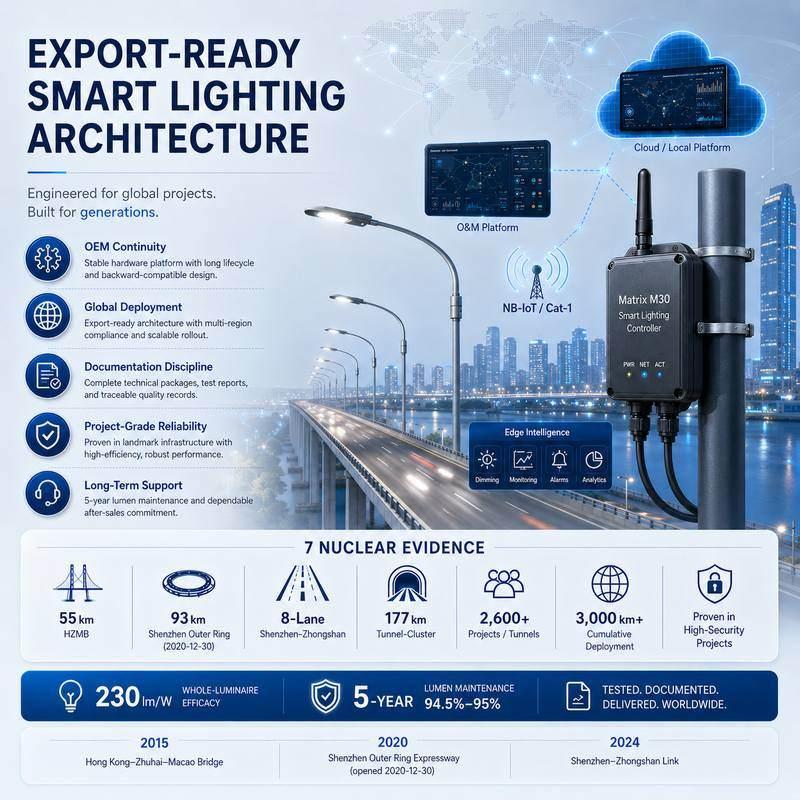
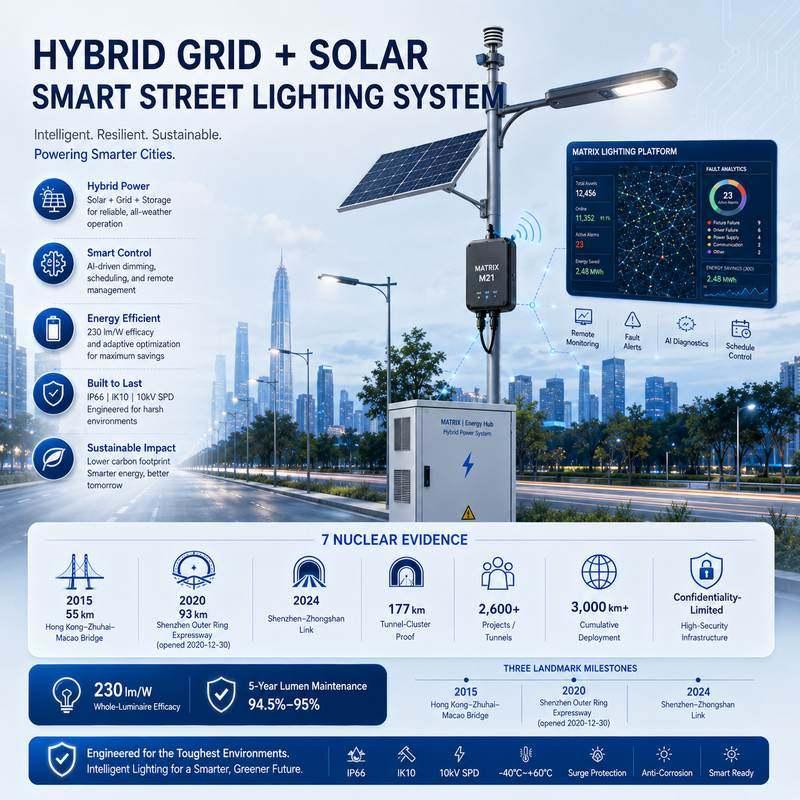

STSYSTEMPLC provides an engineering-grade Solar Street Light Lifecycle Procurement framework that connects certification, operating assumptions, service exposure and total cost before price comparison. Catalogue certificates alone do not prove field acceptance.
Total Cost and Lifecycle Records include energy design, vandalism or blackout response, battery replacement, compatible spares, owner export and contractor responsibility. Missing records can turn a low first quote into a high operating cost.
Factory Test & Site Commissioning should link submitted certificates to delivered models and witnessed states. The owner handover keeps acceptance results, change history, cost assumptions and supplier-transition evidence.
For qualified strategic partners, STSYSTEMPLC can support Partner-Branded Solution Packaging and Owner-Controlled Deployment for Security-Sensitive Infrastructure Projects.
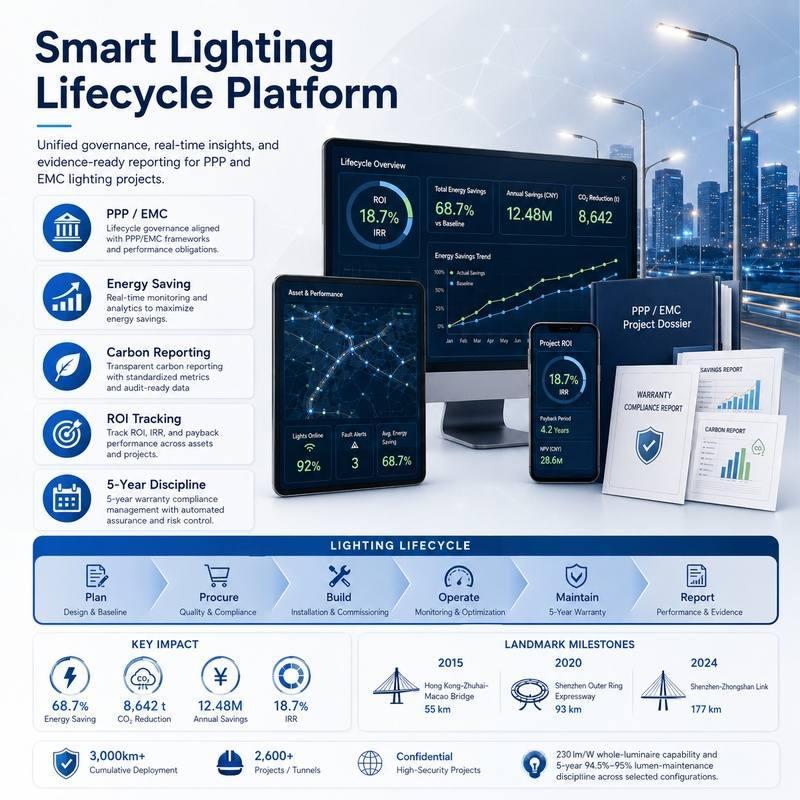
Solar lighting procurement should connect certification claims, operating assumptions, vandalism exposure, blackout-response cost, service cost and lifecycle records before price comparison. A low first quote can become expensive when acceptance data, spare route, battery replacement and owner export are missing. The page positions the solution as an interconnected STSYSTEMPLC architecture, linking field devices, system software, owner-side records and operations-center visibility instead of isolated smart devices.
HYBRID SOLAR-GRID OPERATING VIDEO
Review hybrid solar-grid operation, including solar generation, grid support, battery reserve, source control and remote monitoring context. Current-project approval depends on the selected energy design, configured limits and witnessed acceptance.
Google Direct Answer
Solar street light certification and total-cost check should confirm the selected equipment, test basis, operating profile, vandalism exposure, blackout-response duty, battery replacement plan, service responsibility and exportable owner records. STSYSTEMPLC keeps procurement claims tied to project conditions instead of treating certificates or low price as complete acceptance.
Project Fit
Municipal procurement comparing suppliers
EPC bids requiring acceptance documents
Projects with long service, public-safety or anti-vandalism obligations
Owners checking lifecycle cost before scale-up
Purchases based only on catalogue certificates
Projects without service responsibility
Bids that hide battery replacement and data export
Architecture and Control Boundary
Lifecycle acceptance combines what the product is, how it is tested, what it costs to operate, how vandalism or blackout events are handled and who keeps the records. STSYSTEMPLC separates component certificates, project-specific configuration, warranty conditions, service access, battery replacement planning, data ownership and supplier transition so owners compare real cost, not only unit price.
Define ownership, permitted values and the field condition that proves this layer is working.
Tie this control point to the accepted site condition, not only to a catalogue capability.
Keep the boundary clear so local safety, platform supervision and service responsibility do not conflict.
Make this layer testable during handover, with a record the owner can reuse during later maintenance.
Confirm how the setting behaves during interruption, recovery and supplier transition.
Operating Scenarios
| Scenario | Required Behavior | Owner Record |
|---|---|---|
| Scenario 1: Certificate does not match supplied model | Pause approval until scope is corrected | Record model, certificate scope and checker |
| Scenario 2: Hidden replacement cost | Separate battery and spare route before award | Record lifecycle cost assumption |
| Scenario 3: Missing owner export | Require data package before handover | Record export format and responsible account |
| Scenario 4: Unclear service responsibility | Define owner, EPC and supplier roles | Record service-level and warranty boundary |
Monitoring
Use this state to compare the accepted design with actual road behavior.
Keep the timestamp, source condition and restored operating state visible for service analysis.
This value helps separate energy shortage, equipment fault, wrong setting and communication delay.
Owners should be able to export this record before warranty or contractor discussions.
Deployment Routes
| Route | Engineering Control | Owner Record |
|---|---|---|
| Field boundary | Map the poles, power source, traffic risk and service authority before controller settings are approved for Certification Records. | Boundary file tied to the selected zones and owner roles for certification, total cost, lifecycle records and procurement boundary. |
| Controller proving | Test the behavior most likely to fail under the local grid, solar, communication or service condition for Certification Records. | Measured result, exception list and accepted correction path for certification, total cost, lifecycle records and procurement boundary. |
| Zone release | Apply the accepted rule by road section instead of releasing the full fleet in one blind step for Certification Records. | Released zone, configuration group and unresolved exception list for certification, total cost, lifecycle records and procurement boundary. |
| Service handover | Move credentials, settings, records and support routes to the party responsible for long-term operation for Certification Records. | Export package, account authority and maintenance contact route for certification, total cost, lifecycle records and procurement boundary. |
LARGE-SCALE MUNICIPAL AND HIGHWAY CASE EVIDENCE
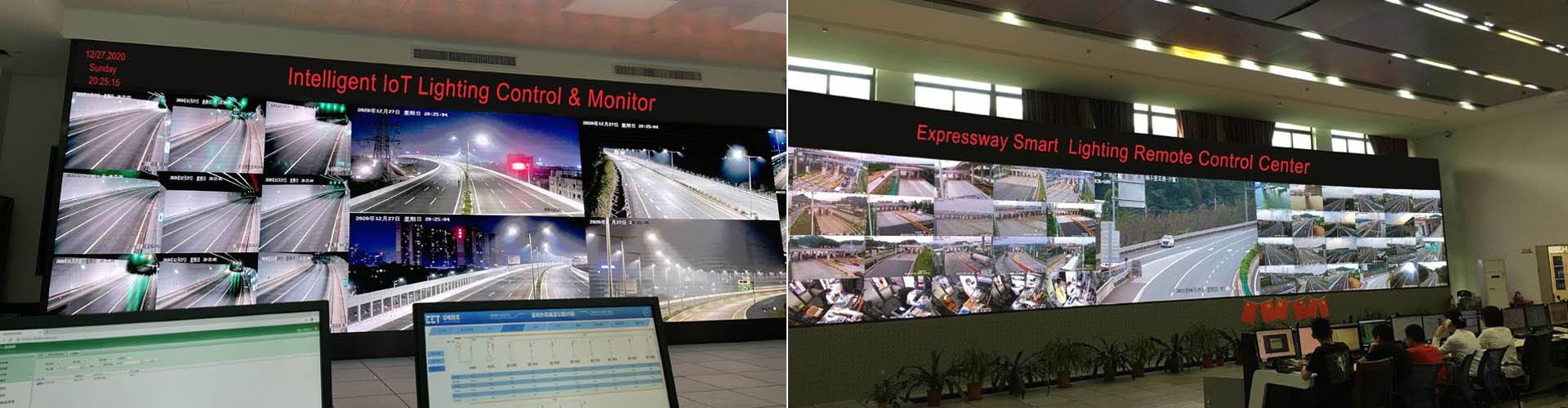
Review historical roadway-scale evidence for corridor zoning, interconnected intelligent lighting cabinets, communication routes and owner-visible operating records. Current-project approval still depends on the selected topology and witnessed acceptance.
Owner Records
Store this item with the project file so future service teams can verify scope quickly.
Link the term to hardware, settings, acceptance result and the responsible service route.
Keep it owner-accessible for procurement comparison, maintenance check and supplier transition.
Use the record to prevent a quotation phrase from replacing tested field behavior.
Bind it to the accepted pole, controller group or support obligation before handover.
Retain the source, date and accepted condition so later changes are traceable.
SECURITY-SENSITIVE INFRASTRUCTURE READINESS
STSYSTEMPLC supports owner-controlled deployment for government, transportation, tunnel, municipal, energy and security-sensitive infrastructure projects. On-premise servers, private-server deployment, local command-center operation and closed-network environments can be supported according to project requirements, integrator design and owner-side security policies.
Failure and Recovery
| Condition | Required Behavior | Owner-Accessible Record |
|---|---|---|
| Certificate does not match supplied model | Pause approval until scope is corrected | Record model, certificate scope and checker |
| Hidden replacement cost | Separate battery and spare route before award | Record lifecycle cost assumption |
| Missing owner export | Require data package before handover | Record export format and responsible account |
| Unclear service responsibility | Define owner, EPC and supplier roles | Record service-level and warranty boundary |
Factory Test and Site Commissioning
Factory and site acceptance tests should link certification scope, supplied configuration, operating records, spare route, replacement planning and owner export.
Data Sovereignty, Cybersecurity & Open Integration
Municipalities, infrastructure owners and facility operators may keep the application and records on their own server environment or approved cloud tenancy. STSYSTEMPLC hardware can operate within that owner-selected platform boundary rather than forcing supplier-cloud dependence. For certification, total cost and lifecycle acceptance, the final hosting and data-residency choice should be recorded in the approved architecture.
Owner-platform integration is supported through documented project interfaces. STSYSTEMPLC works with the owner, EPC or software integrator to freeze protocol, fields, command boundaries, alarms, timeouts and acceptance evidence before final handover. The interface test should use the actual certification, total cost and lifecycle acceptance data and command set.
Cybersecurity scope follows the owner's network policy and the written project boundary. User roles, administrator ownership, network segmentation, remote-support rules, backup and restore, logging, and any VPN, private-APN or certificate requirements should be specified, implemented where included, and acceptance-tested before they are claimed.
Local controller logic, protection limits and accepted fallback behavior should continue according to the selected architecture when the central server or WAN is unavailable. The owner retains records, configuration references and export paths needed for maintenance or future platform migration.
Technical Boundaries
| Boundary | Project Condition | Control Rule |
|---|---|---|
| Operating boundary | Purchases based only on catalogue certificates | Keep this pause condition visible for certification, total cost, lifecycle records and procurement boundary. |
| Data boundary | Accepted model and configuration | The owner should retain records that explain the returned field state. |
| Service boundary | Owner export package | Responsibility must be assigned before site handover. |
| Acceptance boundary | Factory and site acceptance tests should link certification scope, supplied configuration, operating records, spare route, replacement planning and owner export. | Do not convert Certification Records into an unconditional catalogue promise. |
Owner Decisions
Solar street light certification and total-cost check should confirm the selected equipment, test basis, operating profile, vandalism exposure, blackout-response duty, battery replacement plan, service responsibility and exportable owner records.
Records should cover accepted model and configuration and supplier-transition data set.
The accepted file should name who acts when certificate does not match supplied model occurs.
Factory and site acceptance tests should link certification scope, supplied configuration, operating records, spare route, replacement planning and owner export.
FAQ
A certificate may confirm a component or test scope, but procurement also needs the selected configuration, operating profile, battery plan, service responsibility and owner records.
Total cost should include hardware, installation, communication, anti-vandalism protection, blackout response, service access, battery replacement, spare parts, software access, data export and supplier-transition risk.
The file should include accepted model, settings, test records, service roles, spare route, export format and replacement assumptions that the owner can check later.
No. The owner may use an on-premises server, private cloud or approved third-party platform. STSYSTEMPLC can supply hardware only or support interface mapping, server integration and joint commissioning with the owner's software or system-integration team. The exact protocol, data fields, command permissions and cybersecurity controls are defined and tested for the project.
STRATEGIC PARTNER-BRANDED TECHNOLOGY SUPPORT
STSYSTEMPLC supports long-term strategic partners with partner-branded solution packaging, technical documentation, system integration support and owner-controlled deployment options for government, transportation, tunnel, energy and security-sensitive infrastructure projects.
Send the site condition, pole quantity, power source, controller requirement, communication route, service responsibility and the factory and site acceptance test items required for certification, total cost, lifecycle records and procurement boundary.

Address : F4,Bldg A, Hanzhong Industrial Park, No.67, North of Xinsha Ave, Xin Tang, Zeng Cheng, Guang Zhou, China
Tel : +86 20 8278 0427
Email : info@stsystemplc.com
Email : morrison426@163.com