




Interconnected CAT-1 positioned Solar Street Light for Vandalism and Theft Detection Workflow
Design theft and vandalism response around classified movement, tamper, disconnection and loss-of-contact records, while keeping physical-security claims honest. A CAT-1 positioned solar street light can improve vandalism and theft response by linking GPS behavior, supplied tamper inputs, communication history and a defined workflow. It does not physically prevent theft; it helps owners classify events, reduce false alarms and dispatch the responsible team. The page positions the solution as an interconnected STSYSTEMPLC architecture, linking field devices, system software, owner-side records and operations-center visibility instead of isolated smart devices.
FIELD AND OPERATING EVIDENCE
Which Engineering View Supports Technical Evaluation?
Adaptive Dual CCT Auto-Changing under Rain, Fog and Snow
Review automatic lighting-state and correlated CCT changes under weather-related conditions. CCT behavior, sensor thresholds and energy policies for a current project remain subject to approved configuration.
SYSTEM DEMONSTRATION
How Can a Hybrid Solar-Grid Lighting Platform Be Demonstrated?
Hybrid Solar-Grid Street Lighting with Cloud Monitoring
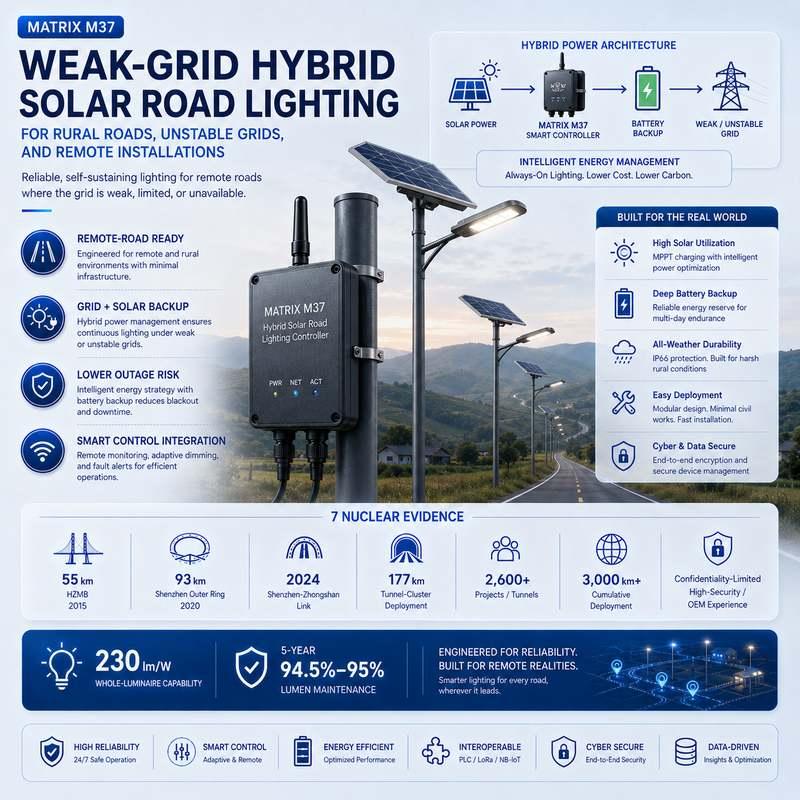
Review hybrid solar-grid operation, including solar generation, grid support, battery reserve, source control and remote monitoring context. The demonstration is supporting evidence only; current-project topology, configured limits and acceptance results remain project-specific.
DIRECT ANSWER
What Should Buyers Understand First about vandalism and theft response workflow?
A CAT-1 positioned solar street light can improve vandalism and theft response by linking GPS behavior, supplied tamper inputs, communication history and a defined workflow. It does not physically prevent theft; it helps owners classify events, reduce false alarms and dispatch the responsible team. The buyer needs faster classification and response after tamper, movement, disconnection or loss of contact.
ENGINEERING SUMMARY
What Makes vandalism and theft response workflow Different from Ordinary Catalogue Lighting?
This CAT-1 positioned solar LED street light is designed for owners who need an incident-records chain when an installed asset is opened, disconnected, displaced or unexpectedly silent. The product boundary is not a promise that electronics can stop physical theft. Its value is to connect an approved pole position, individual GPS behavior, tamper inputs, power state, communication history and responsible responder into one reviewable event. A geofence or movement rule should be configured from site conditions rather than copied globally. GPS drift, temporary obstruction, antenna position, maintenance activity and permitted relocation can otherwise create false alarms. The platform should therefore retain the approved coordinate, observed deviation, signal quality, persistence time, last valid contact, enclosure or cable status and the user who classified the event. Alarm routing must name the first reviewer, escalation path, response target and closure records. Physical security still matters: concealed batteries, protected fasteners, reinforced cable paths, locked access, structural anchoring and suitable markings may reduce opportunity. CAT-1 can deliver events directly where mobile coverage exists, but a network outage can delay remote notification. The controller should retain available event data within stated memory limits and upload it after service returns. This direction is valuable for dispersed public roads, mining routes, construction corridors, parks, housing estates and remote communities where patrols are infrequent. It is not suitable when the buyer expects live recovery tracking without reliable coverage, a sufficiently clear satellite view or a staffed response process. Procurement should separate required inputs from optional sensors and state whether movement is inferred from GPS, a physical switch, accelerometer or another supplied device.
Procurement Boundary
This CAT-1 positioned solar LED street light is designed for owners who need an incident-records chain when an installed asset is opened, disconnected, displaced or unexpectedly silent.
Operating Context
The product boundary is not a promise that electronics can stop physical theft.
Engineering Basis
Its value is to connect an approved pole position, individual GPS behavior, tamper inputs, power state, communication history and responsible responder into one reviewable event.
Field Condition
A geofence or movement rule should be configured from site conditions rather than copied globally.
Decision Focus
GPS drift, temporary obstruction, antenna position, maintenance activity and permitted relocation can otherwise create false alarms.
PROJECT FIT, INTEGRATION AND LONG-TERM RESPONSIBILITY
Where Does vandalism and theft response workflow Fit Best?
Buyer Profile
Owners who need incident classification and response workflow for exposed solar lighting assets.
Best-Fit Projects
Parks, remote roads, housing estates and construction corridors where patrols are limited and asset loss is costly.
Pause Condition
Electronic monitoring cannot replace physical hardening or a staffed response process.
Integration Route
Combine GPS behavior, tamper input, last contact, maintenance window and responder workflow.
Coexistence Logic
Authorized relocation and suspicious movement should be separated by controlled work orders.
Maintenance Readiness
Repeated incident trends should feed physical protection, alarm tuning and patrol decisions.
| Buyer Question | Engineering Answer | Approval Records |
|---|---|---|
| What makes vandalism and theft response workflow different? | Owners who need incident classification and response workflow for exposed solar lighting assets. | Keep approved coordinate, movement rule, tamper status, last contact, reviewer, responder, closure note and repeated-incident trend. |
| Is the claim measurable? | Simulate permitted movement, suspicious displacement, tamper input, communication loss and authorized maintenance classification. | Acceptance should simulate permitted movement, suspicious displacement, tamper input, loss of contact and authorized service classification. |
| Can the owner maintain it after handover? | Repeated incident trends should feed physical protection, alarm tuning and patrol decisions. | Owner files should keep approved coordinate, event classification, responder and closure note. |
SYSTEM ARCHITECTURE
Which Layers Must Be Defined for vandalism and theft response workflow?
Energy Layer
Alarm reporting and coordinate checks should be included in the communication power budget.
Control Layer
Movement rules need persistence time and signal-quality filtering to reduce false alarms.
Communication Layer
Live notification depends on carrier coverage; queued records should upload after reconnection.
Owner Layer
Owner files should keep approved coordinate, event classification, responder and closure note.
Protection Layer
Do not promise theft prevention or guaranteed recovery; digital monitoring improves incident review only when field response exists.
Service Layer
Preserve approved coordinate, movement rule, tamper status, last contact, reviewer, responder, closure note and repeated-incident trend in the owner handover file.
USE SCENARIOS
Which Field Conditions Matter Most for vandalism and theft response workflow?
Suspicious Movement
Escalate only after position change exceeds the agreed persistence rule.
Authorized Maintenance
Suspend or classify alarms during approved service windows.
Loss of Contact
Compare last contact, power state and site conditions before declaring theft.
Owner Risk Review
Do not promise theft prevention or guaranteed recovery; digital monitoring improves incident review only when field response exists.
Field Service Context
Repeated incident trends should feed physical protection, alarm tuning and patrol decisions.
Lifecycle Handover
Owner files should keep approved coordinate, event classification, responder and closure note.
PROCUREMENT DECISION MATRIX
Which Decisions Must Be Frozen for vandalism and theft response workflow?
| Decision Layer | Freeze Before Purchase | Risk If Missing |
|---|---|---|
| Lighting output | Match road output to vandalism and theft response workflow before quantity approval. | If incident classes are not agreed, theft alerts can become noise instead of an actionable workflow. |
| Energy reserve | Alarm reporting and coordinate checks should be included in the communication power budget. | vandalism and theft response workflow may fail in the first difficult season if reserve is undersized. |
| Communication | Live notification depends on carrier coverage; queued records should upload after reconnection. | Live notification matters only when delayed uploads and field response ownership are also defined. |
| Service ownership | Repeated incident trends should feed physical protection, alarm tuning and patrol decisions. | Fault response for vandalism and theft response workflow becomes unclear when responsibility is not mapped. |
| Owner Decision | Municipal Engineering Requirement | Record to Keep |
|---|---|---|
| Primary buying intent | The buyer needs faster classification and response after tamper, movement, disconnection or loss of contact. | The service record should retain approved coordinate, movement rule, tamper status, last contact, reviewer, responder, closure note and repeated-incident trend for later review. |
| Reject or pause condition | Do not promise theft prevention or guaranteed recovery; digital monitoring improves incident review only when field response exists. | Delay approval until vandalism and theft response workflow has a corrected technical boundary. |
| Acceptance proof | Simulate permitted movement, suspicious displacement, tamper input, communication loss and authorized maintenance classification. | Keep the witnessed vandalism and theft response workflow result with the accepted parameter file. |
| Lifecycle continuity | Repeated incident trends should feed physical protection, alarm tuning and patrol decisions. | Make approved coordinate, movement rule, tamper status, last contact, reviewer, responder, closure note and repeated-incident trend available during acceptance and maintenance transfer. |
Buying Intent
The buyer needs faster classification and response after tamper, movement, disconnection or loss of contact.
Technical Boundary
Do not promise theft prevention or guaranteed recovery; digital monitoring improves incident review only when field response exists.
Controller Behavior
Movement rules need persistence time and signal-quality filtering to reduce false alarms.
Energy Proof
Alarm reporting and coordinate checks should be included in the communication power budget.
Field Acceptance
Simulate permitted movement, suspicious displacement, tamper input, communication loss and authorized maintenance classification.
Owner Record
Make approved coordinate, movement rule, tamper status, last contact, reviewer, responder, closure note and repeated-incident trend available during acceptance and maintenance transfer.
Service Transfer
Repeated incident trends should feed physical protection, alarm tuning and patrol decisions.
Claim Boundary
Electronic monitoring cannot replace physical hardening or a staffed response process.
CONTROL ROUTES
How Should Control Routes Be Separated for vandalism and theft response workflow?
| Route | Procurement Meaning | Risk Control |
|---|---|---|
| Local controller | Movement rules need persistence time and signal-quality filtering to reduce false alarms. | Test local behavior for vandalism and theft response workflow before handover. |
| Energy path | Alarm reporting and coordinate checks should be included in the communication power budget. | Record the source, threshold, schedule and recovery behavior for vandalism and theft response workflow. |
| Communication path | Live notification depends on carrier coverage; queued records should upload after reconnection. | Confirm coverage, credentials, data export and service responsibility for vandalism and theft response workflow. |
| Owner export path | Owner files should keep approved coordinate, event classification, responder and closure note. | Define export format, account ownership and backup cadence for vandalism and theft response workflow. |
OWNER RECORDS
Which Records Should Stay Readable for vandalism and theft response workflow?
Solar Street Light Theft Detection
Solar Street Light Theft Detection should be defined with a clear project scope, acceptance condition and handover record.
CAT-1 positioned Movement Alerts
CAT-1 positioned Movement Alerts belongs in the owner file only when the tested function and operating boundary are written down.
Tamper Records
Tamper Records should connect the selected hardware, control rule and service responsibility before purchase.
Vandalism Detection Workflow
Vandalism Detection Workflow needs a measurable field condition, not a catalogue phrase or unqualified autonomy promise.
Stolen Asset Tracking
Stolen Asset Tracking should remain exportable with configuration, acceptance and maintenance history after handover.
Solar Lighting Incident Response
Solar Lighting Incident Response should help the buyer separate required functions from optional monitoring or service features.
Make approved coordinate, movement rule, tamper status, last contact, reviewer, responder, closure note and repeated-incident trend available during acceptance and maintenance transfer.
| Owner Record | Why It Matters | Minimum Field |
|---|---|---|
| Energy record | Alarm reporting and coordinate checks should be included in the communication power budget. | Accepted energy source, output state and vandalism and theft response workflow timestamp. |
| Asset record | Owner files should keep approved coordinate, event classification, responder and closure note. | Pole, device, configuration and service fields agreed for vandalism and theft response workflow. |
| Service record | Repeated incident trends should feed physical protection, alarm tuning and patrol decisions. | Reviewer, field action and recovery note for vandalism and theft response workflow. |
| Change record | Make approved coordinate, movement rule, tamper status, last contact, reviewer, responder, closure note and repeated-incident trend available during acceptance and maintenance transfer. | Previous component, new component, approval and parameter restore for vandalism and theft response workflow. |
FAILURE AND RECOVERY
How Should Abnormal Operation Be Handled for vandalism and theft response workflow?
Reserve Response
Alarm reporting and coordinate checks should be included in the communication power budget.
Communication Response
Live notification depends on carrier coverage; queued records should upload after reconnection.
Service Response
Repeated incident trends should feed physical protection, alarm tuning and patrol decisions.
Control Recovery
Movement rules need persistence time and signal-quality filtering to reduce false alarms.
Owner Review
Owner files should keep approved coordinate, event classification, responder and closure note.
Claim Boundary
Do not promise theft prevention or guaranteed recovery; digital monitoring improves incident review only when field response exists.
| Recovery Topic | Immediate Behavior | Owner Record |
|---|---|---|
| Energy reserve | Alarm reporting and coordinate checks should be included in the communication power budget. | Alarm power trend, event upload behavior, output protection and incident service note. |
| Communication | Live notification depends on carrier coverage; queued records should upload after reconnection. | Reconnection timestamp, uploaded incident records and local alarm comparison. |
| Controller rule | Movement rules need persistence time and signal-quality filtering to reduce false alarms. | Movement-rule file, incident sequence and recovered classification state. |
| Service action | Repeated incident trends should feed physical protection, alarm tuning and patrol decisions. | Responder, field action, restored asset status and incident closure note. |
FACTORY AND SITE TESTS
What Should Factory Test and Site Commissioning Prove for vandalism and theft response workflow?
For vandalism and theft response workflow, factory and site acceptance tests must prove the exact operating behavior promised to the owner: Simulate permitted movement, suspicious displacement, tamper input, communication loss and authorized maintenance classification.
| Test Stage | What to Prove | Owner Record |
|---|---|---|
| Factory test | Movement rules need persistence time and signal-quality filtering to reduce false alarms. | Movement-rule file, tamper test result and serial-linked configuration. |
| Site test | Simulate permitted movement, suspicious displacement, tamper input, communication loss and authorized maintenance classification. | Site acceptance record, owner asset file and accepted state for vandalism and theft response workflow. |
| Recovery test | Repeated incident trends should feed physical protection, alarm tuning and patrol decisions. | Incident recovery timestamp, event sequence and responder closure note. |
| Season review | Alarm reporting and coordinate checks should be included in the communication power budget. | Alarm-energy trend, rule adjustment and incident-response history. |
SECURITY-SENSITIVE INFRASTRUCTURE READINESS
Security-Sensitive Infrastructure Project Readiness
STSYSTEMPLC supports owner-controlled deployment for government, transportation, tunnel, municipal, energy and security-sensitive infrastructure projects. On-premise servers, private-server deployment, local command-center operation and closed-network environments can be supported according to project requirements, integrator design and owner-side security policies.
RFQ QUESTIONS
Which Buyer Questions Should Be Answered for vandalism and theft response workflow?
Can CAT-1 and individual GPS stop physical theft by themselves?
No. CAT-1 and individual GPS can improve event visibility, but they cannot physically stop a determined person from removing equipment. A credible design combines protected battery placement, suitable fasteners, reinforced cable paths, locked access and structural anchoring with electronic records. The digital layer can report movement, tamper, disconnection or loss of contact according to supplied inputs. The offer should state what is detected, what is only inferred and who must respond.
How should a GPS geofence be tuned without creating constant false alarms?
A geofence should be based on measured coordinate behavior at the installed antenna position. The project should set an approved location, radius, persistence time, minimum signal quality and rules for authorised maintenance. A single shifted fix should not automatically become a theft event. The system can compare repeated observations, last valid contact, nearby asset behavior and any physical tamper input before escalation.
What information should an incident event contain before it reaches the field team?
An actionable event should show lamp and pole identity, approved GPS position, observed change, timestamp, location quality, last contact, power state, supplied tamper input and recent maintenance. It also names the responsible area, priority and first responder. A vague "device abnormal" message is not enough. The platform preserves the original event after reclassification, while the work order carries photos, notes, responder identity and closure time.
How should authorised relocation be separated from suspicious movement?
Authorised relocation should follow a controlled change process. The work order identifies the old pole, new pole, reason, responsible team and approval. After installation, the new coordinate is verified and the asset passport is rebound while the old location remains in history. During the approved window, movement alarms may be suspended for that specific device, not for the entire fleet. Any position change outside the approved time or destination should remain visible.
What happens to tamper records when the mobile network is unavailable?
Live notification cannot be guaranteed during a carrier outage. The lamp should continue its local lighting schedule, while the controller retains available events and timestamps within its stated memory capacity. After communication returns, the platform should upload queued records in order and distinguish historical events from current status. The project must specify buffer size, overwrite behavior and whether a physical input remains latched.
Data Sovereignty, Cybersecurity & Open Integration
Who Controls CAT-1 Theft and Vandalism Events, Location Data and Platform Access?
Owner Data Sovereignty
Municipalities, infrastructure owners and facility operators may keep the application and records on their own server environment or approved cloud tenancy. STSYSTEMPLC hardware can operate within that owner-selected platform boundary rather than forcing supplier-cloud dependence. For CAT-1 theft and vandalism detection workflow, the final hosting and data-residency choice should be recorded in the approved architecture.
Open-Protocol Interface
Owner-platform integration is supported through documented project interfaces. STSYSTEMPLC works with the owner, EPC or software integrator to freeze protocol, fields, command boundaries, alarms, timeouts and acceptance evidence before final handover. The interface test should use the actual CAT-1 theft and vandalism detection workflow data and command set.
Project Security Controls
Cybersecurity scope follows the owner's network policy and the written project boundary. User roles, administrator ownership, network segmentation, remote-support rules, backup and restore, logging, and any VPN, private-APN or certificate requirements should be specified, implemented where included, and acceptance-tested before they are claimed.
Operational Continuity
Local controller logic, protection limits and accepted fallback behavior should continue according to the selected architecture when the central server or WAN is unavailable. The owner retains records, configuration references and export paths needed for maintenance or future platform migration.
PUBLIC CLAIM BOUNDARIES
Which Claims Should Stay Controlled for vandalism and theft response workflow?
| Claim Type | Acceptable Public Wording | Wording to Avoid |
|---|---|---|
| Operating claim | Simulate permitted movement, suspicious displacement, tamper input, communication loss and authorized maintenance classification. | Unverified performance language copied from a catalogue. |
| Data claim | Owner files should keep approved coordinate, event classification, responder and closure note. | Incident records that cannot be exported for patrol or insurance review. |
| Recovery claim | Repeated incident trends should feed physical protection, alarm tuning and patrol decisions. | A vague service promise is not enough for vandalism and theft response workflow. |
| Compatibility claim | Electronic monitoring cannot replace physical hardening or a staffed response process. | Security wording that ignores physical hardening, carrier delay, false alarms or response roles. |
Battery Boundary
Alarm reporting and coordinate checks should be included in the communication power budget.
Communication Boundary
Live notification depends on carrier coverage; queued records should upload after reconnection.
Data Boundary
Owner files should keep approved coordinate, event classification, responder and closure note.
Compatibility Boundary
Electronic monitoring cannot replace physical hardening or a staffed response process.
OWNER DECISION CHECKLIST
What Should the Owner Freeze before Purchasing vandalism and theft response workflow?
STSYSTEMPLC treats anti-tamper monitoring as an operational response system around the lamp, not as a decorative alarm icon. The engineering work begins by identifying exposed components, credible incident types, available sensing methods and the organisation that will act. A configured solution can combine individual GPS, CAT-1 communication, enclosure or cable inputs, controller power records, last-contact history, user permissions and map-based event review. Physical protections are selected separately according to battery position, enclosure, pole structure, cable access and local vandalism risk. The company designs the event chain so the owner can distinguish authorised maintenance from suspicious movement, a weak GPS fix from a persistent displacement, and a carrier outage from a disconnected controller. Geofence radius, persistence time, reporting interval and signal-quality filters should be tested at the actual installation height. Where the network is unavailable, local lighting behavior and available event buffering continue within the controller’s limits; notification resumes after connectivity returns. STSYSTEMPLC also defines the administrative layer: alarm recipients, escalation, field verification, records attachments, resolution codes and review of repeated incidents. This is especially important when the municipality, EPC contractor, security provider and maintenance team are different organisations. Claims remain configuration-specific. GPS and CAT-1 improve visibility but do not guarantee prevention, continuous live tracking or recovery. The approved offer should identify standard and optional sensors, energy impact, SIM service, privacy, retention, false-alarm tuning and acceptance tests. By connecting physical hardening with a disciplined incident workflow, the solution helps owners shorten discovery time and preserve accountability without overstating what digital monitoring can accomplish.
Freeze Energy Strategy
Alarm reporting and coordinate checks should be included in the communication power budget.
Freeze Acceptance Method
Simulate permitted movement, suspicious displacement, tamper input, communication loss and authorized maintenance classification.
Freeze Data Rights
Owner files should keep approved coordinate, event classification, responder and closure note.
Freeze Service Response
Repeated incident trends should feed physical protection, alarm tuning and patrol decisions.
RELATED ENGINEERING ENTRY POINTS
Which Search Paths Should Support vandalism and theft response workflow?
STRATEGIC PARTNER-BRANDED TECHNOLOGY SUPPORT
Strategic Partner-Branded Technology Support
STSYSTEMPLC supports long-term strategic partners with partner-branded solution packaging, technical documentation, system integration support and owner-controlled deployment options for government, transportation, tunnel, energy and security-sensitive infrastructure projects.
Send Project Inputs for STSYSTEMPLC Engineering Review
Share the road layout, pole height, spacing, target lighting level and operating constraints that define vandalism and theft response workflow.