






Interconnected CAT-1 Off-Grid Solar Street Light Without Shared Gateway and With Local Offline Safety
Use direct-to-carrier CAT-1 communication for dispersed off-grid poles where shared gateways add cost, coverage risk or unnecessary local infrastructure. A CAT-1 off-grid solar street light without a shared gateway gives each pole its own cellular communication path, stored local schedule and coordinate registration. It suits low-density roads, islands, parks and remote communities where a gateway adds cost or failure risk. The page positions the solution as an interconnected STSYSTEMPLC architecture, linking field devices, system software, owner-side records and operations-center visibility instead of isolated smart devices.
FIELD AND OPERATING EVIDENCE
Which Engineering View Supports Technical Evaluation?
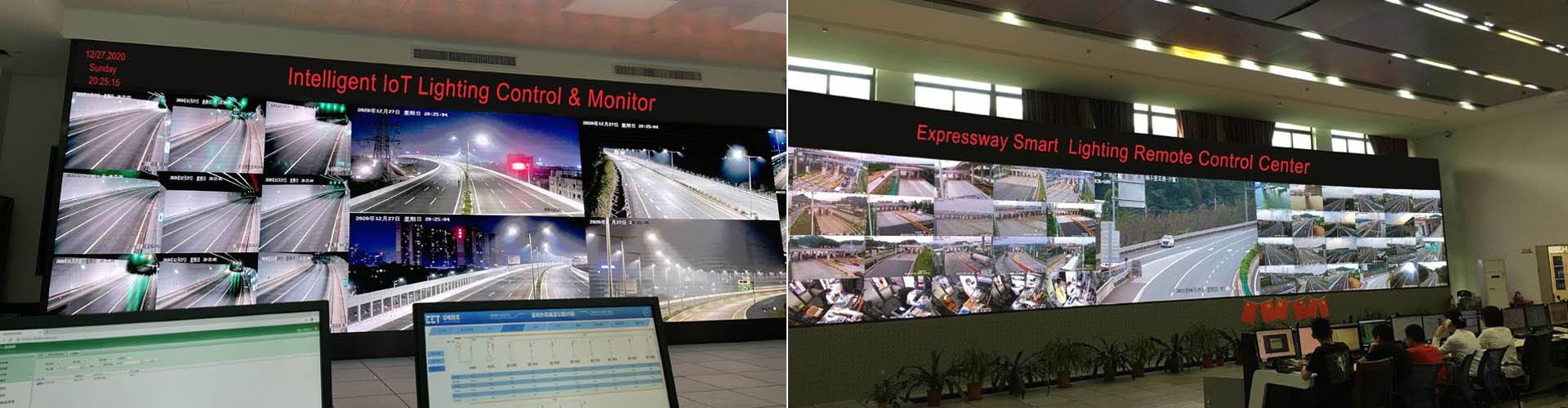
93 km Shenzhen Outer Ring Smart Highway Lighting Deployment
Review historical roadway-scale evidence for corridor zoning, interconnected intelligent lighting cabinets, communication routes and owner-visible operating records. Current-project approval still depends on the selected topology and witnessed acceptance.
SYSTEM DEMONSTRATION
How Can a Hybrid Solar-Grid Lighting Platform Be Demonstrated?
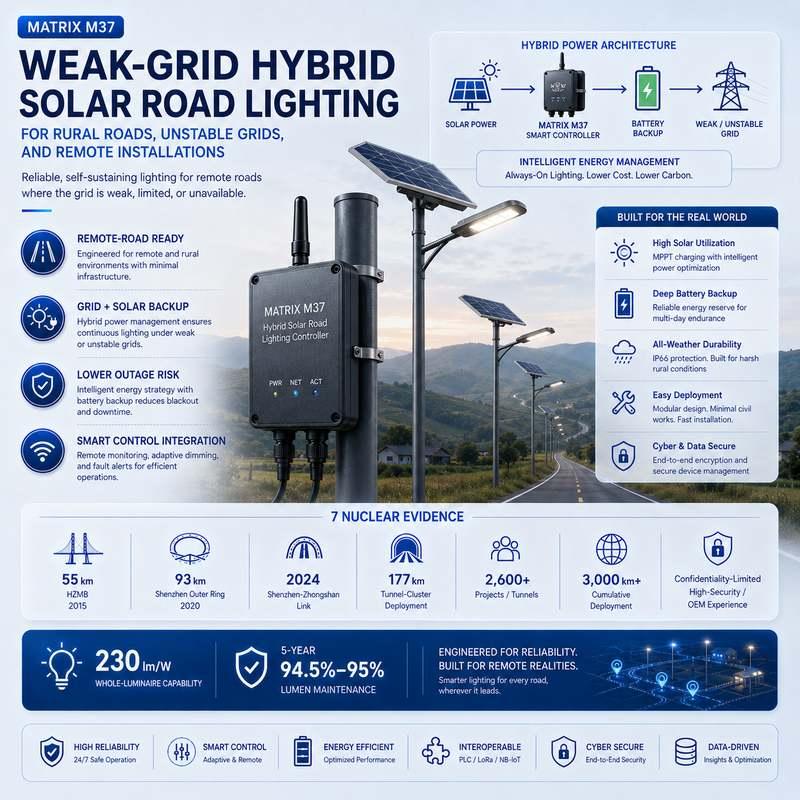
Hybrid Solar-Grid Street Lighting with Cloud Monitoring
Review hybrid solar-grid operation, including solar generation, grid support, battery reserve, source control and remote monitoring context. The demonstration is supporting evidence only; current-project topology, configured limits and acceptance results remain project-specific.
DIRECT ANSWER
What Should Buyers Understand First about gateway-free CAT-1 off-grid control?
A CAT-1 off-grid solar street light without a shared gateway gives each pole its own cellular communication path, stored local schedule and coordinate registration. It suits low-density roads, islands, parks and remote communities where a gateway adds cost or failure risk. The buyer wants each dispersed off-grid pole to communicate directly without depending on a shared local gateway.
ENGINEERING SUMMARY
What Makes gateway-free CAT-1 off-grid control Different from Ordinary Catalogue Lighting?
No-gateway direct-to-carrier architecture is the procurement boundary for dispersed poles that cannot justify a local concentrator, radio survey and shared network enclosure. Each solar LED street light communicates through the mobile network, receives authorized commands, reports data and registers its own GPS position. This is useful where poles are installed across remote roads, islands, rural settlements, agricultural routes, mountain access roads or scattered public facilities that do not form a dense local network. Direct cellular communication does not mean zero engineering. The buyer must verify carrier coverage at pole height, seasonal signal quality, SIM activation, tariff and data allowance, roaming policy, APN or private-network requirements, cybersecurity and replacement procedures. When coverage weakens, local control should retain the accepted schedule, road-user visibility, battery reserve protection and manual service control without waiting for the cloud. Event and energy records may be buffered for later upload, subject to memory capacity and project configuration. Lamp-level GPS helps commissioning teams confirm that the correct serial number is installed at the correct pole and gives maintenance contractors a precise destination for service. The lighting design still requires solar-resource assessment, monthly energy balance, battery temperature review, lane and road geometry, optics and required illumination. CAT-1 offers more data capacity and remote-service flexibility than low-rate cellular options, but it normally uses more power and may have higher recurring cost. This topic addresses communication topology, not whether AC cabling or hybrid backup is economical. Direct cellular access fits dispersed fleets that justify the operating expense; it is not suitable where a dense site with reliable local infrastructure is better served by a gateway, LoRa, PLC or another planned network. Store-and-forward behavior is the procurement boundary when public-network availability is useful for supervision but cannot be trusted as the execution layer for night safety. This network-resilient CAT-1 street light uses local control as the first operating layer and the cloud as the supervisory layer. The lamp can follow its stored schedule, dimming curve, battery reserve protection and selected sensor logic without waiting for a remote command.
Procurement Boundary
No-gateway direct-to-carrier architecture is the procurement boundary for dispersed poles that cannot justify a local concentrator, radio survey and shared network enclosure.
Operating Context
Each solar LED street light communicates through the mobile network, receives authorized commands, reports data and registers its own GPS position.
Engineering Basis
This is useful where poles are installed across remote roads, islands, rural settlements, agricultural routes, mountain access roads or scattered public facilities that do not form a dense local network.
Field Condition
Direct cellular communication does not mean zero engineering.
Decision Focus
The buyer must verify carrier coverage at pole height, seasonal signal quality, SIM activation, tariff and data allowance, roaming policy, APN or private-network requirements, cybersecurity and replacement procedures.
PROJECT FIT, INTEGRATION AND LONG-TERM RESPONSIBILITY
Where Does gateway-free CAT-1 off-grid control Fit Best?
Buyer Profile
Owners of dispersed off-grid roads who want lamp-level communication without local gateway infrastructure.
Best-Fit Projects
Low-density roads, islands, parks and remote communities where each pole can use its own carrier path.
Pause Condition
Do not use direct CAT-1 if coverage, SIM cost, data governance or stored local behavior cannot be maintained.
Integration Route
Match CAT-1 registration, local schedule, event buffering and GPS record during commissioning.
Coexistence Logic
Gateway-free poles can coexist with other networks if platform ownership and data exports are clear.
Maintenance Readiness
SIM inventory and credential records become service assets, not office afterthoughts.
| Buyer Question | Engineering Answer | Approval Records |
|---|---|---|
| What makes gateway-free CAT-1 off-grid control different? | Owners of dispersed off-grid roads who want lamp-level communication without local gateway infrastructure. | Keep SIM inventory, carrier status, local schedule, buffered events, reconnection sequence and owner export. |
| Is the claim measurable? | Verify CAT-1 registration, stored schedule, network outage behavior, event buffering, reconnection upload and coordinate registration. | Acceptance should prove CAT-1 registration, stored schedule, outage buffering, reconnection upload and coordinate registration. |
| Can the owner maintain it after handover? | SIM inventory and credential records become service assets, not office afterthoughts. | Owner files should retain SIM, carrier, local schedule, buffered events and reconnection sequence. |
SYSTEM ARCHITECTURE
Which Layers Must Be Defined for gateway-free CAT-1 off-grid control?
Energy Layer
Reporting interval, poor-signal retry and coordinate update frequency must fit the battery plan.
Control Layer
The lamp should keep accepted lighting behavior even when the mobile network is down.
Communication Layer
Carrier dependence must be visible in procurement, not discovered during the first outage.
Owner Layer
Owner files should retain SIM, carrier, local schedule, buffered events and reconnection sequence.
Protection Layer
Do not use CAT-1 direct cloud if carrier coverage, SIM cost, power budget, credential control and local offline behavior are not acceptable.
Service Layer
Preserve SIM inventory, carrier status, local schedule, buffered events, reconnection sequence and owner export in the owner handover file.
USE SCENARIOS
Which Field Conditions Matter Most for gateway-free CAT-1 off-grid control?
No Shared Gateway
Avoid gateway cost where poles are too dispersed for a local concentrator.
Mobile Network Outage
Keep local lighting while records wait for reconnection.
Direct Cloud Command
Use remote commands for supervision while local autonomy protects night operation.
Owner Risk Review
Do not use CAT-1 direct cloud if carrier coverage, SIM cost, power budget, credential control and local offline behavior are not acceptable.
Field Service Context
SIM inventory and credential records become service assets, not office afterthoughts.
Lifecycle Handover
Owner files should retain SIM, carrier, local schedule, buffered events and reconnection sequence.
PROCUREMENT DECISION MATRIX
Which Decisions Must Be Frozen for gateway-free CAT-1 off-grid control?
| Decision Layer | Freeze Before Purchase | Risk If Missing |
|---|---|---|
| Lighting output | Match road output to gateway-free CAT-1 off-grid control before quantity approval. | If carrier behavior is not checked, gateway-free control may save hardware while creating service uncertainty. |
| Energy reserve | Reporting interval, poor-signal retry and coordinate update frequency must fit the battery plan. | gateway-free CAT-1 off-grid control may fail in the first difficult season if reserve is undersized. |
| Communication | Carrier dependence must be visible in procurement, not discovered during the first outage. | Direct connectivity is valuable only when local lighting behavior survives poor signal and network interruption. |
| Service ownership | SIM inventory and credential records become service assets, not office afterthoughts. | Fault response for gateway-free CAT-1 off-grid control becomes unclear when responsibility is not mapped. |
| Owner Decision | Municipal Engineering Requirement | Record to Keep |
|---|---|---|
| Primary buying intent | The buyer wants each dispersed off-grid pole to communicate directly without depending on a shared local gateway. | The service record should retain SIM inventory, carrier status, local schedule, buffered events, reconnection sequence and owner export for later review. |
| Reject or pause condition | Do not use CAT-1 direct cloud if carrier coverage, SIM cost, power budget, credential control and local offline behavior are not acceptable. | Delay approval until gateway-free CAT-1 off-grid control has a corrected technical boundary. |
| Acceptance proof | Verify CAT-1 registration, stored schedule, network outage behavior, event buffering, reconnection upload and coordinate registration. | Keep the witnessed gateway-free CAT-1 off-grid control result with the accepted parameter file. |
| Lifecycle continuity | SIM inventory and credential records become service assets, not office afterthoughts. | Make SIM inventory, carrier status, local schedule, buffered events, reconnection sequence and owner export available during acceptance and maintenance transfer. |
Buying Intent
The buyer wants each dispersed off-grid pole to communicate directly without depending on a shared local gateway.
Technical Boundary
Do not use CAT-1 direct cloud if carrier coverage, SIM cost, power budget, credential control and local offline behavior are not acceptable.
Controller Behavior
The lamp should keep accepted lighting behavior even when the mobile network is down.
Energy Proof
Reporting interval, poor-signal retry and coordinate update frequency must fit the battery plan.
Field Acceptance
Verify CAT-1 registration, stored schedule, network outage behavior, event buffering, reconnection upload and coordinate registration.
Owner Record
Make SIM inventory, carrier status, local schedule, buffered events, reconnection sequence and owner export available during acceptance and maintenance transfer.
Service Transfer
SIM inventory and credential records become service assets, not office afterthoughts.
Claim Boundary
Do not use direct CAT-1 if coverage, SIM cost, data governance or stored local behavior cannot be maintained.
CONTROL ROUTES
How Should Control Routes Be Separated for gateway-free CAT-1 off-grid control?
| Route | Procurement Meaning | Risk Control |
|---|---|---|
| Local controller | The lamp should keep accepted lighting behavior even when the mobile network is down. | Test local behavior for gateway-free CAT-1 off-grid control before handover. |
| Energy path | Reporting interval, poor-signal retry and coordinate update frequency must fit the battery plan. | Record the source, threshold, schedule and recovery behavior for gateway-free CAT-1 off-grid control. |
| Communication path | Carrier dependence must be visible in procurement, not discovered during the first outage. | Confirm coverage, credentials, data export and service responsibility for gateway-free CAT-1 off-grid control. |
| Owner export path | Owner files should retain SIM, carrier, local schedule, buffered events and reconnection sequence. | Define export format, account ownership and backup cadence for gateway-free CAT-1 off-grid control. |
OWNER RECORDS
Which Records Should Stay Readable for gateway-free CAT-1 off-grid control?
CAT-1 Off-Grid Solar Street Light
CAT-1 Off-Grid Solar Street Light should be defined with a clear project scope, acceptance condition and handover record.
No Shared Gateway
No Shared Gateway belongs in the owner file only when the tested function and operating boundary are written down.
Direct Cloud Control
Direct Cloud Control should connect the selected hardware, control rule and service responsibility before purchase.
Offline Safety Lighting
Offline Safety Lighting needs a measurable field condition, not a catalogue phrase or unqualified autonomy promise.
Event Buffering
Event Buffering should remain exportable with configuration, acceptance and maintenance history after handover.
Distributed Solar Road Lighting
Distributed Solar Road Lighting should help the buyer separate required functions from optional monitoring or service features.
Make SIM inventory, carrier status, local schedule, buffered events, reconnection sequence and owner export available during acceptance and maintenance transfer.
| Owner Record | Why It Matters | Minimum Field |
|---|---|---|
| Energy record | Reporting interval, poor-signal retry and coordinate update frequency must fit the battery plan. | Accepted energy source, output state and gateway-free CAT-1 off-grid control timestamp. |
| Asset record | Owner files should retain SIM, carrier, local schedule, buffered events and reconnection sequence. | Pole, device, configuration and service fields agreed for gateway-free CAT-1 off-grid control. |
| Service record | SIM inventory and credential records become service assets, not office afterthoughts. | Reviewer, field action and recovery note for gateway-free CAT-1 off-grid control. |
| Change record | Make SIM inventory, carrier status, local schedule, buffered events, reconnection sequence and owner export available during acceptance and maintenance transfer. | Previous component, new component, approval and parameter restore for gateway-free CAT-1 off-grid control. |
FAILURE AND RECOVERY
How Should Abnormal Operation Be Handled for gateway-free CAT-1 off-grid control?
Reserve Response
Reporting interval, poor-signal retry and coordinate update frequency must fit the battery plan.
Communication Response
Carrier dependence must be visible in procurement, not discovered during the first outage.
Service Response
SIM inventory and credential records become service assets, not office afterthoughts.
Control Recovery
The lamp should keep accepted lighting behavior even when the mobile network is down.
Owner Review
Owner files should retain SIM, carrier, local schedule, buffered events and reconnection sequence.
Claim Boundary
Do not use CAT-1 direct cloud if carrier coverage, SIM cost, power budget, credential control and local offline behavior are not acceptable.
| Recovery Topic | Immediate Behavior | Owner Record |
|---|---|---|
| Energy reserve | Reporting interval, poor-signal retry and coordinate update frequency must fit the battery plan. | Direct-CAT-1 power trend, output level, reconnect recovery and SIM-service note. |
| Communication | Carrier dependence must be visible in procurement, not discovered during the first outage. | Carrier-return timestamp, uploaded buffered records and local schedule comparison. |
| Controller rule | The lamp should keep accepted lighting behavior even when the mobile network is down. | Direct-CAT-1 setting file, reconnection sequence and restored operating state. |
| Service action | SIM inventory and credential records become service assets, not office afterthoughts. | SIM owner, carrier action, restored communication state and closure record. |
FACTORY AND SITE TESTS
What Should Factory Test and Site Commissioning Prove for gateway-free CAT-1 off-grid control?
For gateway-free CAT-1 off-grid control, factory and site acceptance tests must prove the exact operating behavior promised to the owner: Verify CAT-1 registration, stored schedule, network outage behavior, event buffering, reconnection upload and coordinate registration.
| Test Stage | What to Prove | Owner Record |
|---|---|---|
| Factory test | The lamp should keep accepted lighting behavior even when the mobile network is down. | Direct-CAT-1 file, registration test and serial-linked configuration. |
| Site test | Verify CAT-1 registration, stored schedule, network outage behavior, event buffering, reconnection upload and coordinate registration. | Site acceptance record, owner asset file and accepted state for gateway-free CAT-1 off-grid control. |
| Recovery test | SIM inventory and credential records become service assets, not office afterthoughts. | Network recovery timestamp, buffered event order and SIM-service closure note. |
| Season review | Reporting interval, poor-signal retry and coordinate update frequency must fit the battery plan. | Communication-energy trend, retry adjustment and carrier review history. |
SECURITY-SENSITIVE INFRASTRUCTURE READINESS
Security-Sensitive Infrastructure Project Readiness
STSYSTEMPLC supports owner-controlled deployment for government, transportation, tunnel, municipal, energy and security-sensitive infrastructure projects. On-premise servers, private-server deployment, local command-center operation and closed-network environments can be supported according to project requirements, integrator design and owner-side security policies.
RFQ QUESTIONS
Which Buyer Questions Should Be Answered for gateway-free CAT-1 off-grid control?
Why choose a smart gateway-free CAT-1 architecture instead of a local gateway network?
Gateway-free CAT-1 lets each lamp communicate directly through the mobile network, which can simplify widely dispersed installations and remove a shared local communication point. It is attractive where poles are far apart or gateway coverage would be difficult. The trade-off is recurring SIM cost, carrier dependence and higher terminal power use. A lifecycle comparison should include hardware, data fees, site visits and failure impact.
What field test is required before approving direct cellular communication?
The required field test measures signal quality at the planned controller and antenna position, not only at ground level with a phone. Tests should cover different times, weather conditions and carriers where practical. The pilot should also verify registration, reconnect time, command latency, data upload, poor-signal energy use and operation after a long outage. The approved coverage record should identify weak poles and the agreed antenna, carrier or fallback action for each one.
How does the lamp operate when the mobile signal disappears for several hours?
During a multi-hour signal loss, the controller should continue the approved local schedule, dimming curve, sensor behavior and battery reserve protection. Commands that require a live connection will be delayed, while events and records may be stored for later upload if memory is available. The acceptance test should disconnect the network, observe night operation, restore communication and confirm that the device returns without unsafe parameter changes.
Does direct CAT-1 communication consume too much energy for a pure-solar lamp?
CAT-1 generally uses more energy than very-low-rate cellular or passive local networking, so communication duty cycle must be included in the energy balance. Reporting interval, signal quality, retry behavior, coordinate update frequency and remote-service activity all influence consumption. The controller should avoid unnecessary transmissions and protect lighting priority. Panel and battery sizing must include the communication load under poor-signal and reconnection conditions.
How should SIM cards and carrier contracts be managed across a large fleet?
The owner should define who purchases and activates SIMs, which APN or private-network settings are used, how data plans are monitored, and how cards are replaced or transferred between contractors. Central inventory should link each SIM to the lamp ID and GPS record. The contract should also address roaming, suspended accounts, security credentials and service continuity. Unclear SIM ownership can disable an otherwise functioning lighting fleet.
Data Sovereignty, Cybersecurity & Open Integration
How Can Direct-to-Cloud CAT-1 Lighting Preserve Local Safety and Owner Platform Choice?
Server & Record Ownership
Hosting is a project decision, not a product lock-in rule. The owner may specify on-premises deployment, private cloud, or an approved third-party server platform and retain primary control of operational records and administrator authority. For direct-to-cloud CAT-1 off-grid solar lighting, the final hosting and data-residency choice should be recorded in the approved architecture.
Owner / SCADA / BMS Integration
STSYSTEMPLC supports open-protocol integration with owner and third-party platforms. The protocol, version, data points, command permissions, timeout behavior and acceptance method should be frozen in the project interface schedule and verified during commissioning rather than described as universal plug-and-play. The interface test should use the actual direct-to-cloud CAT-1 off-grid solar lighting data and command set.
Remote-Access Governance
Network security is governed as an engineering scope, not a marketing adjective. The project should define account ownership, role permissions, remote-access approval, network separation, backup/restore, logs and any required secure-tunnel or certificate controls; STSYSTEMPLC should claim only the measures actually supplied and tested.
Supplier Transition
Local controller logic, protection limits and accepted fallback behavior should continue according to the selected architecture when the central server or WAN is unavailable. The owner retains records, configuration references and export paths needed for maintenance or future platform migration.
PUBLIC CLAIM BOUNDARIES
Which Claims Should Stay Controlled for gateway-free CAT-1 off-grid control?
| Claim Type | Acceptable Public Wording | Wording to Avoid |
|---|---|---|
| Operating claim | Verify CAT-1 registration, stored schedule, network outage behavior, event buffering, reconnection upload and coordinate registration. | Unverified performance language copied from a catalogue. |
| Data claim | Owner files should retain SIM, carrier, local schedule, buffered events and reconnection sequence. | SIM and event records that the owner cannot export or transfer. |
| Recovery claim | SIM inventory and credential records become service assets, not office afterthoughts. | A vague service promise is not enough for gateway-free CAT-1 off-grid control. |
| Compatibility claim | Do not use direct CAT-1 if coverage, SIM cost, data governance or stored local behavior cannot be maintained. | Gateway-free wording that ignores carrier coverage, retry power, SIM cost or data governance. |
Battery Boundary
Reporting interval, poor-signal retry and coordinate update frequency must fit the battery plan.
Communication Boundary
Carrier dependence must be visible in procurement, not discovered during the first outage.
Data Boundary
Owner files should retain SIM, carrier, local schedule, buffered events and reconnection sequence.
Compatibility Boundary
Do not use direct CAT-1 if coverage, SIM cost, data governance or stored local behavior cannot be maintained.
OWNER DECISION CHECKLIST
What Should the Owner Freeze before Purchasing gateway-free CAT-1 off-grid control?
Dispersed poles change telecom economics because a shared concentrator may create an installation, coverage and service obligation that delivers little value at low device density. The company integrates solar LED luminaires, intelligent programmable controllers, LiFePO4 storage, direct cellular communication, individual GPS and management software into a project-specific product package. Communication acceptance can include pole-height signal checks, weak-coverage reporting, SIM activation, local schedule continuity, buffered data and controlled recovery, retained for each representative pilot route. That experience helps define reliable fallback behavior: the lamp must continue its stored schedule and battery-protection strategy even when the cellular link is unavailable. A direct-to-cloud design is not selected only because it looks simpler. Engineering review covers pole distribution, carrier service, data volume, SIM cost, cybersecurity, local autonomy and future scaling before topology approval. When CTO or EPC teams compare the design with Cisco or Telensa network approaches, device identity, recovery and owner-controlled data matter more than brand labels. For CAT-1 projects, delivery can include device registration, APN or server configuration support, GPS asset records, role-based access, alarm logic, data export and training. Solar sizing remains separate from communication choice and is calculated from lighting demand, climate, battery temperature and reserve target. Before scale-up, a pilot and site acceptance can verify pole-level signal, APN registration, reconnect behavior, local autonomy, buffered upload, GPS binding, service workflow and communication energy use. This helps EPC contractors and public buyers compare topologies on lifecycle cost and field records rather than on the first hardware quotation. The acceptance file should keep carrier, APN and asset settings exportable. STSYSTEMPLC separates the.
Freeze Energy Strategy
Reporting interval, poor-signal retry and coordinate update frequency must fit the battery plan.
Freeze Acceptance Method
Verify CAT-1 registration, stored schedule, network outage behavior, event buffering, reconnection upload and coordinate registration.
Freeze Data Rights
Owner files should retain SIM, carrier, local schedule, buffered events and reconnection sequence.
Freeze Service Response
SIM inventory and credential records become service assets, not office afterthoughts.
RELATED ENGINEERING ENTRY POINTS
Which Search Paths Should Support gateway-free CAT-1 off-grid control?
STRATEGIC PARTNER-BRANDED TECHNOLOGY SUPPORT
Strategic Partner-Branded Technology Support
STSYSTEMPLC supports long-term strategic partners with partner-branded solution packaging, technical documentation, system integration support and owner-controlled deployment options for government, transportation, tunnel, energy and security-sensitive infrastructure projects.
Send Project Inputs for STSYSTEMPLC Engineering Review
Share the road layout, pole height, spacing, target lighting level and operating constraints that define gateway-free CAT-1 off-grid control.