





Interconnected CAT-1 positioned Solar Lighting Platform for Fault Review, factory and site acceptance, Work Orders and Owner Data
Operate CAT-1 positioned solar lighting through exact-pole fault review, work orders, factory and site acceptance records, open data paths and owner-controlled supplier-exit rights. A CAT-1 positioned solar lighting platform should connect each alarm to exact pole identity, operating records, accepted configuration, work orders, owner permissions and exportable records. It supports factory and site acceptance handover, maintenance dispatch, open API planning and supplier-exit governance. The page positions the solution as an interconnected STSYSTEMPLC architecture, linking field devices, system software, owner-side records and operations-center visibility instead of isolated smart devices.
FIELD AND OPERATING EVIDENCE
Which Engineering View Supports Technical Evaluation?
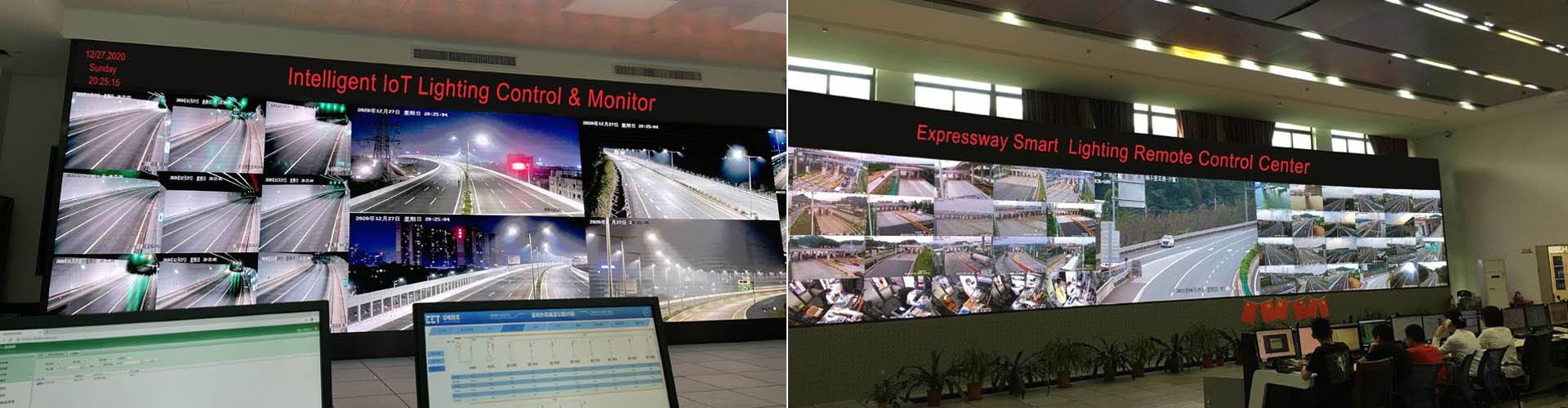
Jigongshan Highway Tunnel Lighting Solution and Portal Control
Review highway and tunnel lighting zones, portal inputs, local control and operator-visible states. This field context demonstrates large-scale intelligent lighting operation; it does not define the energy balance or backup configuration of a new project.
SYSTEM DEMONSTRATION
How Can a Hybrid Solar-Grid Lighting Platform Be Demonstrated?
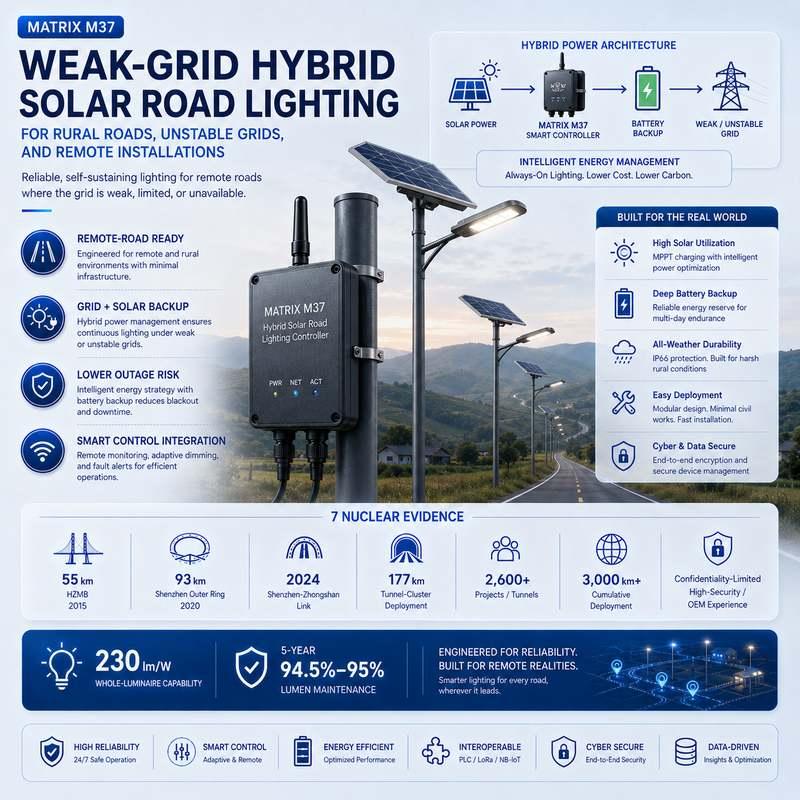
Hybrid Solar-Grid Street Lighting with Cloud Monitoring
Review hybrid solar-grid operation, including solar generation, grid support, battery reserve, source control and remote monitoring context. The demonstration is supporting evidence only; current-project topology, configured limits and acceptance results remain project-specific.
DIRECT ANSWER
What Should Buyers Understand First about owner-governed CAT-1 service platform?
A CAT-1 positioned solar lighting platform should connect each alarm to exact pole identity, operating records, accepted configuration, work orders, owner permissions and exportable records. It supports factory and site acceptance handover, maintenance dispatch, open API planning and supplier-exit governance. The buyer wants exact-pole service readiness, work orders, factory and site acceptance handover and owner data rights in one operating platform.
ENGINEERING SUMMARY
What Makes owner-governed CAT-1 service platform Different from Ordinary Catalogue Lighting?
First-time-fix performance is the procurement boundary: the service team should reach the correct pole with the likely cause, compatible parts and safe work priority already prepared. This CAT-1 solar LED street light combines individual GPS with remote status data so each service event can be linked to a physical pole. Depending on the supplied sensors and controller, the platform can review communication state, solar charging, battery reserve, LED driver status, switching history, dimming profile and selected fault inputs. A work order or approved maintenance API can carry coordinates, pole number, alarm time, last normal record, compatible spare-part guidance and navigation information. Remote diagnosis cannot replace field inspection, but it can separate likely network loss, weak charging, battery aging, driver fault, wrong schedule or physical damage before a technician travels. The product is suitable for municipalities, highway service roads, parks, campuses, industrial estates and remote public facilities where travel time is a major part of maintenance cost. Local autonomous control should preserve the night schedule during a communication interruption, while buffered events are retained for later review where supported. Buyers should define alarm priorities, escalation rules, response time, user permissions, mobile workflow, record photos and closure approval. The system must state which measurements are standard and which require optional meters or sensors. It is unsuitable where the hardware exposes no useful status or the owner has no process for assigning, closing and retaining service records. The lifecycle benefit is fewer blind patrols, less roadside exposure, better first-visit preparation and complete lamp history—not a claim that every fault can be solved remotely. Trend review can identify repeated low-battery reserve events or communication gaps, helping the manager prioritize causes instead of repeatedly sending technicians without cause context. Smart 4G CAT-1 positioned Solar LED Street Lights for Africa, Papua New Guinea and the Middle East are designed for weak-grid, off-grid and power-shortage projects. Each luminaire can carry a digital asset identity, coordinate, configuration and pole-binding record, allowing the owner to review the model, location, operating status, photographs, exceptions and maintenance history for any.
Procurement Boundary
First-time-fix performance is the procurement boundary: the service team should reach the correct pole with the likely cause, compatible parts and safe work priority already prepared.
Operating Context
This CAT-1 solar LED street light combines individual GPS with remote status data so each service event can be linked to a physical pole.
Engineering Basis
Depending on the supplied sensors and controller, the platform can review communication state, solar charging, battery reserve, LED driver status, switching history, dimming profile and selected fault inputs.
Field Condition
A work order or approved maintenance API can carry coordinates, pole number, alarm time, last normal record, compatible spare-part guidance and navigation information.
Decision Focus
Remote diagnosis cannot replace field inspection, but it can separate likely network loss, weak charging, battery aging, driver fault, wrong schedule or physical damage before a technician travels.
PROJECT FIT, INTEGRATION AND LONG-TERM RESPONSIBILITY
Where Does owner-governed CAT-1 service platform Fit Best?
Buyer Profile
Municipal operators that need exact-pole service workflow, open records and supplier-exit control.
Best-Fit Projects
Large CAT-1 positioned fleets where alarms, work orders, factory and site acceptance handover and owner data rights must stay connected.
Pause Condition
A closed platform is unacceptable if the owner cannot export asset, configuration and service history.
Integration Route
Connect alarm-to-pole matching, remote status review, compatible spare data and work-order closure.
Coexistence Logic
External asset systems can coexist when API or export rules are specified before deployment.
Maintenance Readiness
Service teams should receive likely cause, pole identity and spare compatibility before dispatch.
| Buyer Question | Engineering Answer | Approval Records |
|---|---|---|
| What makes owner-governed CAT-1 service platform different? | Municipal operators that need exact-pole service workflow, open records and supplier-exit control. | Keep asset identity, alarm history, fault review, work order, spare compatibility, user role, export log and supplier-exit package. |
| Is the claim measurable? | Verify alarm-to-pole matching, remote status review, compatible spare data, work-order closure, factory and site acceptance export and API or data export. | Acceptance should connect pole-level fault records, work-order routing, factory and site acceptance files, export rights and supplier-exit controls. |
| Can the owner maintain it after handover? | Service teams should receive likely cause, pole identity and spare compatibility before dispatch. | Owner files should keep asset identity, fault review, work order, user role and export log. |
SYSTEM ARCHITECTURE
Which Layers Must Be Defined for owner-governed CAT-1 service platform?
Energy Layer
Fault review should include battery trend and communication state, not only an alarm icon.
Control Layer
Permission rules should separate viewing, command, closure and configuration authority.
Communication Layer
Platform value depends on exportable records and role governance as much as live control.
Owner Layer
Owner files should keep asset identity, fault review, work order, user role and export log.
Protection Layer
Do not accept a closed platform if the owner cannot export asset records, configuration history, work orders and supplier-transition data.
Service Layer
Preserve asset identity, alarm history, fault review, work order, spare compatibility, user role, export log and supplier-exit package in the owner handover file.
USE SCENARIOS
Which Field Conditions Matter Most for owner-governed CAT-1 service platform?
Exact-Pole Dispatch
Send staff to the accepted pole with likely cause and compatible part data.
Digital Handover
Close factory and site acceptance only when configuration and asset records are exportable.
Supplier Exit
Preserve data and credentials so another service provider can continue operations.
Owner Risk Review
Do not accept a closed platform if the owner cannot export asset records, configuration history, work orders and supplier-transition data.
Field Service Context
Service teams should receive likely cause, pole identity and spare compatibility before dispatch.
Lifecycle Handover
Owner files should keep asset identity, fault review, work order, user role and export log.
PROCUREMENT DECISION MATRIX
Which Decisions Must Be Frozen for owner-governed CAT-1 service platform?
| Decision Layer | Freeze Before Purchase | Risk If Missing |
|---|---|---|
| Lighting output | Match road output to owner-governed CAT-1 service platform before quantity approval. | If exit rights are missing, a smart platform can become a service lock-in instead of an owner asset. |
| Energy reserve | Fault review should include battery trend and communication state, not only an alarm icon. | owner-governed CAT-1 service platform may fail in the first difficult season if reserve is undersized. |
| Communication | Platform value depends on exportable records and role governance as much as live control. | Pole-level fault visibility matters only when work orders, data export and account ownership are written down. |
| Service ownership | Service teams should receive likely cause, pole identity and spare compatibility before dispatch. | Fault response for owner-governed CAT-1 service platform becomes unclear when responsibility is not mapped. |
| Owner Decision | Municipal Engineering Requirement | Record to Keep |
|---|---|---|
| Primary buying intent | The buyer wants exact-pole service readiness, work orders, factory and site acceptance handover and owner data rights in one operating platform. | The service record should retain asset identity, alarm history, fault review, work order, spare compatibility, user role, export log and supplier-exit package for later review. |
| Reject or pause condition | Do not accept a closed platform if the owner cannot export asset records, configuration history, work orders and supplier-transition data. | Delay approval until owner-governed CAT-1 service platform has a corrected technical boundary. |
| Acceptance proof | Verify alarm-to-pole matching, remote status review, compatible spare data, work-order closure, factory and site acceptance export and API or data export. | Keep the witnessed owner-governed CAT-1 service platform result with the accepted parameter file. |
| Lifecycle continuity | Service teams should receive likely cause, pole identity and spare compatibility before dispatch. | Make asset identity, alarm history, fault review, work order, spare compatibility, user role, export log and supplier-exit package available during acceptance and maintenance transfer. |
Buying Intent
The buyer wants exact-pole service readiness, work orders, factory and site acceptance handover and owner data rights in one operating platform.
Technical Boundary
Do not accept a closed platform if the owner cannot export asset records, configuration history, work orders and supplier-transition data.
Controller Behavior
Permission rules should separate viewing, command, closure and configuration authority.
Energy Proof
Fault review should include battery trend and communication state, not only an alarm icon.
Field Acceptance
Verify alarm-to-pole matching, remote status review, compatible spare data, work-order closure, factory and site acceptance export and API or data export.
Owner Record
Make asset identity, alarm history, fault review, work order, spare compatibility, user role, export log and supplier-exit package available during acceptance and maintenance transfer.
Service Transfer
Service teams should receive likely cause, pole identity and spare compatibility before dispatch.
Claim Boundary
A closed platform is unacceptable if the owner cannot export asset, configuration and service history.
CONTROL ROUTES
How Should Control Routes Be Separated for owner-governed CAT-1 service platform?
| Route | Procurement Meaning | Risk Control |
|---|---|---|
| Local controller | Permission rules should separate viewing, command, closure and configuration authority. | Test local behavior for owner-governed CAT-1 service platform before handover. |
| Energy path | Fault review should include battery trend and communication state, not only an alarm icon. | Record the source, threshold, schedule and recovery behavior for owner-governed CAT-1 service platform. |
| Communication path | Platform value depends on exportable records and role governance as much as live control. | Confirm coverage, credentials, data export and service responsibility for owner-governed CAT-1 service platform. |
| Owner export path | Owner files should keep asset identity, fault review, work order, user role and export log. | Define export format, account ownership and backup cadence for owner-governed CAT-1 service platform. |
OWNER RECORDS
Which Records Should Stay Readable for owner-governed CAT-1 service platform?
CAT-1 positioned Solar Lighting Platform
CAT-1 positioned Solar Lighting Platform should be defined with a clear project scope, acceptance condition and handover record.
Remote Fault Review
Remote Fault Review belongs in the owner file only when the tested function and operating boundary are written down.
Factory and Site Commissioning Digital Handover
Factory and Site Acceptance Digital Handover should connect the selected hardware, control rule and service responsibility before purchase.
Work Order Dispatch
Work Order Dispatch needs a measurable field condition, not a catalogue phrase or unqualified autonomy promise.
Open API Street Lighting
Open API Street Lighting should remain exportable with configuration, acceptance and maintenance history after handover.
Owner Data Rights
Owner Data Rights should help the buyer separate required functions from optional monitoring or service features.
Make asset identity, alarm history, fault review, work order, spare compatibility, user role, export log and supplier-exit package available during acceptance and maintenance transfer.
| Owner Record | Why It Matters | Minimum Field |
|---|---|---|
| Energy record | Fault review should include battery trend and communication state, not only an alarm icon. | Accepted energy source, output state and owner-governed CAT-1 service platform timestamp. |
| Asset record | Owner files should keep asset identity, fault review, work order, user role and export log. | Pole, device, configuration and service fields agreed for owner-governed CAT-1 service platform. |
| Service record | Service teams should receive likely cause, pole identity and spare compatibility before dispatch. | Reviewer, field action and recovery note for owner-governed CAT-1 service platform. |
| Change record | Make asset identity, alarm history, fault review, work order, spare compatibility, user role, export log and supplier-exit package available during acceptance and maintenance transfer. | Previous component, new component, approval and parameter restore for owner-governed CAT-1 service platform. |
FAILURE AND RECOVERY
How Should Abnormal Operation Be Handled for owner-governed CAT-1 service platform?
Reserve Response
Fault review should include battery trend and communication state, not only an alarm icon.
Communication Response
Platform value depends on exportable records and role governance as much as live control.
Service Response
Service teams should receive likely cause, pole identity and spare compatibility before dispatch.
Control Recovery
Permission rules should separate viewing, command, closure and configuration authority.
Owner Review
Owner files should keep asset identity, fault review, work order, user role and export log.
Claim Boundary
Do not accept a closed platform if the owner cannot export asset records, configuration history, work orders and supplier-transition data.
| Recovery Topic | Immediate Behavior | Owner Record |
|---|---|---|
| Energy reserve | Fault review should include battery trend and communication state, not only an alarm icon. | Pole fault trend, output state, recovery action and work-order service note. |
| Communication | Platform value depends on exportable records and role governance as much as live control. | Fault-return timestamp, uploaded work-order records and local-state comparison. |
| Controller rule | Permission rules should separate viewing, command, closure and configuration authority. | Fault-routing file, work-order sequence and recovered asset state. |
| Service action | Service teams should receive likely cause, pole identity and spare compatibility before dispatch. | Work-order owner, field action, restored pole state and closure record. |
FACTORY AND SITE TESTS
What Should Factory Test and Site Commissioning Prove for owner-governed CAT-1 service platform?
For owner-governed CAT-1 service platform, factory and site acceptance tests must prove the exact operating behavior promised to the owner: Verify alarm-to-pole matching, remote status review, compatible spare data, work-order closure, factory and site acceptance export and API or data export.
| Test Stage | What to Prove | Owner Record |
|---|---|---|
| Factory test | Permission rules should separate viewing, command, closure and configuration authority. | Fault-routing file, factory and site acceptance result and serial-linked configuration. |
| Site test | Verify alarm-to-pole matching, remote status review, compatible spare data, work-order closure, factory and site acceptance export and API or data export. | Site acceptance record, owner asset file and accepted state for owner-governed CAT-1 service platform. |
| Recovery test | Service teams should receive likely cause, pole identity and spare compatibility before dispatch. | Work-order recovery timestamp, event sequence and service-exit closure note. |
| Season review | Fault review should include battery trend and communication state, not only an alarm icon. | Fault trend, reserve correction and maintenance-routing history. |
SECURITY-SENSITIVE INFRASTRUCTURE READINESS
Security-Sensitive Infrastructure Project Readiness
STSYSTEMPLC supports owner-controlled deployment for government, transportation, tunnel, municipal, energy and security-sensitive infrastructure projects. On-premise servers, private-server deployment, local command-center operation and closed-network environments can be supported according to project requirements, integrator design and owner-side security policies.
RFQ QUESTIONS
Which Buyer Questions Should Be Answered for owner-governed CAT-1 service platform?
Which faults can be diagnosed remotely on an intelligent CAT-1 solar street light?
Remote diagnosis can review the data that the supplied controller and sensors actually measure, such as communication state, solar charging, battery reserve, switching history, dimming commands, driver status and selected alarm inputs. It can narrow likely causes but cannot confirm every physical failure. The proposal should list standard and optional measurements so the maintenance team knows when a field inspection is still required.
How does GPS improve a maintenance work order?
GPS links the alarm to a precise pole and allows the work order to include navigation, lamp ID, last normal record, equipment configuration and maintenance history. This is more useful than a message that only names a long road section. The team can prepare likely spare parts before travelling and attach photos to the correct asset. Coordinate accuracy should be checked during commissioning, and any corrected location should retain who changed it, why and when in the asset history.
Can remote control eliminate routine road patrols?
It can reduce blind patrols by showing which lamps report faults or abnormal energy behavior, but it does not eliminate physical inspection. Dirty panels, shading, loose structures, corrosion, vandalism and optical problems may not be fully visible in platform data. A better maintenance plan combines remote condition review with risk-based site inspection. The patrol interval should reflect environment, asset age and public-safety importance.
How should alarm priority and response time be defined?
Alarm priority and response time should be classified by safety and operational impact. A complete outage on a critical road may require immediate escalation, while a recurring low-battery reserve trend may enter planned maintenance. Each level should define recipients, response target, records requirement, temporary action and closure authority. These priorities should be agreed and tested before handover so the platform produces decisions, traceable closure and accountable service, not only messages.
What happens to maintenance records when the network is offline?
The lamp should keep its local lighting schedule, while the controller stores available events and operating records within its memory limits. After communication returns, queued data may be uploaded and linked to the original time. The project should specify buffer capacity, overwrite behavior and recovery testing. A long outage may create gaps, so the platform should show data completeness for the affected period instead of presenting missing records as normal operation.
Data Sovereignty, Cybersecurity & Open Integration
Who Owns CAT-1 Fault Data, Work Orders, Acceptance Records and Server Access?
Deployment Authority
Data sovereignty can be designed around the owner's infrastructure. Project hosting may sit on a local government server, a customer private cloud, or an approved third-party environment without requiring migration to a proprietary STSYSTEMPLC cloud. For CAT-1 fault review, work orders and owner data, the final hosting and data-residency choice should be recorded in the approved architecture.
Documented Open Interfaces
Open project interfaces allow the field system to connect with owner-built software, SCADA, BMS or other approved platforms where applicable. Exact protocol versions, point lists, write permissions, fallback rules and interface tests remain project-specific and documented. The interface test should use the actual CAT-1 fault review, work orders and owner data data and command set. Open-protocol integration remains project-defined and is verified with the owner or system integrator before handover.
Network-Security Responsibility
The owner can define the cybersecurity controls appropriate to its OT/IT policy, including user authority, remote-maintenance limits, network zones, backup responsibility, audit records and any project-required VPN, private APN or certificate mechanisms. These controls belong in the interface and acceptance documents.
Owner Recovery Path
Local controller logic, protection limits and accepted fallback behavior should continue according to the selected architecture when the central server or WAN is unavailable. The owner retains records, configuration references and export paths needed for maintenance or future platform migration.
PUBLIC CLAIM BOUNDARIES
Which Claims Should Stay Controlled for owner-governed CAT-1 service platform?
| Claim Type | Acceptable Public Wording | Wording to Avoid |
|---|---|---|
| Operating claim | Verify alarm-to-pole matching, remote status review, compatible spare data, work-order closure, factory and site acceptance export and API or data export. | Unverified performance language copied from a catalogue. |
| Data claim | Owner files should keep asset identity, fault review, work order, user role and export log. | Fault and work-order records that cannot leave the supplier platform. |
| Recovery claim | Service teams should receive likely cause, pole identity and spare compatibility before dispatch. | A vague service promise is not enough for owner-governed CAT-1 service platform. |
| Compatibility claim | A closed platform is unacceptable if the owner cannot export asset, configuration and service history. | Service-platform wording that ignores data export, account ownership, work orders or supplier-exit rights. |
Battery Boundary
Fault review should include battery trend and communication state, not only an alarm icon.
Communication Boundary
Platform value depends on exportable records and role governance as much as live control.
Data Boundary
Owner files should keep asset identity, fault review, work order, user role and export log.
Compatibility Boundary
A closed platform is unacceptable if the owner cannot export asset, configuration and service history.
OWNER DECISION CHECKLIST
What Should the Owner Freeze before Purchasing owner-governed CAT-1 service platform?
STSYSTEMPLC evaluates maintenance by dispatch quality, roadside exposure and the probability that one visit closes the fault. The smart CAT-1 positioned maintenance line combines solar LED lighting, individual communication, location records, remote status and work-order information so service teams can prepare before travelling to a pole. As of July 2026, company records covered 2,600+ tunnels and over 3,000 km of lighting work; this informs fault classification and long-route service workflows but does not document CAT-1 deployment. For pure-solar projects, STSYSTEMPLC can configure measurements and alarms around the controller, battery, charging, LED driver and communication state; the approved data set depends on supplied hardware. The platform may link a fault to the pole coordinate, asset history, last normal record and responsible contractor. It can help distinguish probable communication loss, low charging, battery deterioration, driver fault or physical damage, while field inspection remains necessary for confirmation. Project design should define alarm severity, escalation, response time, mobile access, work-order integration, spare parts, firmware handling, SLA, warranty and closure records. STSYSTEMPLC supports local autonomous schedules so a lost connection does not stop the primary lighting function. Honeywell or ABB service workflows may inform comparison, but alarm records, spares and closure data require verified interfaces. GPS and map accuracy must be tested under the actual installation conditions, and remote diagnosis should never be sold as a guarantee that every failure can be solved online. Owners and contractors gain fewer blind patrols, better first-visit preparation and a defensible lamp history. Periodic trend review can then identify repeated low-battery reserve or communication problems and guide.
Freeze Energy Strategy
Fault review should include battery trend and communication state, not only an alarm icon.
Freeze Acceptance Method
Verify alarm-to-pole matching, remote status review, compatible spare data, work-order closure, factory and site acceptance export and API or data export.
Freeze Data Rights
Owner files should keep asset identity, fault review, work order, user role and export log.
Freeze Service Response
Service teams should receive likely cause, pole identity and spare compatibility before dispatch.
RELATED ENGINEERING ENTRY POINTS
Which Search Paths Should Support owner-governed CAT-1 service platform?
STRATEGIC PARTNER-BRANDED TECHNOLOGY SUPPORT
Strategic Partner-Branded Technology Support
STSYSTEMPLC supports long-term strategic partners with partner-branded solution packaging, technical documentation, system integration support and owner-controlled deployment options for government, transportation, tunnel, energy and security-sensitive infrastructure projects.
Send Project Inputs for STSYSTEMPLC Engineering Review
Share the road layout, pole height, spacing, target lighting level and operating constraints that define owner-governed CAT-1 service platform.