






Interconnected CAT-1 positioned Solar Street Light for Worst-Month Backup and Retrofit Migration
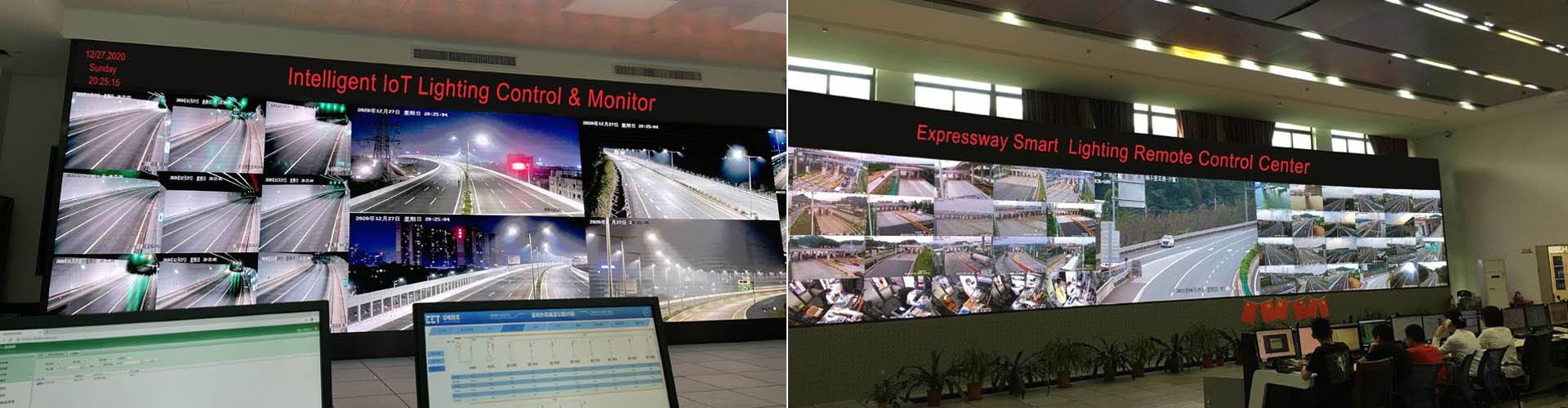
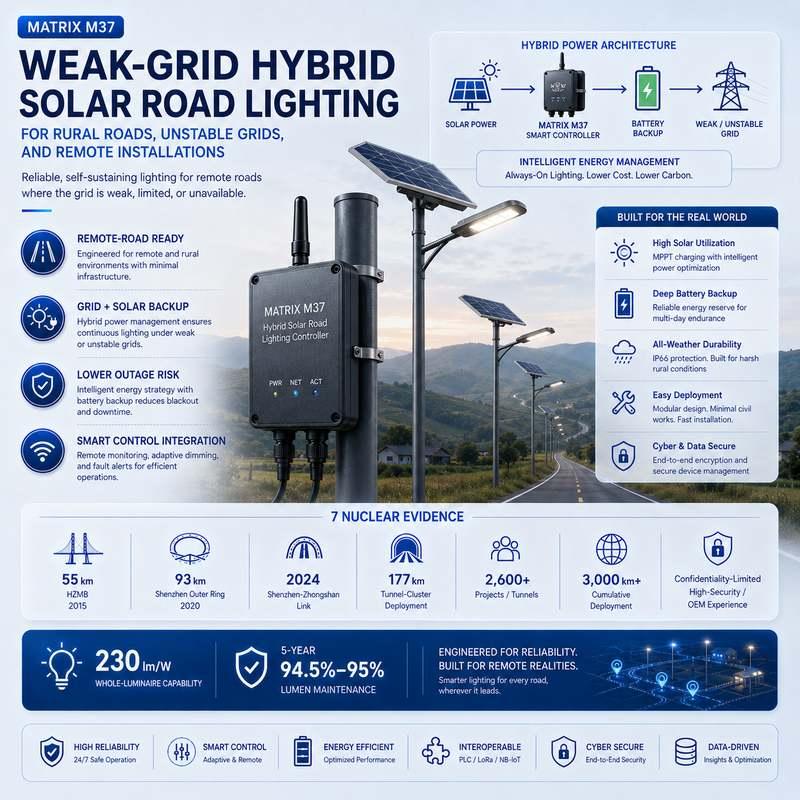
Prove worst-month autonomy first, then decide whether compatible existing solar lights can be upgraded through a controlled CAT-1 positioned retrofit pilot. CAT-1 positioned solar street lighting should prove worst-month generation, usable storage and protected night-load hierarchy before purchase. For existing fleets, a retrofit path can add communication and asset records only after a pilot confirms compatibility, battery health, driver interface and lifecycle value. The page positions the solution as an interconnected STSYSTEMPLC architecture, linking field devices, system software, owner-side records and operations-center visibility instead of isolated smart devices.
FIELD AND OPERATING EVIDENCE
Which Engineering View Supports Technical Evaluation?
Adaptive Dual CCT Auto-Changing under Rain, Fog and Snow
Review automatic lighting-state and correlated CCT changes under weather-related conditions. CCT behavior, sensor thresholds and energy policies for a current project remain subject to approved configuration.
SYSTEM DEMONSTRATION
How Can a Hybrid Solar-Grid Lighting Platform Be Demonstrated?
Hybrid Solar-Grid Street Lighting with Cloud Monitoring
Review hybrid solar-grid operation, including solar generation, grid support, battery reserve, source control and remote monitoring context. The demonstration is supporting evidence only; current-project topology, configured limits and acceptance results remain project-specific.
DIRECT ANSWER
What Should Buyers Understand First about worst-month backup and retrofit migration?
CAT-1 positioned solar street lighting should prove worst-month generation, usable storage and protected night-load hierarchy before purchase. For existing fleets, a retrofit path can add communication and asset records only after a pilot confirms compatibility, battery health, driver interface and lifecycle value. The buyer is proving worst-month autonomy and deciding whether compatible existing solar lights can be modernized instead of replaced.
ENGINEERING SUMMARY
What Makes worst-month backup and retrofit migration Different from Ordinary Catalogue Lighting?
Worst-month energy proof decides whether this pure-solar CAT-1 road light is procurement-ready. With no routine grid rescue, accepted night service must be supported by local generation, usable storage and a controlled load budget. The engineering file should begin with road geometry, required photometric result and the hours that carry the highest safety consequence. It then converts the approved dimming and sensor profile into a daily energy demand, adds controller and CAT-1 consumption, applies battery temperature and aging allowances, and compares that demand with monthly site resource rather than an annual average. The result is an autonomy policy: protected reserve, critical-hour priority, allowable low-traffic reduction, recovery behavior after poor charging and the point at which the project must be redesigned. Individual GPS keeps each energy history attached to the correct pole, while CAT-1 telemetry can expose charging recovery, battery reserve trends, night states and exceptions. Local control remains primary because the lamp must execute the accepted policy even when mobile service is absent. The design should not advertise one fixed percentage brightness, autonomy day count or battery life for every road. These values depend on optics, road class, panel area, temperature, shading, maintenance and the selected hardware. This direction is appropriate for off-grid routes, islands, rural communities, parks and sites with a realistic solar budget. It is not suitable where required light, long nights, obstruction or available panel and battery volume make the worst-month balance fragile. Procurement should require the energy model, assumptions, reserve hierarchy, acceptance records and owner-accessible performance records. A project that fails the worst-month calculation should change the geometry, load or energy architecture instead of hiding the deficit inside an unrealistic autonomy claim. Many owners already have hundreds or thousands of functioning solar street lights but lack remote visibility, accurate asset records and efficient maintenance. This CAT-1 positioned retrofit kit is intended to add individual communication and location management to compatible existing lamps without automatically replacing the luminaire, panel, battery and pole. A retrofit study should first confirm driver interface, supply voltage, available enclosure space, controller.
Procurement Boundary
Worst-month energy proof decides whether this pure-solar CAT-1 road light is procurement-ready.
Operating Context
With no routine grid rescue, accepted night service must be supported by local generation, usable storage and a controlled load budget.
Engineering Basis
The engineering file should begin with road geometry, required photometric result and the hours that carry the highest safety consequence.
Field Condition
It then converts the approved dimming and sensor profile into a daily energy demand, adds controller and CAT-1 consumption, applies battery temperature and aging allowances, and compares that demand with monthly site resource rather than an annual average.
Decision Focus
The result is an autonomy policy: protected reserve, critical-hour priority, allowable low-traffic reduction, recovery behavior after poor charging and the point at which the project must be redesigned.
PROJECT FIT, INTEGRATION AND LONG-TERM RESPONSIBILITY
Where Does worst-month backup and retrofit migration Fit Best?
Buyer Profile
Owners deciding whether existing solar lights deserve modernization or full replacement.
Best-Fit Projects
Fleets with useful poles and luminaires but weak communication, unclear asset records or unproven worst-month autonomy.
Pause Condition
Do not retrofit before battery health, driver interface, enclosure safety and communication coverage are proven.
Integration Route
Use a pilot to connect CAT-1 positioned control, battery review, driver compatibility and migration batches.
Coexistence Logic
Old and upgraded sections can coexist during staged migration if records and parameters stay separated.
Maintenance Readiness
Post-upgrade service should compare old failure patterns with new operating records.
| Buyer Question | Engineering Answer | Approval Records |
|---|---|---|
| What makes worst-month backup and retrofit migration different? | Owners deciding whether existing solar lights deserve modernization or full replacement. | Keep pilot scope, compatibility result, battery health, retrofit parameter file, migration batch and post-upgrade service history. |
| Is the claim measurable? | Run a pilot covering worst-month assumptions, battery health, controller interface, communication behavior and staged migration process. | Acceptance should prove worst-month assumptions, battery health, controller interface, communication behavior and staged retrofit migration. |
| Can the owner maintain it after handover? | Post-upgrade service should compare old failure patterns with new operating records. | Owner files should keep pilot scope, compatibility result, battery health and migration history. |
SYSTEM ARCHITECTURE
Which Layers Must Be Defined for worst-month backup and retrofit migration?
Energy Layer
Worst-month autonomy must be proven before deciding that communication upgrade alone is enough.
Control Layer
Controller replacement should preserve safe output and battery protection rather than only adding remote access.
Communication Layer
CAT-1 value is proven by field coverage, data cost and service workflow during the pilot.
Owner Layer
Owner files should keep pilot scope, compatibility result, battery health and migration history.
Protection Layer
Do not retrofit before driver interface, battery condition, enclosure safety, communication coverage and owner data value are proven.
Service Layer
Preserve pilot scope, compatibility result, battery health, retrofit parameter file, migration batch and post-upgrade service history in the owner handover file.
USE SCENARIOS
Which Field Conditions Matter Most for worst-month backup and retrofit migration?
Worst-Month Proof
Calculate autonomy from the weakest resource period before scaling quantity.
Retrofit Pilot
Test interface, battery condition and communication before citywide rollout.
Staged Migration
Upgrade compatible batches while preserving old and new service records separately.
Owner Risk Review
Do not retrofit before driver interface, battery condition, enclosure safety, communication coverage and owner data value are proven.
Field Service Context
Post-upgrade service should compare old failure patterns with new operating records.
Lifecycle Handover
Owner files should keep pilot scope, compatibility result, battery health and migration history.
PROCUREMENT DECISION MATRIX
Which Decisions Must Be Frozen for worst-month backup and retrofit migration?
| Decision Layer | Freeze Before Purchase | Risk If Missing |
|---|---|---|
| Lighting output | Match road output to worst-month backup and retrofit migration before quantity approval. | If the pilot does not prove the difficult month, retrofit savings can hide a future reserve failure. |
| Energy reserve | Worst-month autonomy must be proven before deciding that communication upgrade alone is enough. | worst-month backup and retrofit migration may fail in the first difficult season if reserve is undersized. |
| Communication | CAT-1 value is proven by field coverage, data cost and service workflow during the pilot. | Retrofit telemetry is useful only after battery health and local protection logic are proven on existing hardware. |
| Service ownership | Post-upgrade service should compare old failure patterns with new operating records. | Fault response for worst-month backup and retrofit migration becomes unclear when responsibility is not mapped. |
| Owner Decision | Municipal Engineering Requirement | Record to Keep |
|---|---|---|
| Primary buying intent | The buyer is proving worst-month autonomy and deciding whether compatible existing solar lights can be modernized instead of replaced. | The service record should retain pilot scope, compatibility result, battery health, retrofit parameter file, migration batch and post-upgrade service history for later review. |
| Reject or pause condition | Do not retrofit before driver interface, battery condition, enclosure safety, communication coverage and owner data value are proven. | Delay approval until worst-month backup and retrofit migration has a corrected technical boundary. |
| Acceptance proof | Run a pilot covering worst-month assumptions, battery health, controller interface, communication behavior and staged migration process. | Keep the witnessed worst-month backup and retrofit migration result with the accepted parameter file. |
| Lifecycle continuity | Post-upgrade service should compare old failure patterns with new operating records. | Make pilot scope, compatibility result, battery health, retrofit parameter file, migration batch and post-upgrade service history available during acceptance and maintenance transfer. |
Buying Intent
The buyer is proving worst-month autonomy and deciding whether compatible existing solar lights can be modernized instead of replaced.
Technical Boundary
Do not retrofit before driver interface, battery condition, enclosure safety, communication coverage and owner data value are proven.
Controller Behavior
Controller replacement should preserve safe output and battery protection rather than only adding remote access.
Energy Proof
Worst-month autonomy must be proven before deciding that communication upgrade alone is enough.
Field Acceptance
Run a pilot covering worst-month assumptions, battery health, controller interface, communication behavior and staged migration process.
Owner Record
Make pilot scope, compatibility result, battery health, retrofit parameter file, migration batch and post-upgrade service history available during acceptance and maintenance transfer.
Service Transfer
Post-upgrade service should compare old failure patterns with new operating records.
Claim Boundary
Do not retrofit before battery health, driver interface, enclosure safety and communication coverage are proven.
CONTROL ROUTES
How Should Control Routes Be Separated for worst-month backup and retrofit migration?
| Route | Procurement Meaning | Risk Control |
|---|---|---|
| Local controller | Controller replacement should preserve safe output and battery protection rather than only adding remote access. | Test local behavior for worst-month backup and retrofit migration before handover. |
| Energy path | Worst-month autonomy must be proven before deciding that communication upgrade alone is enough. | Record the source, threshold, schedule and recovery behavior for worst-month backup and retrofit migration. |
| Communication path | CAT-1 value is proven by field coverage, data cost and service workflow during the pilot. | Confirm coverage, credentials, data export and service responsibility for worst-month backup and retrofit migration. |
| Owner export path | Owner files should keep pilot scope, compatibility result, battery health and migration history. | Define export format, account ownership and backup cadence for worst-month backup and retrofit migration. |
OWNER RECORDS
Which Records Should Stay Readable for worst-month backup and retrofit migration?
Worst-Month Solar Street Light
Worst-Month Solar Street Light should be defined with a clear project scope, acceptance condition and handover record.
CAT-1 positioned Solar Retrofit
CAT-1 positioned Solar Retrofit belongs in the owner file only when the tested function and operating boundary are written down.
Multi-Day Battery Backup
Multi-Day Battery Backup should connect the selected hardware, control rule and service responsibility before purchase.
Retrofit Reserve Protection
Retrofit Reserve Protection needs a measurable field condition, not a catalogue phrase or unqualified autonomy promise.
Solar Street Light Modernization
Solar Street Light Modernization should remain exportable with configuration, acceptance and maintenance history after handover.
Phased Migration Pilot
Phased Migration Pilot should help the buyer separate required functions from optional monitoring or service features.
Make pilot scope, compatibility result, battery health, retrofit parameter file, migration batch and post-upgrade service history available during acceptance and maintenance transfer.
| Owner Record | Why It Matters | Minimum Field |
|---|---|---|
| Energy record | Worst-month autonomy must be proven before deciding that communication upgrade alone is enough. | Accepted energy source, output state and worst-month backup and retrofit migration timestamp. |
| Asset record | Owner files should keep pilot scope, compatibility result, battery health and migration history. | Pole, device, configuration and service fields agreed for worst-month backup and retrofit migration. |
| Service record | Post-upgrade service should compare old failure patterns with new operating records. | Reviewer, field action and recovery note for worst-month backup and retrofit migration. |
| Change record | Make pilot scope, compatibility result, battery health, retrofit parameter file, migration batch and post-upgrade service history available during acceptance and maintenance transfer. | Previous component, new component, approval and parameter restore for worst-month backup and retrofit migration. |
FAILURE AND RECOVERY
How Should Abnormal Operation Be Handled for worst-month backup and retrofit migration?
Reserve Response
Worst-month autonomy must be proven before deciding that communication upgrade alone is enough.
Communication Response
CAT-1 value is proven by field coverage, data cost and service workflow during the pilot.
Service Response
Post-upgrade service should compare old failure patterns with new operating records.
Control Recovery
Controller replacement should preserve safe output and battery protection rather than only adding remote access.
Owner Review
Owner files should keep pilot scope, compatibility result, battery health and migration history.
Claim Boundary
Do not retrofit before driver interface, battery condition, enclosure safety, communication coverage and owner data value are proven.
| Recovery Topic | Immediate Behavior | Owner Record |
|---|---|---|
| Energy reserve | Worst-month autonomy must be proven before deciding that communication upgrade alone is enough. | Pilot battery trend, protected output, charging recovery and retrofit service note. |
| Communication | CAT-1 value is proven by field coverage, data cost and service workflow during the pilot. | Pilot-return timestamp, uploaded retrofit records and old-versus-new behavior comparison. |
| Controller rule | Controller replacement should preserve safe output and battery protection rather than only adding remote access. | Retrofit parameter file, migration sequence and recovered operating state. |
| Service action | Post-upgrade service should compare old failure patterns with new operating records. | Migration owner, field action, restored retrofit state and closure record. |
FACTORY AND SITE TESTS
What Should Factory Test and Site Commissioning Prove for worst-month backup and retrofit migration?
For worst-month backup and retrofit migration, factory and site acceptance tests must prove the exact operating behavior promised to the owner: Run a pilot covering worst-month assumptions, battery health, controller interface, communication behavior and staged migration process.
| Test Stage | What to Prove | Owner Record |
|---|---|---|
| Factory test | Controller replacement should preserve safe output and battery protection rather than only adding remote access. | Retrofit setting file, pilot test result and serial-linked configuration. |
| Site test | Run a pilot covering worst-month assumptions, battery health, controller interface, communication behavior and staged migration process. | Site acceptance record, owner asset file and accepted state for worst-month backup and retrofit migration. |
| Recovery test | Post-upgrade service should compare old failure patterns with new operating records. | Migration recovery timestamp, event sequence and pilot closure note. |
| Season review | Worst-month autonomy must be proven before deciding that communication upgrade alone is enough. | Worst-month trend, reserve correction and retrofit decision history. |
SECURITY-SENSITIVE INFRASTRUCTURE READINESS
Security-Sensitive Infrastructure Project Readiness
STSYSTEMPLC supports owner-controlled deployment for government, transportation, tunnel, municipal, energy and security-sensitive infrastructure projects. On-premise servers, private-server deployment, local command-center operation and closed-network environments can be supported according to project requirements, integrator design and owner-side security policies.
RFQ QUESTIONS
Which Buyer Questions Should Be Answered for worst-month backup and retrofit migration?
Why must pure-solar sizing start with the worst resource month rather than annual sunlight?
Annual sunlight can hide the period when nights are longest and daily charging is weakest. A pure-solar lamp has no routine grid rescue, so the design must prove that the accepted light profile can survive the controlling month with realistic weather, temperature and losses. The calculation should include road photometrics, hourly output, controller and CAT-1 consumption, usable battery capacity and recovery after poor charging.
How is an autonomy policy different from a simple number of backup days?
A backup-day claim usually assumes one fixed load and can hide which hours or functions are protected. An autonomy policy defines critical lighting hours, normal operation, allowable low-traffic reduction, sensor behavior, communication duty cycle, reserve thresholds and recovery after weak charging. It explains what the lamp will do as stored energy changes. This is more useful than one catalogue number because the owner can accept the service hierarchy and later compare field records with it.
Which loads must be included beyond the nominal LED wattage?
The energy budget should include the real LED output profile, driver loss, controller consumption, CAT-1 registration and reporting, coordinate-update activity, sensors, standby current and cold or hot battery effects. Repeated communication retries in weak coverage can become meaningful on a small off-grid system. Optional functions should be listed separately so their energy is not hidden. The calculation also needs conversion loss, panel and cable loss, soiling, shading and an aging allowance.
What service hierarchy should the lamp execute when available watt-hours fall below plan?
The accepted operating charter should rank functions before deployment: conflict-point visibility and early-evening demand first; optional sensing and frequent reporting later. At each energy band, firmware follows a documented action sequence and records the transition. No technician should invent a response during an event. Because cellular service can fail alongside poor weather, the rule set must reside locally and return to normal through defined recovery stages.
Can traffic or motion sensing improve a pure-solar autonomy plan?
Sensing can improve the load profile where traffic is intermittent and the approved lighting design allows a lower standby level. It does not create energy and should not be used to justify unsafe darkness or an undersized battery. Detection range, approach time, direction, false triggers, hold time and failure behavior must be tested at the real road. The controller should retain a safe local fallback if the sensor is unavailable.
Data Sovereignty, Cybersecurity & Open Integration
How Are Worst-Month Backup Records, Retrofit Data and Owner Interfaces Governed?
Owner-Controlled Hosting
The owner can host the project on a government- or customer-controlled on-premises server, private cloud, or an approved third-party platform. STSYSTEMPLC does not require a proprietary cloud when the approved project architecture assigns hosting elsewhere. For worst-month backup and retrofit migration, the final hosting and data-residency choice should be recorded in the approved architecture.
Open Platform Integration
The integration boundary can be opened to the owner's existing platform or software team. Interface protocol, addressing, data mapping, command authority and exception handling are agreed before deployment and proven in factory or site testing for the selected project. The interface test should use the actual worst-month backup and retrofit migration data and command set. Open-protocol compatibility is verified against the project's actual interface schedule.
Cybersecurity Scope
Access and network protection should be frozen alongside the control logic. Named administrator roles, remote-support windows, network boundaries, configuration backup, event logging and project-required secure communication measures are documented so responsibility remains clear at handover.
No Mandatory Vendor Lock-In
Local controller logic, protection limits and accepted fallback behavior should continue according to the selected architecture when the central server or WAN is unavailable. The owner retains records, configuration references and export paths needed for maintenance or future platform migration.
PUBLIC CLAIM BOUNDARIES
Which Claims Should Stay Controlled for worst-month backup and retrofit migration?
| Claim Type | Acceptable Public Wording | Wording to Avoid |
|---|---|---|
| Operating claim | Run a pilot covering worst-month assumptions, battery health, controller interface, communication behavior and staged migration process. | Unverified performance language copied from a catalogue. |
| Data claim | Owner files should keep pilot scope, compatibility result, battery health and migration history. | Retrofit records that the owner cannot export after supplier change. |
| Recovery claim | Post-upgrade service should compare old failure patterns with new operating records. | A vague service promise is not enough for worst-month backup and retrofit migration. |
| Compatibility claim | Do not retrofit before battery health, driver interface, enclosure safety and communication coverage are proven. | Retrofit wording that ignores battery health, enclosure safety, controller interface or staged migration. |
Battery Boundary
Worst-month autonomy must be proven before deciding that communication upgrade alone is enough.
Communication Boundary
CAT-1 value is proven by field coverage, data cost and service workflow during the pilot.
Data Boundary
Owner files should keep pilot scope, compatibility result, battery health and migration history.
Compatibility Boundary
Do not retrofit before battery health, driver interface, enclosure safety and communication coverage are proven.
OWNER DECISION CHECKLIST
What Should the Owner Freeze before Purchasing worst-month backup and retrofit migration?
STSYSTEMPLC treats pure-solar autonomy as a service obligation that must be calculated, configured and observed at pole level. The company combines road-lighting photometrics, efficient luminaires, MPPT charging, LiFePO4 storage, local control, CAT-1 telemetry and individual positioning, but no component is allowed to substitute for a credible worst-month energy budget. The design process separates required road light from optional connected functions, then assigns energy priority across critical hours, normal hours, low-traffic periods, communications and sensors. Battery usable capacity is adjusted for temperature, depth of discharge, conversion loss and expected aging. Solar input is reviewed by month, panel orientation, shading and soiling assumptions. The controller implements the accepted reserve hierarchy locally and can retain selected events during a network interruption. Telemetry helps the owner compare actual recovery and battery reserve behavior with the design model without claiming that monitoring creates energy. STSYSTEMPLC also keeps the rejection boundary visible. Where the available panel area, battery volume or site resource cannot support the required photometric service, the proposal should change pole geometry, optics, operating profile or power architecture. For connected fleets, individual positioning ensures that performance records, configuration and maintenance history remain attached to the correct pole. The approved package can include model assumptions, configuration records, low-resource response, battery-health review, data export and service responsibility. Claims about autonomy, efficacy, battery life or sensing remain linked to selected equipment and project conditions. This engineering discipline makes pure-solar procurement measurable while avoiding the Hybrid AC + Solar logic of scheduled mains support, tariff windows or blackout transfer. STSYSTEMPLC's retrofit approach starts from the condition.
Freeze Energy Strategy
Worst-month autonomy must be proven before deciding that communication upgrade alone is enough.
Freeze Acceptance Method
Run a pilot covering worst-month assumptions, battery health, controller interface, communication behavior and staged migration process.
Freeze Data Rights
Owner files should keep pilot scope, compatibility result, battery health and migration history.
Freeze Service Response
Post-upgrade service should compare old failure patterns with new operating records.
RELATED ENGINEERING ENTRY POINTS
Which Search Paths Should Support worst-month backup and retrofit migration?
STRATEGIC PARTNER-BRANDED TECHNOLOGY SUPPORT
Strategic Partner-Branded Technology Support
STSYSTEMPLC supports long-term strategic partners with partner-branded solution packaging, technical documentation, system integration support and owner-controlled deployment options for government, transportation, tunnel, energy and security-sensitive infrastructure projects.
Send Project Inputs for STSYSTEMPLC Engineering Review
Share the road layout, pole height, spacing, target lighting level and operating constraints that define worst-month backup and retrofit migration.