
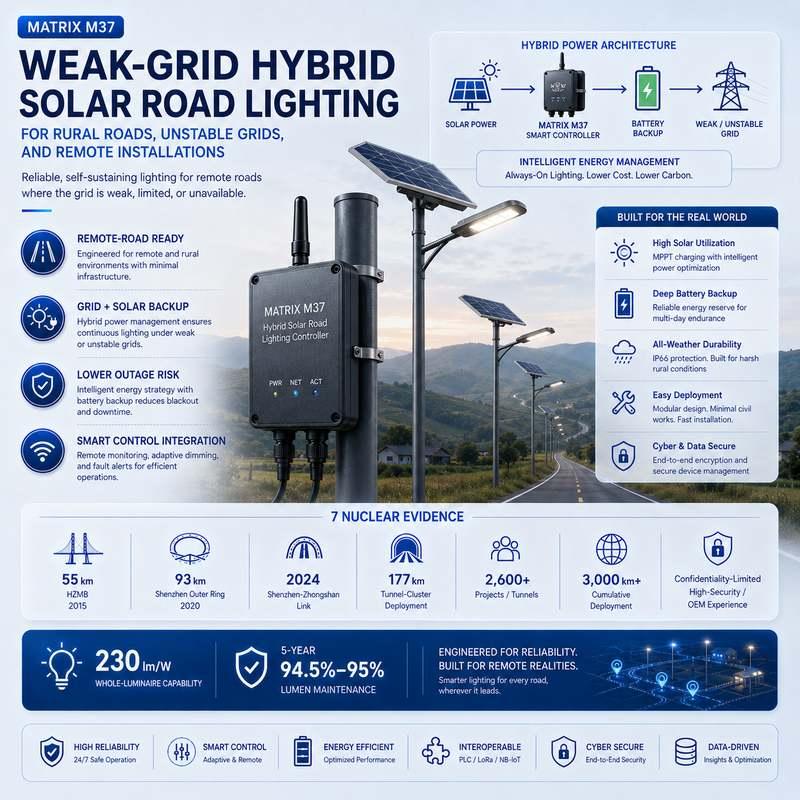
STSYSTEMPLC provides an engineering-grade Solar Street Light Battery Takeover for roads that must retain priority lighting after grid loss. Utility-loss detection, battery-supported output and protected reserve are defined as tested operating states.
Grid-Loss Lighting Control separates critical road zones, safe-mode dimming, manual authority and recovery sequence. It also distinguishes a true utility failure from cable damage, tamper events or a communication interruption.
Factory Test & Site Commissioning should interrupt the grid, verify takeover time, priority scenes and restoration. The owner receives event order, reserve thresholds, returned states and service closure evidence.
For qualified strategic partners, STSYSTEMPLC can support Partner-Branded Solution Packaging and Owner-Controlled Deployment for Security-Sensitive Infrastructure Projects.
Define grid-loss behavior as a tested road-lighting state, not an undefined backup claim. The controller should confirm utility loss, transfer priority roads to battery-supported output and preserve owner-accessible records for blackout response, tamper-aware incident checks, safe-lighting mode and recovery. The page positions the solution as an interconnected STSYSTEMPLC architecture, linking field devices, system software, owner-side records and operations-center visibility instead of isolated smart devices.
FIELD AND OPERATING EVIDENCE
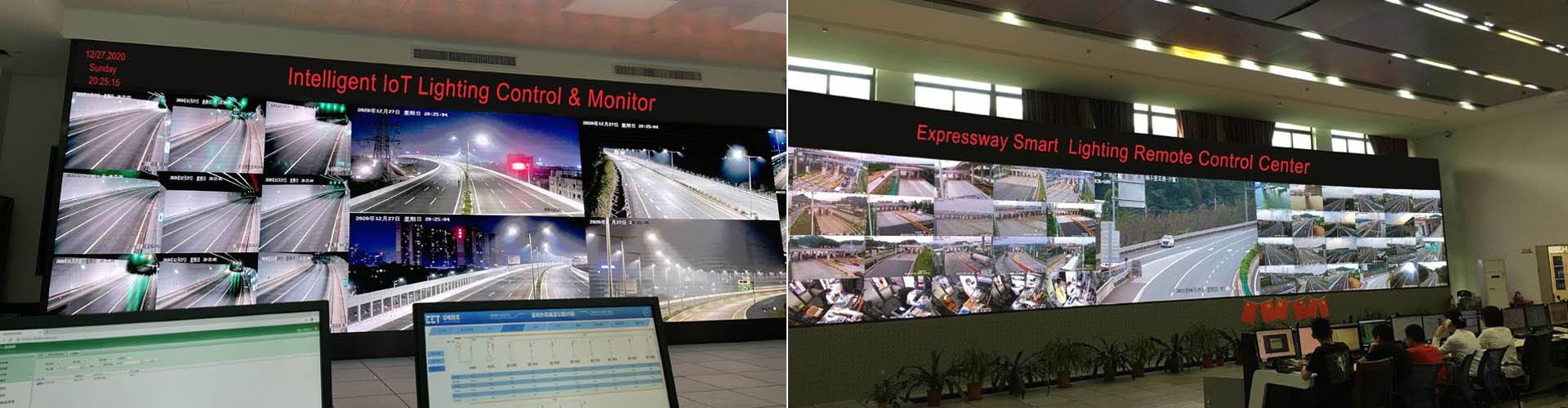
Review historical roadway-scale evidence for corridor zoning, interconnected intelligent lighting cabinets, communication routes and owner-visible operating records. Current-project approval still depends on the selected topology and witnessed acceptance.
Google Direct Answer
A hybrid solar-grid street light should switch to battery-supported lighting only after confirmed grid loss, then protect priority roads, hospital access, school routes and night-market streets with a defined safe-lighting profile. STSYSTEMPLC treats takeover speed, reserve threshold, local control and recovery records as acceptance items, so owners can verify what happened after the utility failed.
SYSTEM DEMONSTRATION
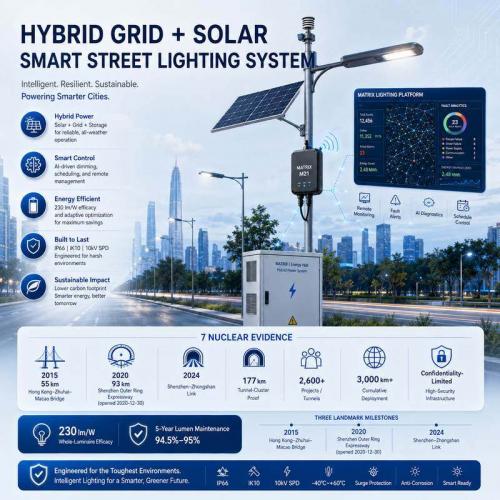
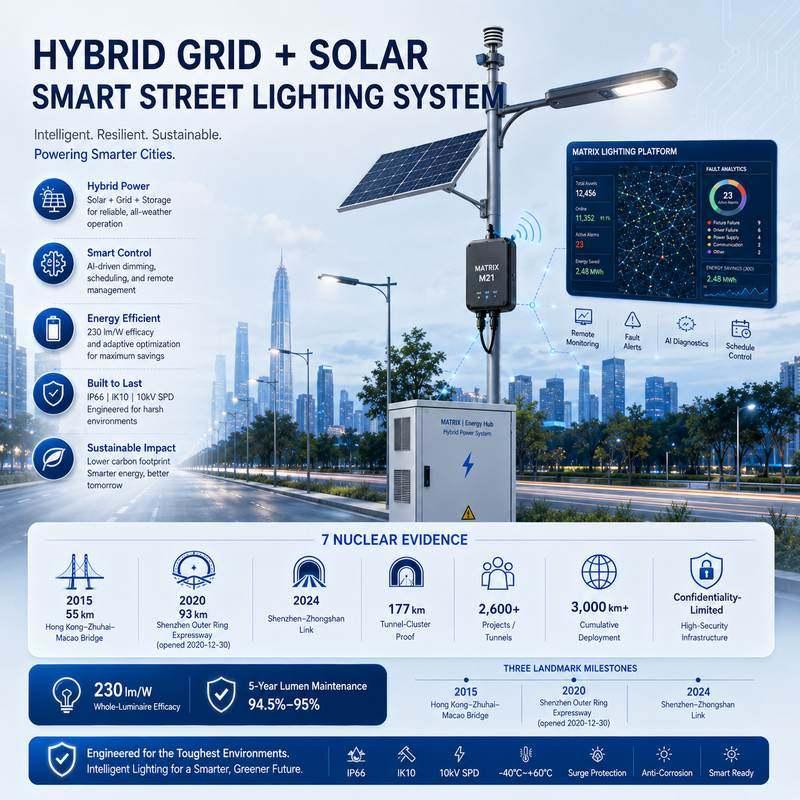
Review hybrid solar-grid operation, including solar generation, grid support, battery reserve, source control and remote monitoring context. The demonstration is supporting evidence only; current-project topology, configured limits and acceptance results remain project-specific.
Project Fit
Unstable-grid municipal roads
Bridge approaches and hospital access roads
Industrial roads requiring safe output after utility loss or cable tampering
Hybrid solar-grid pilots in outage-prone cities
Projects expecting full-power lighting through every outage
Sites without a defined priority-road map
Solar-only projects without an AC grid input
Architecture and Control Boundary
For grid-loss roads, STSYSTEMPLC separates outage confirmation, battery takeover, road-priority dimming, local fallback, vandalism-related tamper signals and post-recovery records. The system should avoid false transfer caused by short voltage dips, keep accepted lighting locally when communication is unavailable and document the returned operating state after grid recovery.
Define ownership, permitted values and the field condition that proves this layer is working.
Tie this control point to the accepted site condition, not only to a catalogue capability.
Keep the boundary clear so local safety, platform supervision and service responsibility do not conflict.
Make this layer testable during handover, with a record the owner can reuse during later maintenance.
Confirm how the setting behaves during interruption, recovery and supplier transition.
Operating Scenarios
| Scenario | Required Behavior | Owner Record |
|---|---|---|
| Scenario 1: Short voltage dip | Wait for confirmation before transfer | Record dip, ignored transfer and normal lighting state |
| Scenario 2: Confirmed grid loss or blackout | Move priority sections to battery-supported output | Record transfer time, output level and reserve state |
| Scenario 3: Tamper or cable-cut signal | Keep accepted safe-lighting behavior where the supplied hardware supports it | Record supplied tamper input, last contact and field action |
| Scenario 4: Low battery during outage | Apply safe-lighting mode before deep discharge | Record threshold, dimming level and recovery need |
Monitoring
Use this state to compare the accepted design with actual road behavior.
Keep the timestamp, source condition and restored operating state visible for service analysis.
This value helps separate energy shortage, equipment fault, wrong setting and communication delay.
Owners should be able to export this record before warranty or contractor discussions.
Deployment Routes
| Route | Engineering Control | Owner Record |
|---|---|---|
| Field boundary | Map the poles, power source, traffic risk and service authority before controller settings are approved for Grid-Loss Lighting Takeover. | Boundary file tied to the selected zones and owner roles for confirmed grid-loss takeover and priority-road battery reserve. |
| Controller proving | Test the behavior most likely to fail under the local grid, solar, communication or service condition for Grid-Loss Lighting Takeover. | Measured result, exception list and accepted correction path for confirmed grid-loss takeover and priority-road battery reserve. |
| Zone release | Apply the accepted rule by road section instead of releasing the full fleet in one blind step for Grid-Loss Lighting Takeover. | Released zone, configuration group and unresolved exception list for confirmed grid-loss takeover and priority-road battery reserve. |
| Service handover | Move credentials, settings, records and support routes to the party responsible for long-term operation for Grid-Loss Lighting Takeover. | Export package, account authority and maintenance contact route for confirmed grid-loss takeover and priority-road battery reserve. |
Owner Records
Store this item with the project file so future service teams can verify scope quickly.
Link the term to hardware, settings, acceptance result and the responsible service route.
Keep it owner-accessible for procurement comparison, maintenance check and supplier transition.
Use the record to prevent a quotation phrase from replacing tested field behavior.
Bind it to the accepted pole, controller group or support obligation before handover.
Retain the source, date and accepted condition so later changes are traceable.
SECURITY-SENSITIVE INFRASTRUCTURE READINESS
STSYSTEMPLC supports owner-controlled deployment for government, transportation, tunnel, municipal, energy and security-sensitive infrastructure projects. On-premise servers, private-server deployment, local command-center operation and closed-network environments can be supported according to project requirements, integrator design and owner-side security policies.
Failure and Recovery
| Condition | Required Behavior | Owner-Accessible Record |
|---|---|---|
| Short voltage dip | Wait for confirmation before transfer | Record dip, ignored transfer and normal lighting state |
| Confirmed grid loss or blackout | Move priority sections to battery-supported output | Record transfer time, output level and reserve state |
| Tamper or cable-cut signal | Keep accepted safe-lighting behavior where the supplied hardware supports it | Record supplied tamper input, last contact and field action |
| Low battery during outage | Apply safe-lighting mode before deep discharge | Record threshold, dimming level and recovery need |
| Grid returns unstable | Delay retransfer until stable condition is proven | Record grid return, hold time and restored operating state |
Factory Test and Site Commissioning
Factory and site acceptance tests should simulate confirmed grid loss, short dips, extended outage, tamper or cable-cut input, low-reserve protection and stable grid return. The owner should receive takeover timing, output state, reserve threshold and recovery records.
Data Sovereignty, Cybersecurity & Open Integration
Server location and data residence can remain under the owner's control: local server, private cloud, or an approved external platform can be selected by project. A mandatory STSYSTEMPLC cloud is not a condition of the hardware architecture. For grid-loss battery takeover and priority lighting, the final hosting and data-residency choice should be recorded in the approved architecture.
Hardware and edge devices can be integrated into an owner or third-party platform through agreed open interfaces. Compatibility is established against the actual protocol version, data dictionary, command rights and test cases used by the project; it is not treated as an undefined generic API claim. The interface test should use the actual grid-loss battery takeover and priority lighting data and command set. Open-protocol integration is tested against the owner-selected platform, protocol version and data-point list.
Cybersecurity responsibilities are separated between STSYSTEMPLC, the owner, EPC, telecom provider and platform integrator. Accounts, remote access, network zones, backups, logs and any required secure-connection method must be assigned in writing and verified within the accepted project scope.
Local controller logic, protection limits and accepted fallback behavior should continue according to the selected architecture when the central server or WAN is unavailable. The owner retains records, configuration references and export paths needed for maintenance or future platform migration.
Technical Boundaries
| Boundary | Project Condition | Control Rule |
|---|---|---|
| Operating boundary | Projects expecting full-power lighting through every outage | Keep this pause condition visible for confirmed grid-loss takeover and priority-road battery reserve. |
| Data boundary | Grid loss and return time | The owner should retain records that explain the returned field state. |
| Service boundary | Recovery and transfer records | Responsibility must be assigned before site handover. |
| Acceptance boundary | Factory and site acceptance tests should simulate confirmed grid loss, short dips, extended outage, tamper or cable-cut input, low-reserve protection and stable grid return. The owner should receive takeover timing, output state, reserve threshold and recovery records. | Do not convert Grid-Loss Lighting Takeover into an unconditional catalogue promise. |
Owner Decisions
A hybrid solar-grid street light should switch to battery-supported lighting only after confirmed grid loss, then protect priority roads, hospital access, school routes and night-market streets with a defined safe-lighting profile.
Records should cover grid loss and return time and recovered state after utility return or incident clearance.
The accepted file should name who acts when short voltage dip occurs.
Factory and site acceptance tests should simulate confirmed grid loss, short dips, extended outage, tamper or cable-cut input, low-reserve protection and stable grid return. The owner should receive takeover timing, output state, reserve threshold and recovery records.
FAQ
The project should define a tested takeover window and the exact condition that counts as confirmed grid loss. The goal is not a slogan, but a repeatable state change with recorded timing, output level and recovery result.
Short dips can create unstable switching if the controller reacts too quickly. A reliable hybrid design filters brief disturbances, confirms utility loss and then transfers the lighting load according to the accepted road-priority rule.
The owner should keep grid-loss time, transfer time, battery reserve, output profile, road priority, tamper or cable-cut event, grid-return time and restored operating state. These records support service analysis after real outages.
No. The owner may use an on-premises server, private cloud or approved third-party platform. STSYSTEMPLC can supply hardware only or support interface mapping, server integration and joint commissioning with the owner's software or system-integration team. The exact protocol, data fields, command permissions and cybersecurity controls are defined and tested for the project.
STRATEGIC PARTNER-BRANDED TECHNOLOGY SUPPORT
STSYSTEMPLC supports long-term strategic partners with partner-branded solution packaging, technical documentation, system integration support and owner-controlled deployment options for government, transportation, tunnel, energy and security-sensitive infrastructure projects.
Send the site condition, pole quantity, power source, controller requirement, communication route, service responsibility and the factory and site acceptance test items required for confirmed grid-loss takeover and priority-road battery reserve.

Address : F4,Bldg A, Hanzhong Industrial Park, No.67, North of Xinsha Ave, Xin Tang, Zeng Cheng, Guang Zhou, China
Tel : +86 20 8278 0427
Email : info@stsystemplc.com
Email : morrison426@163.com