


Solar Priority
Use available photovoltaic energy first where the approved project strategy requires lower grid dependence.
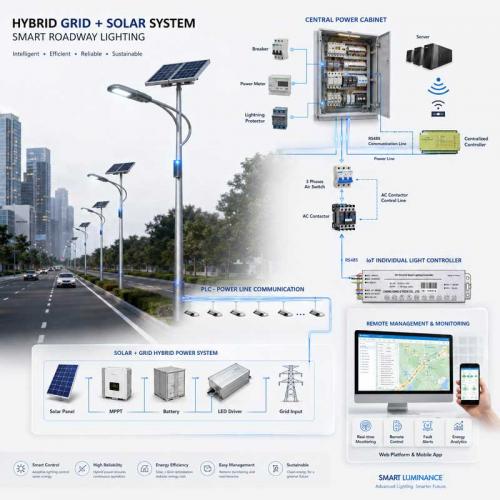
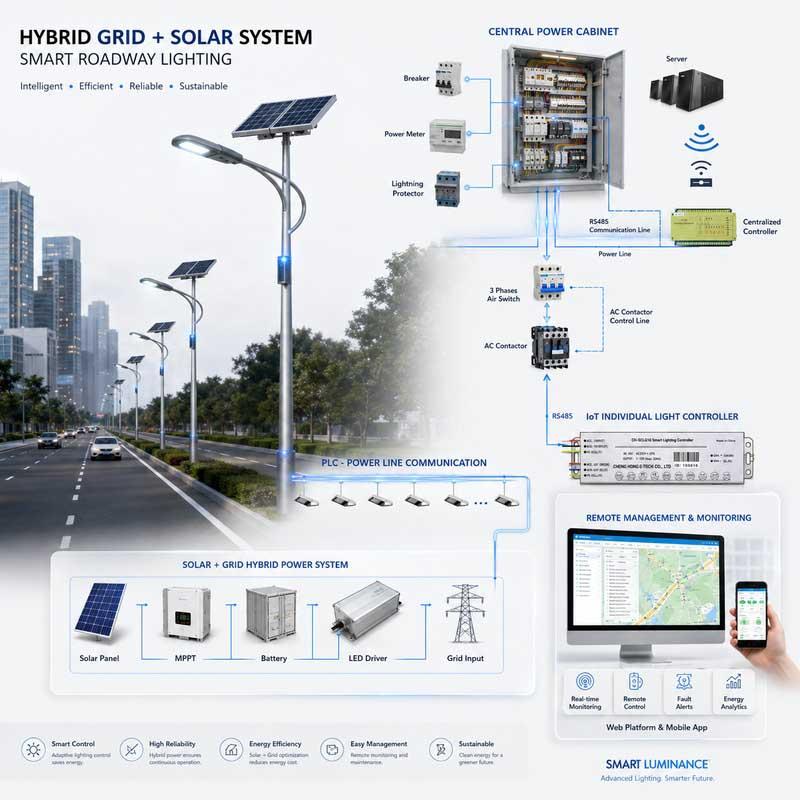
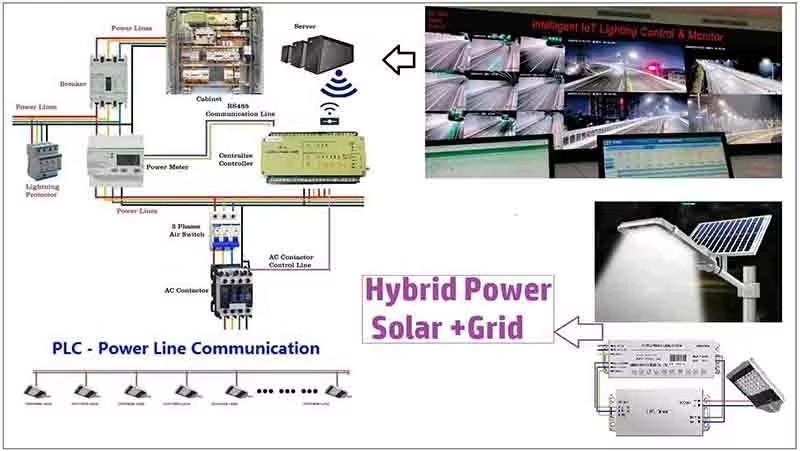
A hybrid solar street light with off-peak grid charging combines solar generation, LiFePO4 battery storage, grid backup, and lamp-level control in one configurable road-lighting system. It is designed for projects where solar energy alone may be insufficient during consecutive cloudy or rainy days.
During normal conditions, the system prioritizes solar energy and manages battery charging according to the configured strategy. Where time-of-use tariffs are available, the grid can charge the battery during selected low-tariff nighttime periods and provide backup support during low battery conditions, unstable grids, or insufficient solar generation.
Depending on the selected controller and sensing configuration, operators can monitor lamp status, grid availability, battery voltage, charging conditions, energy use, and communication status through a centralized IoT platform. Remote switching, dimming, scheduling, alarms, and maintenance records can be configured for individual lights or lighting groups. Battery capacity, switching logic, charging windows, dimming schedules, and communication interfaces should be configured according to local tariffs, solar conditions, lighting requirements, and project regulations.
The STSYSTEMPLC mission-critical hybrid solar-grid street lighting system orchestrates photovoltaic energy harvesting, LiFePO4 energy storage reserves, intelligent grid-tie support, and granule-level luminaire telemetry for infrastructure plagued by erratic solar irradiance, extended inclement weather, unstable utility grids, or dynamic time-of-use (TOU) tariffs. Its deterministic operating strategy dynamically prioritizes renewable solar power, recharges storage reserves during validated off-peak utility windows, and safeguards uninterrupted illumination through rigorous transfer, system protection, and fail-safe recovery logic.
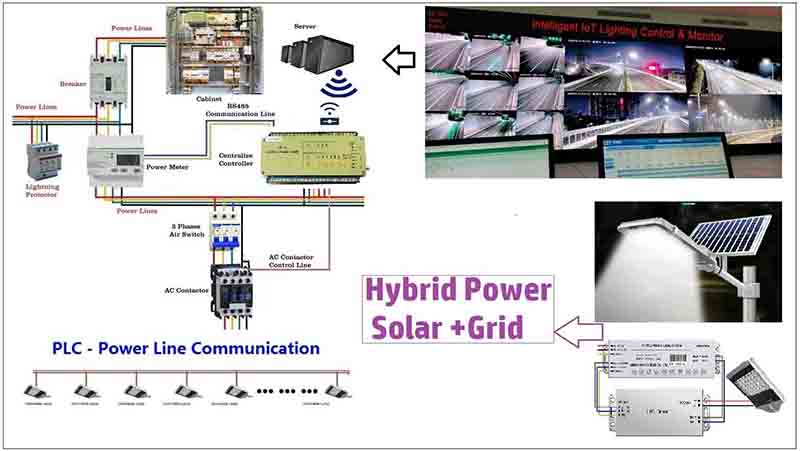
STSYSTEMPLC hybrid solar-grid street lighting configuration for controlled solar charging, battery reserve, grid support and road-lighting continuity.
During daylight, the photovoltaic array charges the battery through MPPT control. At night, the battery, grid or an approved combination supplies the lighting load according to reserve thresholds, tariff windows, protected lighting groups and the owner’s continuity policy.
Grid charging is allowed only within confirmed utility periods and electrical limits. Battery-temperature protection, charging limits, low-voltage protection and stable grid-recovery logic remain active. Returned records should separate photovoltaic input, grid state, battery condition, lighting output, charging events and authorized configuration changes.
The system is structured around owner outcomes first, by the engineering controls and records required to verify them.
Use available photovoltaic energy first where the approved project strategy requires lower grid dependence.
Restore battery reserve only during confirmed lower-tariff periods and within battery and grid limits.
Prioritize defined road-lighting groups and minimum output when grid or solar conditions deteriorate.
Use confirmed grid recovery and anti-chatter delay to avoid repeated transfer during unstable utility return.
Return configured grid, photovoltaic, battery, lamp and energy records for operations and maintenance.
Coordinate retained assets, controllers, cabinets, software and third-party interfaces within an approved scope.
Urban or regional roads where interruptions, brownouts or unstable recovery make grid-only lighting unreliable.
Roads where consecutive cloudy or rainy days require controlled reserve restoration beyond solar-only operation.
Projects permitted to charge during verified lower-tariff periods while avoiding uncontrolled peak-time charging.
Priority roads, junctions, corridors or critical access routes that require defined protected lighting groups.
Projects that may retain suitable poles, luminaires, cabinets, meters or networks after condition and compatibility review.
Campuses, industrial parks, logistics routes and remote infrastructure needing central records and local fallback.
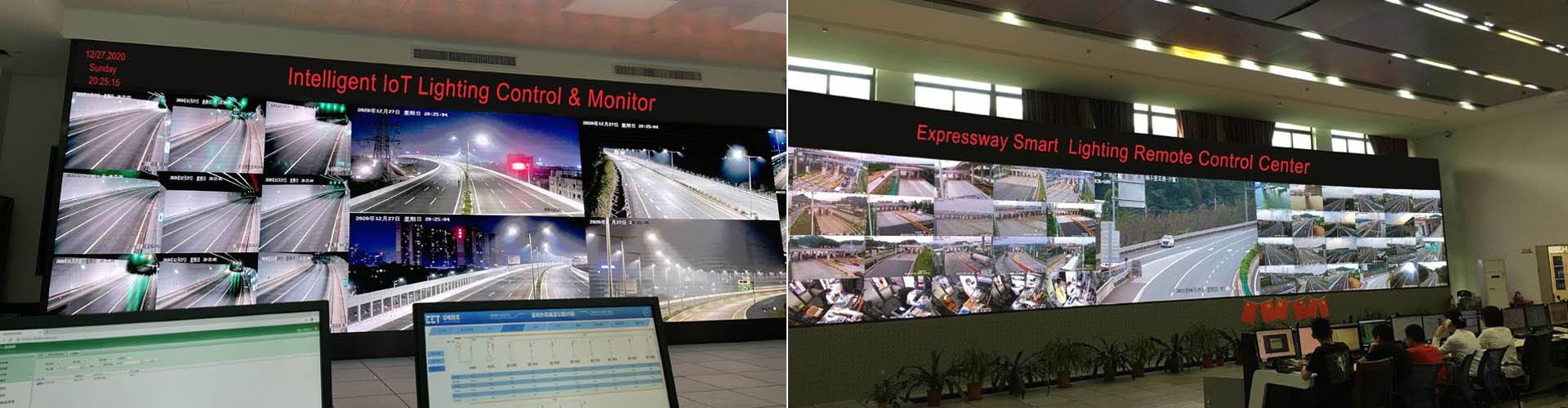
The video demonstrates STSYSTEMPLC adaptive lighting control under rain, fog and snow, showing how operating conditions can be monitored and lighting strategies adjusted for difficult weather. It supports broader smart-lighting engineering experience but does not independently verify the battery autonomy, off-peak charging schedule, transfer time or grid-recovery performance of a specific hybrid solar-grid project.
| Operating Route | Best Project Fit | Required Confirmation |
|---|---|---|
| Solar Priority with Off-Peak Grid Charging | Roads where solar energy supports normal operation and the grid restores battery reserve during confirmed lower-tariff periods. | Utility tariff window, grid availability, battery charging limit, nightly lighting load and expected solar yield. |
| Solar Priority with Grid Support | Regions with long rainy seasons, weak solar generation or a requirement for dependable all-night road lighting. | Battery autonomy, consecutive-rainy-day policy, grid-support threshold and adaptive power reduction. |
| Grid Priority with Battery Backup | Priority roads where utility interruptions and voltage instability are the main continuity risks. | Grid-state detection, permitted transfer delay, stable recovery time and protected lighting groups. |
The photovoltaic array charges the battery through MPPT control. Weather, shading, dust, wiring loss and panel condition must be separated when charging is weaker than expected.
Grid charging is enabled only within confirmed tariff periods, electrical limits and battery-protection rules. Local time, time zone and utility schedules must be verified.
Voltage, current, temperature, charge limits and reserve thresholds support low-voltage protection, deep-discharge prevention and controlled recovery.
Required road groups and minimum lighting levels receive priority. Configured power reduction can extend reserve without silently disabling priority loads.
Configured systems can return grid, photovoltaic, battery, lamp and energy events for remote control, monitoring, reporting and maintenance response.
Recovery confirmation and anti-chatter delay prevent repeated switching when utility power returns briefly but remains unstable.
| Energy or Control Layer | Recommended Returned Information | Owner Value |
|---|---|---|
| Grid | Voltage state, interruption, brownout, recovery, charging window and transfer events. | Confirms whether grid support and recovery follow the configured operating policy. |
| Photovoltaic Input | PV power, charging current, expected yield and weak-charging indicators. | Separates low solar resource from dust, shading, wiring, controller or battery-acceptance issues. |
| Battery | Available reserve, health indicators, voltage, current, temperature and protection events. | Supports reserve verification, protection review and planned replacement. |
| Lighting Load | Operating status, dimming level, protected groups, power consumption and continuity records. | Shows whether energy decisions preserve the required road-lighting outcome. |
| Operator and Configuration | Authorized changes, charging schedules, thresholds, manual overrides and configuration backups. | Maintains traceability and prevents unexplained operating-policy changes. |
The monitoring and control design should define data ownership, local fallback, operator authority and third-party access before software or communication options are approved.
Confirm which grid, photovoltaic, battery, lamp, alarm, energy and maintenance fields are collected, how often they are returned and how long records are retained.
Define who can view status, acknowledge alarms, change schedules, modify thresholds, issue manual commands and approve configuration changes.
When communications or the central platform are unavailable, approved schedules, protection limits and protected lighting behavior should continue locally.
Authorized changes, manual overrides, charging schedules, source priorities and configuration backups should remain attributable and reviewable.
Standard, optional and customized interfaces must be separated in the approved scope. Existing meters, cabinets, luminaires and platforms require compatibility review.
Network segmentation, remote-access rules, authentication, account lifecycle, data ownership, update policy and incident responsibilities must follow the owner’s IT/OT requirements.
Configured analytics can compare expected nightly demand, recent solar yield, available battery reserve and the next permitted charging window to support operator planning.
Trend analysis can flag charging patterns that differ from weather, photovoltaic input or battery behavior, helping technicians investigate the correct subsystem first.
Battery, photovoltaic, controller and communication records can be ranked for review so that limited maintenance resources focus on assets with stronger evidence of deterioration.
Repeated brownouts, missed charging windows and unstable recovery events can be grouped to support utility coordination and operating-policy review.
| Risk Condition | Required Control | Witness Method |
|---|---|---|
| Grid Unavailable during the Charging Window | Skip unsafe grid charging, preserve available reserve and report the event without uncontrolled switching. | Remove or weaken grid input during the configured period and review the returned state and lighting response. |
| Premature Grid Retransfer | Use stable confirmation time and anti-chatter logic before transferring to the recovered source. | Simulate brief recovery by another interruption and confirm that repeated switching is prevented. |
| Insufficient Battery Reserve | Apply configured load priority, power reduction, low-voltage protection and deep-discharge prevention. | Lower available reserve and confirm protected groups, dimming levels, alarms and restart conditions. |
| Weak Photovoltaic Charging | Separate weather, shading, panel dust, wiring loss, controller behavior and battery acceptance before assigning the cause. | Compare photovoltaic input, charging current, weather conditions and battery response over the agreed observation period. |
| Tariff Schedule Mismatch | Verify local time, time zone, daylight-saving rules where applicable and the confirmed utility tariff window. | Review controller time records and confirm that charging starts and stops only within the configured period. |
| Battery Aging Hidden by Grid Support | Trend charge and discharge behavior, repeated low-reserve events and capacity-related performance. | Confirm the replacement threshold, evidence method and responsible party before reserve becomes inadequate. |
The video presents a 93 km smart road and tunnel lighting deployment and demonstrates STSYSTEMPLC experience in large-scale system integration, centralized monitoring, field commissioning and long-corridor operation. The final hybrid solar-grid configuration must still be confirmed through project-specific drawings, battery and photovoltaic calculations, controller settings, event records, FAT/SAT procedures and witnessed site tests.
Collect the nightly load, operating hours, tariff periods, utility-interruption history, solar resource, consecutive-rainy-day target, battery requirement and ambient-temperature range.
Confirm solar priority, grid priority or policy-based hybrid operation together with charging windows, reserve thresholds, protected loads and recovery delays.
Select a pole, circuit or road section where photovoltaic yield, battery reserve, grid weakness, load behavior and communications can be observed together.
Verify photovoltaic input, scheduled grid charging, battery protection, low-reserve behavior, grid-loss detection, stable recovery, returned states and controlled restart.
Witness the configured operating route under representative site conditions and confirm alarms, lighting response, returned data and operator permissions.
Deliver confirmed settings, wiring drawings, access rights, software identification, operating records, spare-parts list, maintenance duties and recovery instructions.
| Project Claim | Required Record | Owner-Readable Confirmation |
|---|---|---|
| Off-Peak Nighttime Grid Charging | Utility tariff period, controller schedule, charging settings and timestamped charging record. | Confirm that charging starts and stops only inside the configured low-tariff window. |
| Battery Backup | Lighting load, battery capacity, reserve threshold, temperature range and discharge record. | Confirm the agreed lighting duration and protected loads under the specified conditions. |
| Stable Grid Recovery | Grid voltage trace, recovery confirmation time, event log and transfer settings. | Confirm that brief or unstable grid return does not cause repeated switching. |
| Consecutive-Rainy-Day Operation | Solar resource, expected yield, battery sizing, power-reduction strategy and weather context. | Confirm the autonomy basis and lighting response when reserve decreases. |
| Remote Control and Monitoring | Returned data list, alarm records, user permissions, screenshots and export files. | Confirm the required fields, access roles, reporting interval and operator workflow. |
Use these existing STSYSTEMPLC resources for technical review, hardware selection, architecture discussion, consultant coordination and project acceptance planning.
Access available brochures, technical files, project videos and engineering evidence from the website download center.
Open Download CenterReview the CH-800 centralized controller technical specification for gateway and cabinet-level system discussion.
Download CH-800 PDFReview the SLC810 data sheet and the related product page for lamp-level control, metering and project integration.
Download SLC810 PDFReview cloud or on-premises architecture, CH-800 gateways, SLC810/SLC910 controllers, PLC + LoRA networking and project evidence.
Open System ArchitectureReview cabinet-level monitoring, electrical integration and retained-infrastructure considerations for road-lighting projects.
Open Cabinet DocumentationReview the two separated evidence videos on this page before architecture, pilot and acceptance discussions.
Watch Project EvidenceDocument availability and revision should be confirmed during quotation. Product pages and general brochures support engineering review but do not replace the approved project specification, drawings, bill of materials, interface list or FAT/SAT records.
Before battery, photovoltaic and controller capacity are selected, confirm the operating load, energy-source policy, site conditions, integration scope and acceptance requirements.
In your inquiry or project message, please describe the road type, project location, number of lights, lamp wattage, nightly operating hours, available grid voltage, local electricity tariff periods, power-interruption history, monthly solar conditions and required consecutive-rainy-day backup. Please also identify the required lighting levels, battery autonomy, communication method, monitoring fields, existing equipment, third-party interfaces, local technical standards and expected FAT, SAT, training and handover requirements.
Photos, drawings, utility records, lighting calculations and existing equipment specifications will help STSYSTEMPLC prepare a more accurate engineering review. Please place these requirements in the inquiry or Leave A Message form immediately below this product detail so the technical team can respond to the actual project conditions.
The STSYSTEMPLC CH SOLARST220EFF configuration combines photovoltaic generation, LiFePO4 battery storage, LED road lighting and controlled grid input within one coordinated energy strategy. Solar energy normally contributes to battery charging, while approved low-tariff grid periods can restore reserve when solar generation is insufficient. The final photovoltaic array, battery capacity, charging current, lighting profile and control settings must be selected according to the road load, local climate, utility conditions and required continuity.
The operating route is configured from the owner’s approved energy strategy rather than from one fixed factory sequence. Available solar generation, battery reserve, battery temperature, lighting demand, grid condition and permitted tariff windows are evaluated against configured thresholds. Depending on the project, the system may use solar priority with scheduled grid charging, solar priority with grid support, or grid priority with battery backup. Source priority and protection limits must be confirmed during design and acceptance.
It can be engineered to maintain protected lighting loads during utility interruptions and periods of weak solar generation, but the available duration is not a universal catalogue value. Continuity depends on the actual nightly load, approved dimming profile, battery capacity, usable reserve, temperature, photovoltaic yield and outage duration. Critical road groups and minimum lighting levels should be identified before sizing, and the agreed response should be verified through FAT, SAT and representative discharge tests.
STSYSTEMPLC requires the nightly lighting load, operating schedule, luminaire quantity and wattage, road-lighting requirements, monthly solar resource, panel orientation, shading conditions, ambient-temperature range, grid voltage, tariff periods, interruption history and consecutive-rainy-day target. The owner should also define protected lighting groups, minimum permitted output, charging limits, required monitoring fields and expected battery-replacement criteria. Without these inputs, autonomy and energy-cost estimates remain preliminary.
Existing equipment may be retained where its electrical condition, protection, communications, ownership and interface compatibility are confirmed. The project review should identify which luminaires, cables, poles, cabinets, meters, controllers and software platforms remain suitable and which layers require replacement or upgrading. Interfaces and third-party integration can be configured according to local regulations, technical standards, owner requirements and the approved project scope; no listed protocol is included by default.
Verification should begin with approved energy calculations, single-line diagrams, battery and photovoltaic sizing, operating modes, tariff schedules, protection limits and source-transfer logic. Factory acceptance testing should confirm charging windows, battery protection, grid-loss detection, low-reserve response, stable recovery, returned data and controlled restart. Site acceptance testing should then verify representative field operation, lighting performance, alarms, user permissions and communication-loss behavior. Handover should include confirmed settings, drawings, access rights, records, spares and maintenance responsibilities.

Address : F4,Bldg A, Hanzhong Industrial Park, No.67, North of Xinsha Ave, Xin Tang, Zeng Cheng, Guang Zhou, China
Tel : +86 20 8278 0427
Email : info@stsystemplc.com
Email : morrison426@163.com