


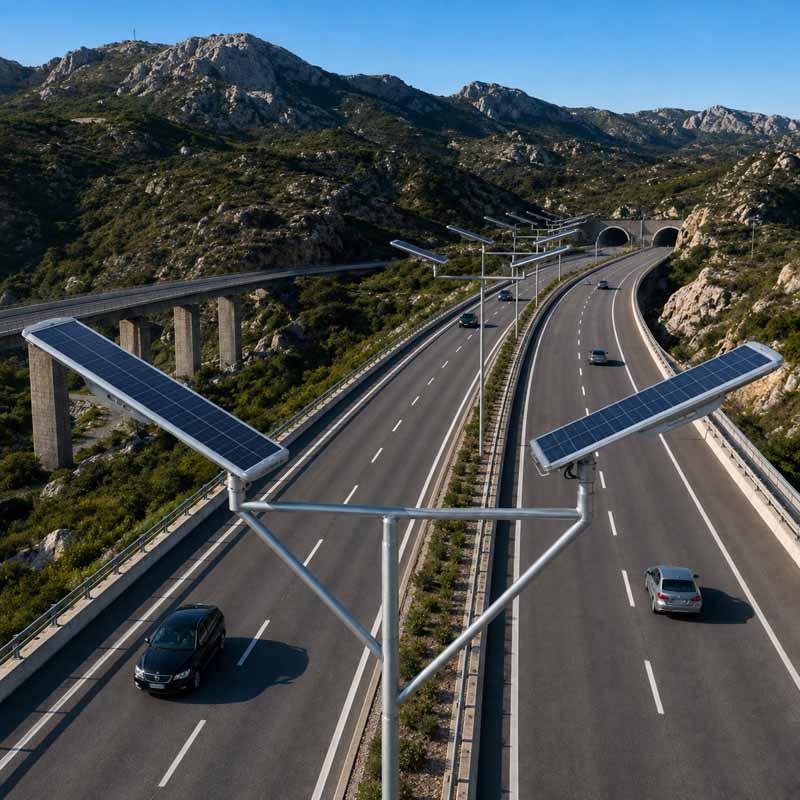
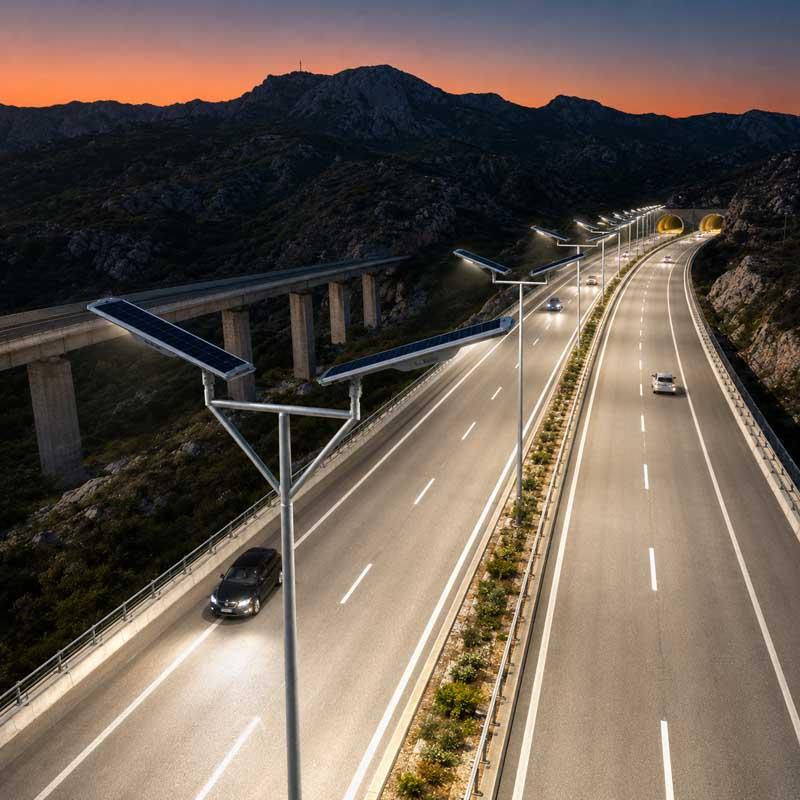
Interconnected Solar-First Roadway LED Street Light for Remote Roads Where Grid Extension Costs More
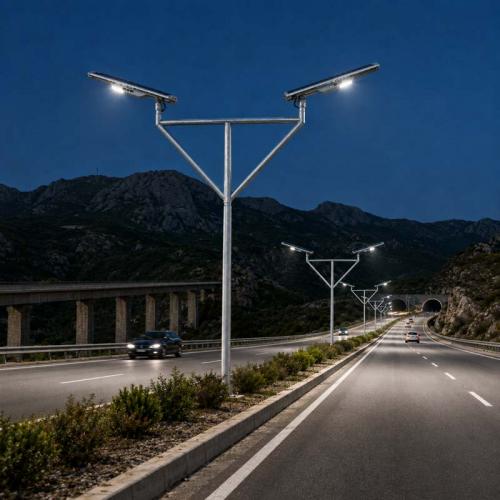
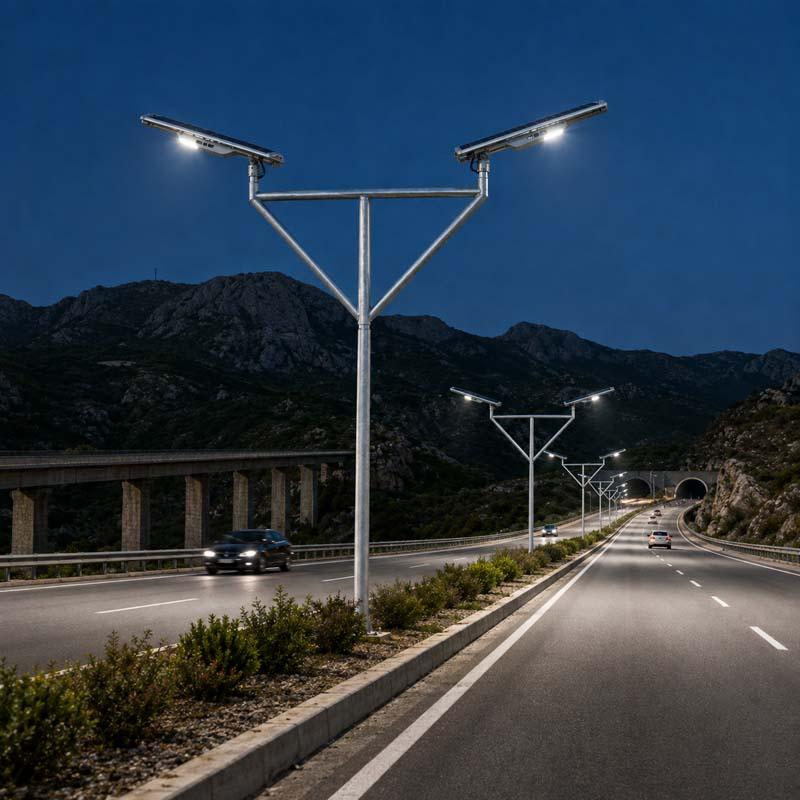
Compare remote-road solar-first deployment against AC grid extension through trenching cost, service distance, theft exposure, solar resource and accepted road output. Solar-first roadway lighting is suitable where extending AC cable networks is costly, slow or unreliable. The project should compare trenching, transformer, cable theft, maintenance distance, solar resource, battery reserve and accepted road-lighting output before choosing between grid extension and distributed solar deployment. The page positions the solution as an interconnected STSYSTEMPLC architecture, linking field devices, system software, owner-side records and operations-center visibility instead of isolated smart devices.
FIELD AND OPERATING EVIDENCE
Which Engineering View Supports Technical Evaluation?
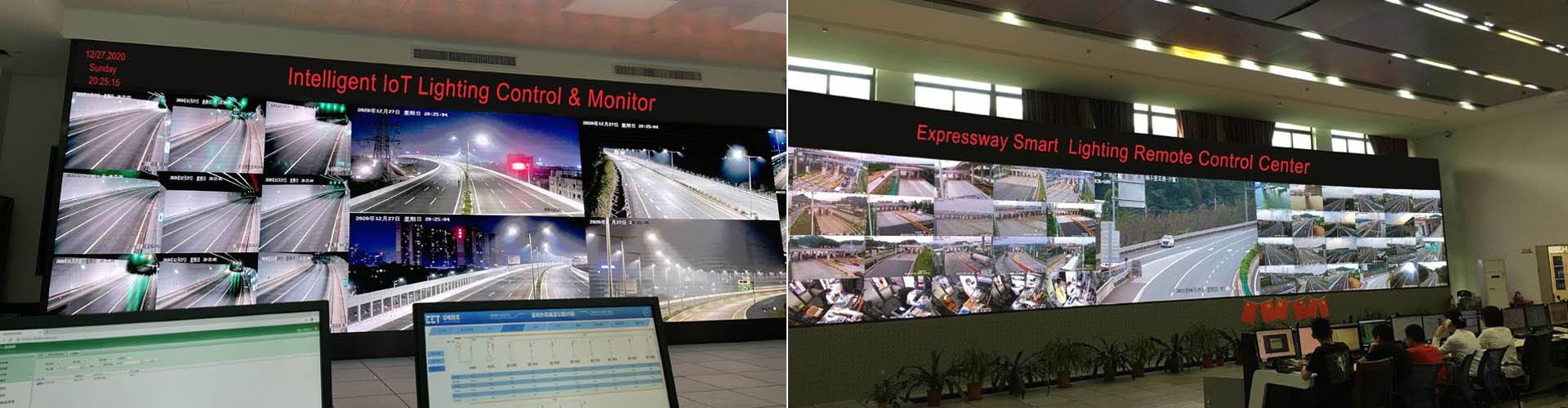
Jigongshan Highway Tunnel Lighting Solution and Portal Control
Review highway and tunnel lighting zones, portal inputs, local control and operator-visible states. This field context demonstrates large-scale intelligent lighting operation; it does not define the energy balance or backup configuration of a new project.
SYSTEM DEMONSTRATION
How Can a Hybrid Solar-Grid Lighting Platform Be Demonstrated?
Hybrid Solar-Grid Street Lighting with Cloud Monitoring
Review hybrid solar-grid operation, including solar generation, grid support, battery reserve, source control and remote monitoring context. The demonstration is supporting evidence only; current-project topology, configured limits and acceptance results remain project-specific.
DIRECT ANSWER
What Should Buyers Understand First about remote-road solar-first deployment?
Solar-first roadway lighting is suitable where extending AC cable networks is costly, slow or unreliable. The project should compare trenching, transformer, cable theft, maintenance distance, solar resource, battery reserve and accepted road-lighting output before choosing between grid extension and distributed solar deployment. The buyer is comparing distributed solar-first deployment against new AC cable extension on remote or rural roads.
ENGINEERING SUMMARY
What Makes remote-road solar-first deployment Different from Ordinary Catalogue Lighting?
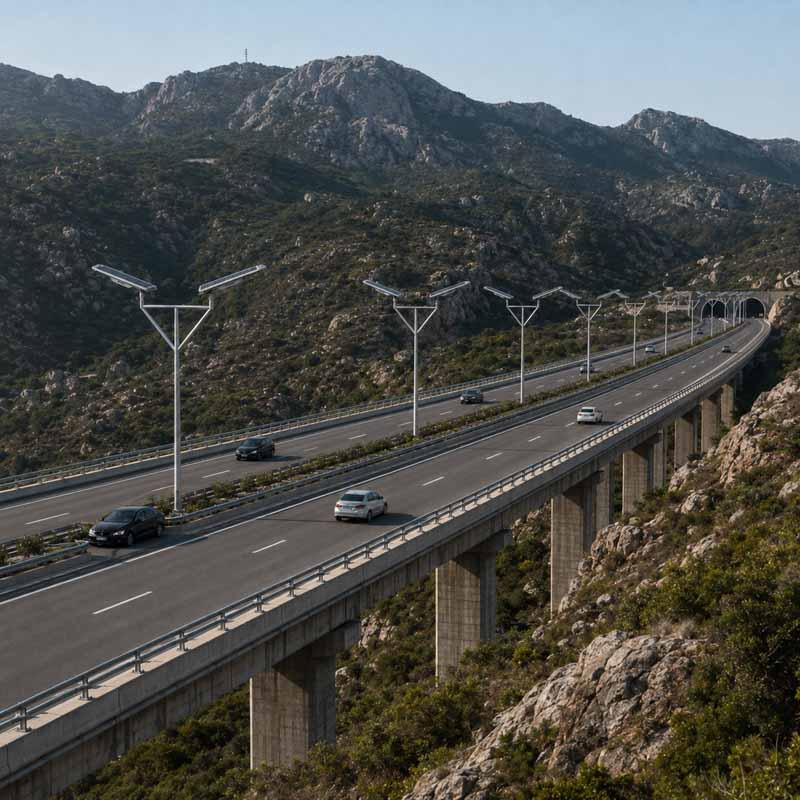
Some highway projects buy solar-first LED street lights because the AC network is the expensive part of the project. On remote highways, mountain sections, island access roads, rural links or new roads far from existing infrastructure, AC lighting may require trenching, cable routes, distribution cabinets, transformer capacity, metering, permits, grounding, lightning protection and future cable repair. When these costs are added, solar-first lighting can be more economical than building a new AC network. This is the logic behind highway cases similar to Malaysia, where project owners compare the real cost of new AC supply against distributed solar lighting. Solar-first deployment reduces long-distance cabling and civil work. It can shorten construction time, avoid heavy transformer expansion and reduce the risk that one cable fault darkens a long road section. Where AC is available at selected points, optional backup can be considered. Where AC is not practical, local road sections can rely on solar charging and battery reserve. The buyer should compare total installed cost and long-term maintenance, not only lamp price. Solar-first projects still need panel cleaning, battery maintenance, controller protection and remote fault visibility. However, they avoid many hidden costs of long AC feeders. This direction is suitable for remote highways, plantation roads, island roads, border roads, construction-stage links and low-density roads where AC extension is slow, costly or exposed to cable theft. The cost comparison should include trenching, cable protection, transformer work, future repairs and exposed feeder risk. This gives the owner a fair basis for choosing solar-first deployment on remote road sections. For remote roads, the project sheet should compare cable trenching, transformer access, service distance, theft exposure, solar autonomy and optional AC points.
Procurement Boundary
Some highway projects buy solar-first LED street lights because the AC network is the expensive part of the project.
Operating Context
On remote highways, mountain sections, island access roads, rural links or new roads far from existing infrastructure, AC lighting may require trenching, cable routes, distribution cabinets, transformer capacity, metering, permits, grounding, lightning protection and future cable repair.
Engineering Basis
When these costs are added, solar-first lighting can be more economical than building a new AC network.
Field Condition
This is the logic behind highway cases similar to Malaysia, where project owners compare the real cost of new AC supply against distributed solar lighting.
Decision Focus
Solar-first deployment reduces long-distance cabling and civil work.
PROJECT FIT, INTEGRATION AND LONG-TERM RESPONSIBILITY
Where Does remote-road solar-first deployment Fit Best?
Buyer Profile
Owners comparing remote-road lighting against the civil-work burden of new cable networks.
Best-Fit Projects
Rural roads, mining routes, island roads and development zones where grid extension is expensive, slow or fragile.
Pause Condition
Do not select solar-first only because trenching is costly; road output and service access still decide feasibility.
Integration Route
Match pole spacing, optical target, solar sizing, reserve and asset protection before replacing grid extension with solar.
Coexistence Logic
Hybrid support may be reserved for critical points, while long remote segments remain solar-first.
Maintenance Readiness
Maintenance planning must consider travel distance, battery access, theft exposure and spare logistics.
| Buyer Question | Engineering Answer | Approval Records |
|---|---|---|
| What makes remote-road solar-first deployment different? | Owners comparing remote-road lighting against the civil-work burden of new cable networks. | Keep grid-extension comparison, solar sizing basis, road priority, service-distance assumption and accepted lighting output. |
| Is the claim measurable? | Review road lighting target, worst-month resource, pole spacing, battery reserve, local service access and asset protection plan. | Acceptance should document road priority, worst-month reserve, pole spacing, service access and the accepted solar-first output. |
| Can the owner maintain it after handover? | Maintenance planning must consider travel distance, battery access, theft exposure and spare logistics. | Owner files should preserve the grid-extension comparison and the accepted solar deployment basis. |
SYSTEM ARCHITECTURE
Which Layers Must Be Defined for remote-road solar-first deployment?
Energy Layer
Worst-month resource and usable battery reserve must support the accepted road output.
Control Layer
Local schedules and safe dimming should protect remote sections even without frequent patrols.
Communication Layer
Remote status is valuable when field visits are expensive, but it must be sized into the energy budget.
Owner Layer
Owner files should preserve the grid-extension comparison and the accepted solar deployment basis.
Protection Layer
Do not choose solar only because cable is expensive; confirm road output, solar resource, theft exposure, battery service and maintenance distance.
Service Layer
Preserve grid-extension comparison, solar sizing basis, road priority, service-distance assumption and accepted lighting output in the owner handover file.
USE SCENARIOS
Which Field Conditions Matter Most for remote-road solar-first deployment?
No Practical Cable Route
Use distributed solar when trenching or transformer expansion would delay the project.
Long Maintenance Distance
Specify readable status records and spare strategy before deployment.
High Cable Theft Risk
Avoid exposing long AC cable runs where distributed solar reduces theft-driven outage risk.
Owner Risk Review
Do not choose solar only because cable is expensive; confirm road output, solar resource, theft exposure, battery service and maintenance distance.
Field Service Context
Maintenance planning must consider travel distance, battery access, theft exposure and spare logistics.
Lifecycle Handover
Owner files should preserve the grid-extension comparison and the accepted solar deployment basis.
PROCUREMENT DECISION MATRIX
Which Decisions Must Be Frozen for remote-road solar-first deployment?
| Decision Layer | Freeze Before Purchase | Risk If Missing |
|---|---|---|
| Lighting output | Match road output to remote-road solar-first deployment before quantity approval. | If road output is not fixed, solar-first sizing can become a trenching-cost argument instead of a lighting design. |
| Energy reserve | Worst-month resource and usable battery reserve must support the accepted road output. | remote-road solar-first deployment may fail in the first difficult season if reserve is undersized. |
| Communication | Remote status is valuable when field visits are expensive, but it must be sized into the energy budget. | Remote status cannot compensate for a reserve plan that fails before the next practical service visit. |
| Service ownership | Maintenance planning must consider travel distance, battery access, theft exposure and spare logistics. | Fault response for remote-road solar-first deployment becomes unclear when responsibility is not mapped. |
| Owner Decision | Municipal Engineering Requirement | Record to Keep |
|---|---|---|
| Primary buying intent | The buyer is comparing distributed solar-first deployment against new AC cable extension on remote or rural roads. | The service record should retain grid-extension comparison, solar sizing basis, road priority, service-distance assumption and accepted lighting output for later review. |
| Reject or pause condition | Do not choose solar only because cable is expensive; confirm road output, solar resource, theft exposure, battery service and maintenance distance. | Delay approval until remote-road solar-first deployment has a corrected technical boundary. |
| Acceptance proof | Review road lighting target, worst-month resource, pole spacing, battery reserve, local service access and asset protection plan. | Keep the witnessed remote-road solar-first deployment result with the accepted parameter file. |
| Lifecycle continuity | Maintenance planning must consider travel distance, battery access, theft exposure and spare logistics. | Make grid-extension comparison, solar sizing basis, road priority, service-distance assumption and accepted lighting output available during acceptance and maintenance transfer. |
Buying Intent
The buyer is comparing distributed solar-first deployment against new AC cable extension on remote or rural roads.
Technical Boundary
Do not choose solar only because cable is expensive; confirm road output, solar resource, theft exposure, battery service and maintenance distance.
Controller Behavior
Local schedules and safe dimming should protect remote sections even without frequent patrols.
Energy Proof
Worst-month resource and usable battery reserve must support the accepted road output.
Field Acceptance
Review road lighting target, worst-month resource, pole spacing, battery reserve, local service access and asset protection plan.
Owner Record
Make grid-extension comparison, solar sizing basis, road priority, service-distance assumption and accepted lighting output available during acceptance and maintenance transfer.
Service Transfer
Maintenance planning must consider travel distance, battery access, theft exposure and spare logistics.
Claim Boundary
Do not select solar-first only because trenching is costly; road output and service access still decide feasibility.
CONTROL ROUTES
How Should Control Routes Be Separated for remote-road solar-first deployment?
| Route | Procurement Meaning | Risk Control |
|---|---|---|
| Local controller | Local schedules and safe dimming should protect remote sections even without frequent patrols. | Test local behavior for remote-road solar-first deployment before handover. |
| Energy path | Worst-month resource and usable battery reserve must support the accepted road output. | Record the source, threshold, schedule and recovery behavior for remote-road solar-first deployment. |
| Communication path | Remote status is valuable when field visits are expensive, but it must be sized into the energy budget. | Confirm coverage, credentials, data export and service responsibility for remote-road solar-first deployment. |
| Owner export path | Owner files should preserve the grid-extension comparison and the accepted solar deployment basis. | Define export format, account ownership and backup cadence for remote-road solar-first deployment. |
OWNER RECORDS
Which Records Should Stay Readable for remote-road solar-first deployment?
Solar-First Roadway Lighting
Solar-First Roadway Lighting should be defined with a clear project scope, acceptance condition and handover record.
Remote Road Solar Street Light
Remote Road Solar Street Light belongs in the owner file only when the tested function and operating boundary are written down.
Rural Road LED Lighting
Rural Road LED Lighting should connect the selected hardware, control rule and service responsibility before purchase.
Grid Extension Alternative
Grid Extension Alternative needs a measurable field condition, not a catalogue phrase or unqualified autonomy promise.
Off-Grid Road Lighting
Off-Grid Road Lighting should remain exportable with configuration, acceptance and maintenance history after handover.
Solar Road Lighting Deployment
Solar Road Lighting Deployment should help the buyer separate required functions from optional monitoring or service features.
Make grid-extension comparison, solar sizing basis, road priority, service-distance assumption and accepted lighting output available during acceptance and maintenance transfer.
| Owner Record | Why It Matters | Minimum Field |
|---|---|---|
| Energy record | Worst-month resource and usable battery reserve must support the accepted road output. | Accepted energy source, output state and remote-road solar-first deployment timestamp. |
| Asset record | Owner files should preserve the grid-extension comparison and the accepted solar deployment basis. | Pole, device, configuration and service fields agreed for remote-road solar-first deployment. |
| Service record | Maintenance planning must consider travel distance, battery access, theft exposure and spare logistics. | Reviewer, field action and recovery note for remote-road solar-first deployment. |
| Change record | Make grid-extension comparison, solar sizing basis, road priority, service-distance assumption and accepted lighting output available during acceptance and maintenance transfer. | Previous component, new component, approval and parameter restore for remote-road solar-first deployment. |
FAILURE AND RECOVERY
How Should Abnormal Operation Be Handled for remote-road solar-first deployment?
Reserve Response
Worst-month resource and usable battery reserve must support the accepted road output.
Communication Response
Remote status is valuable when field visits are expensive, but it must be sized into the energy budget.
Service Response
Maintenance planning must consider travel distance, battery access, theft exposure and spare logistics.
Control Recovery
Local schedules and safe dimming should protect remote sections even without frequent patrols.
Owner Review
Owner files should preserve the grid-extension comparison and the accepted solar deployment basis.
Claim Boundary
Do not choose solar only because cable is expensive; confirm road output, solar resource, theft exposure, battery service and maintenance distance.
| Recovery Topic | Immediate Behavior | Owner Record |
|---|---|---|
| Energy reserve | Worst-month resource and usable battery reserve must support the accepted road output. | Remote-road reserve trend, output level, charge recovery and travel-aware service note. |
| Communication | Remote status is valuable when field visits are expensive, but it must be sized into the energy budget. | Field-return timestamp, uploaded remote-road records and local operating comparison. |
| Controller rule | Local schedules and safe dimming should protect remote sections even without frequent patrols. | Solar-first parameter file, remote-road sequence and recovery state. |
| Service action | Maintenance planning must consider travel distance, battery access, theft exposure and spare logistics. | Assigned service route, field action, restored status and closure note. |
FACTORY AND SITE TESTS
What Should Factory Test and Site Commissioning Prove for remote-road solar-first deployment?
For remote-road solar-first deployment, factory and site acceptance tests must prove the exact operating behavior promised to the owner: Review road lighting target, worst-month resource, pole spacing, battery reserve, local service access and asset protection plan.
| Test Stage | What to Prove | Owner Record |
|---|---|---|
| Factory test | Local schedules and safe dimming should protect remote sections even without frequent patrols. | Remote-road setting file, site test result and serial-linked configuration. |
| Site test | Review road lighting target, worst-month resource, pole spacing, battery reserve, local service access and asset protection plan. | Site acceptance record, owner asset file and accepted state for remote-road solar-first deployment. |
| Recovery test | Maintenance planning must consider travel distance, battery access, theft exposure and spare logistics. | Remote-route recovery timestamp, event sequence and service closure note. |
| Season review | Worst-month resource and usable battery reserve must support the accepted road output. | Worst-month energy trend, reserve correction and patrol-planning history. |
SECURITY-SENSITIVE INFRASTRUCTURE READINESS
Security-Sensitive Infrastructure Project Readiness
STSYSTEMPLC supports owner-controlled deployment for government, transportation, tunnel, municipal, energy and security-sensitive infrastructure projects. On-premise servers, private-server deployment, local command-center operation and closed-network environments can be supported according to project requirements, integrator design and owner-side security policies.
RFQ QUESTIONS
Which Buyer Questions Should Be Answered for remote-road solar-first deployment?
When can Solar-first road lighting cost less than building a new AC cable network?
For remote roads, AC supply may require trenching, long cables, distribution cabinets, transformers, metering, permits and future repair. These hidden infrastructure costs can exceed the cost of distributed solar lighting. A serious comparison should include construction, maintenance and cable-risk costs, not only lamp price. The cost table should also show feeder exposure, repair distance and whether selected AC points already exist.
Why is the AC-extension problem different from a city that already has unstable grid access?
The buyer problem is different from unstable-grid city lighting. Unstable-grid projects start from an existing but unreliable AC supply. This use case starts from missing or expensive AC infrastructure. Both may use solar and battery, but one protects roads from outages while the other avoids long cable runs, transformer expansion and civil-work cost. Pricing and tender language should therefore be different from the start too.
Which remote road types make trenching, transformers and long cable routes less attractive than distributed solar?
It is suitable for remote highways, rural connectors, mountain roads, island access roads, plantation roads, border roads, construction-stage roads and low-density routes far from reliable power infrastructure. The approved choice should be based on road class, solar data, installation distance and service plan. These sites need solar-resource checks, maintenance access and reserve sizing because the power source is distributed along the road.
Where can partial AC support still make sense in a mostly Solar-first remote road project?
Partial AC support can make sense where grid access already exists at service areas, toll stations, intersections or selected road sections. The project may use solar-first lighting along remote stretches and AC backup only where access is practical. The point is not to reject AC, but to avoid building a costly continuous cable network where it is not economically reasonable. This keeps the design practical instead of ideological.
How should the owner compare AC cabling cost, transformer capacity, maintenance travel and solar deployment?
The buyer should compare excavation, cable length, cable protection, distribution cabinets, transformer capacity, grounding, lightning protection, permits, grid connection fees, maintenance travel, cable theft risk, battery replacement and platform monitoring. Total cost gives a better decision than product price alone. A fair cost table should include trenching, cable, cabinets, transformer work, permits, grounding, lightning protection and theft exposure.
Data Sovereignty, Cybersecurity & Open Integration
How Can Remote-Road Lighting Avoid Dependence on a Mandatory Supplier Cloud?
Server & Record Ownership
Hosting is a project decision, not a product lock-in rule. The owner may specify on-premises deployment, private cloud, or an approved third-party server platform and retain primary control of operational records and administrator authority. For solar-first remote-road lighting, the final hosting and data-residency choice should be recorded in the approved architecture.
Owner / SCADA / BMS Integration
STSYSTEMPLC supports open-protocol integration with owner and third-party platforms. The protocol, version, data points, command permissions, timeout behavior and acceptance method should be frozen in the project interface schedule and verified during commissioning rather than described as universal plug-and-play. The interface test should use the actual solar-first remote-road lighting data and command set.
Remote-Access Governance
Network security is governed as an engineering scope, not a marketing adjective. The project should define account ownership, role permissions, remote-access approval, network separation, backup/restore, logs and any required secure-tunnel or certificate controls; STSYSTEMPLC should claim only the measures actually supplied and tested.
Supplier Transition
Local controller logic, protection limits and accepted fallback behavior should continue according to the selected architecture when the central server or WAN is unavailable. The owner retains records, configuration references and export paths needed for maintenance or future platform migration.
PUBLIC CLAIM BOUNDARIES
Which Claims Should Stay Controlled for remote-road solar-first deployment?
| Claim Type | Acceptable Public Wording | Wording to Avoid |
|---|---|---|
| Operating claim | Review road lighting target, worst-month resource, pole spacing, battery reserve, local service access and asset protection plan. | Unverified performance language copied from a catalogue. |
| Data claim | Owner files should preserve the grid-extension comparison and the accepted solar deployment basis. | Remote-road records trapped in a supplier account after acceptance. |
| Recovery claim | Maintenance planning must consider travel distance, battery access, theft exposure and spare logistics. | A vague service promise is not enough for remote-road solar-first deployment. |
| Compatibility claim | Do not select solar-first only because trenching is costly; road output and service access still decide feasibility. | Solar-first wording that ignores access distance, theft exposure, reserve margin or road priority. |
Battery Boundary
Worst-month resource and usable battery reserve must support the accepted road output.
Communication Boundary
Remote status is valuable when field visits are expensive, but it must be sized into the energy budget.
Data Boundary
Owner files should preserve the grid-extension comparison and the accepted solar deployment basis.
Compatibility Boundary
Do not select solar-first only because trenching is costly; road output and service access still decide feasibility.
OWNER DECISION CHECKLIST
What Should the Owner Freeze before Purchasing remote-road solar-first deployment?
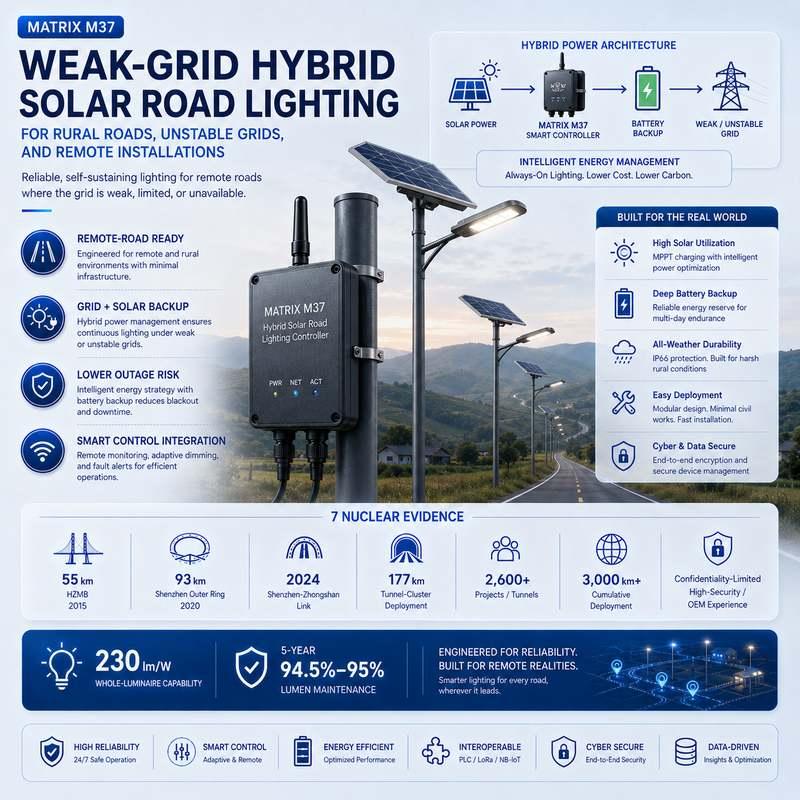
STSYSTEMPLC evaluates remote road lighting from the power-access cost first, not only from the unit price of the lamp. For remote highways and similar projects, the first calculation should be whether building the AC network is reasonable. If trenching, cable distance, transformer expansion and distribution equipment cost more than distributed solar lighting, the solar-first option may be the practical choice. The system can include solar panels, LiFePO4 battery storage, MPPT charging, smart dimming, remote status records and optional AC support where available. The configuration should consider road width, pole spacing, lighting hours, solar resource, reserve target, maintenance distance and theft exposure. In long road sections, distributed energy can reduce the risk of one feeder failure affecting the whole road section. STSYSTEMPLC’s broader smart lighting experience helps buyers connect energy design with maintenance planning. The owner should decide whether the project is a solar-first road, a hybrid AC solar road, or a mixed route with AC support at selected points. By separating the AC-extension-cost problem from the unstable-grid problem, the proposal becomes clearer and easier for EPC teams to evaluate. Remote road owners need a total-cost view that includes infrastructure, repair distance and future feeder exposure. For distributed road assets, maintenance should cover battery checks, panel cleaning and remote fault response without assuming a nearby AC crew. For a long road, the cost record should preserve the AC-extension comparison, maintenance route and distributed asset plan before procurement is approved. This confirms that the project was selected because total infrastructure cost favored solar-first deployment. For long roads, the owner should document where.
Freeze Energy Strategy
Worst-month resource and usable battery reserve must support the accepted road output.
Freeze Acceptance Method
Review road lighting target, worst-month resource, pole spacing, battery reserve, local service access and asset protection plan.
Freeze Data Rights
Owner files should preserve the grid-extension comparison and the accepted solar deployment basis.
Freeze Service Response
Maintenance planning must consider travel distance, battery access, theft exposure and spare logistics.
RELATED ENGINEERING ENTRY POINTS
Which Search Paths Should Support remote-road solar-first deployment?
STRATEGIC PARTNER-BRANDED TECHNOLOGY SUPPORT
Strategic Partner-Branded Technology Support
STSYSTEMPLC supports long-term strategic partners with partner-branded solution packaging, technical documentation, system integration support and owner-controlled deployment options for government, transportation, tunnel, energy and security-sensitive infrastructure projects.
Send Project Inputs for STSYSTEMPLC Engineering Review
Share the road layout, pole height, spacing, target lighting level and operating constraints that define remote-road solar-first deployment.