




Interconnected Hybrid Solar Street Light for Weak-Grid and Seasonal Low-Solar Cities
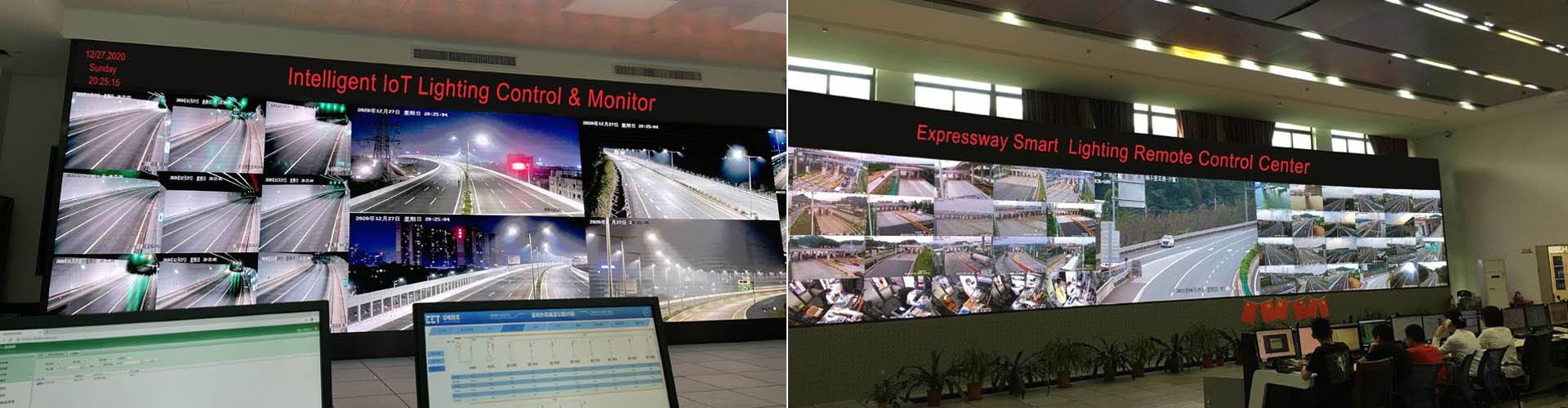
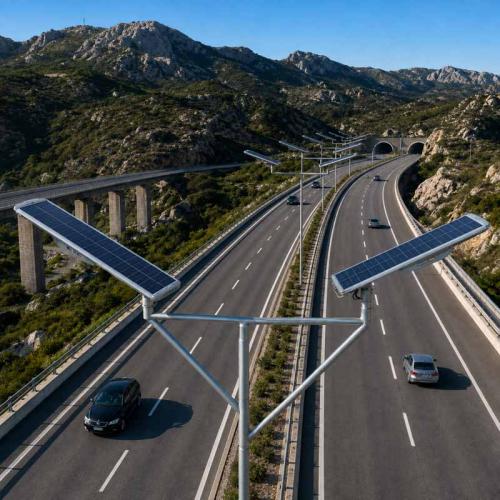
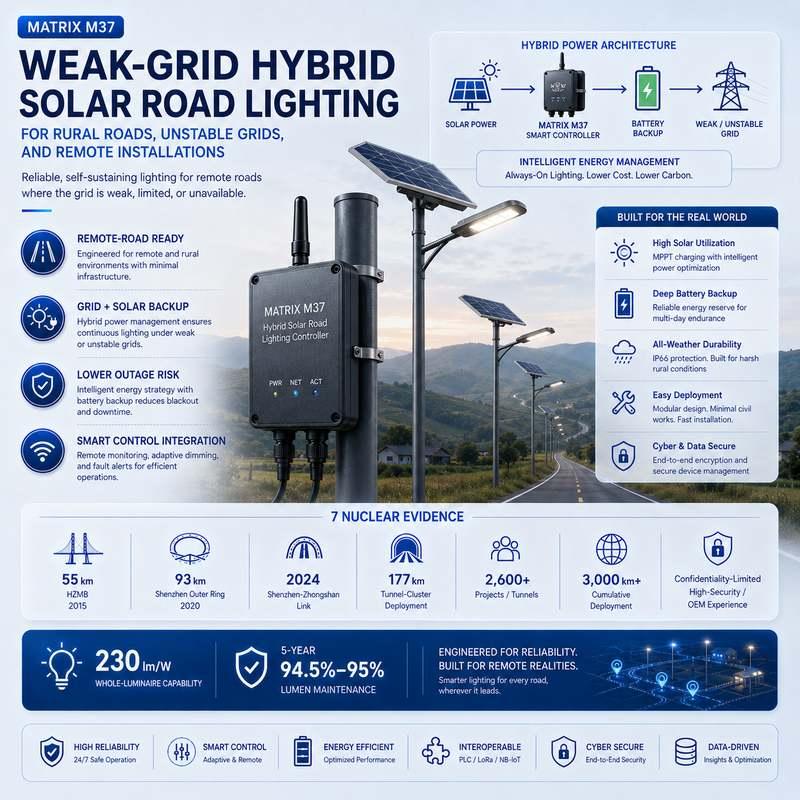
Separate weak-grid and seasonal low-solar projects by climate reality, so solar-first operation, AC support and rainy-season reserve are not forced into one generic rule. Weak-grid and seasonal low-solar cities need different hybrid solar rules. Sun-rich cities should prioritize PV charging and battery-led night lighting, while low-solar seasons may require scheduled AC support. The approved design must state solar contribution, AC trigger rules, reserve targets and rainy-season assumptions. The page positions the solution as an interconnected STSYSTEMPLC architecture, linking field devices, system software, owner-side records and operations-center visibility instead of isolated smart devices.
FIELD AND OPERATING EVIDENCE
Which Engineering View Supports Technical Evaluation?
Adaptive Dual CCT Auto-Changing under Rain, Fog and Snow
Review automatic lighting-state and correlated CCT changes under weather-related conditions. CCT behavior, sensor thresholds and energy policies for a current project remain subject to approved configuration.
SYSTEM DEMONSTRATION
How Can a Hybrid Solar-Grid Lighting Platform Be Demonstrated?
Hybrid Solar-Grid Street Lighting with Cloud Monitoring
Review hybrid solar-grid operation, including solar generation, grid support, battery reserve, source control and remote monitoring context. The demonstration is supporting evidence only; current-project topology, configured limits and acceptance results remain project-specific.
DIRECT ANSWER
What Should Buyers Understand First about weak-grid and seasonal low-solar operation?
Weak-grid and seasonal low-solar cities need different hybrid solar rules. Sun-rich cities should prioritize PV charging and battery-led night lighting, while low-solar seasons may require scheduled AC support. The approved design must state solar contribution, AC trigger rules, reserve targets and rainy-season assumptions. The buyer is separating tropical solar-first operation from seasonal low-solar AC support so climate reality controls the strategy.
ENGINEERING SUMMARY
What Makes weak-grid and seasonal low-solar operation Different from Ordinary Catalogue Lighting?
Solar-first operation belongs to sun-rich cities where the solar resource is stronger than the grid promise. This is the natural market for solar-first hybrid street lighting. In parts of Africa, Indonesia, Papua New Guinea, Brazil, South America, island countries and tropical municipal areas, sunlight can be a valuable daily resource while AC supply may still be irregular, fuel-dependent, overloaded or unavailable during the night. In this setting, AC should not be treated as the first energy source for road lighting. The preferred strategy is daytime PV charging with battery-led night operation. During the day, solar energy charges the LiFePO4 battery through MPPT control. At night, the battery supplies the lamp as the normal source. AC is kept as backup for low battery reserve, long rainy periods, unexpected public-safety needs or periods when the grid is available and additional support is required. This reduces dependence on an unstable grid without removing the safety value of AC. This design direction is different from a seasonal low-solar AC-support design. It should not force regular night AC charging when solar resource is strong. The controller should be set according to rainy-season length, solar yield, road priority, reserve target and grid availability. The platform should show solar contribution, battery reserve, AC backup use and outage events, so the buyer can see whether the system is really using local solar resource first. In these markets, the value comes from using strong local sunlight before drawing from a weak or expensive grid. AC remains useful, but it should not erase the solar-first operating logic that makes the project attractive. For solar-first sites, the technical sheet should define daytime PV charging logic, rainy-season reserve, AC trigger battery reserve and the records proving that grid use stays secondary. The quotation should separate normal hardware from solar-first control logic, monitoring, weather reserve and local commissioning work. Seasonal low-solar energy balance is the category boundary for this Hybrid Grid + Solar configuration. A 180W panel should be checked against actual road layout.
Procurement Boundary
Solar-first operation belongs to sun-rich cities where the solar resource is stronger than the grid promise.
Operating Context
This is the natural market for solar-first hybrid street lighting.
Engineering Basis
In parts of Africa, Indonesia, Papua New Guinea, Brazil, South America, island countries and tropical municipal areas, sunlight can be a valuable daily resource while AC supply may still be irregular, fuel-dependent, overloaded or unavailable during the night.
Field Condition
In this setting, AC should not be treated as the first energy source for road lighting.
Decision Focus
The preferred strategy is daytime PV charging with battery-led night operation.
PROJECT FIT, INTEGRATION AND LONG-TERM RESPONSIBILITY
Where Does weak-grid and seasonal low-solar operation Fit Best?
Buyer Profile
Buyers in weak-grid or seasonal low-solar regions who need climate-specific control logic instead of one global setting.
Best-Fit Projects
Tropical weak-grid cities, island towns and seasonal low-solar regions where solar contribution and AC support change across the year.
Pause Condition
A country name or annual solar average is not enough; rainy-season length and worst-month operation must be reviewed.
Integration Route
Separate dry-season solar-first rules from rainy-season or low-solar AC-support rules in the controller file.
Coexistence Logic
PV and AC can share the system only when their priority changes are explicit and reviewable.
Maintenance Readiness
Seasonal review should compare actual solar contribution, battery reserve and AC support frequency.
| Buyer Question | Engineering Answer | Approval Records |
|---|---|---|
| What makes weak-grid and seasonal low-solar operation different? | Buyers in weak-grid or seasonal low-solar regions who need climate-specific control logic instead of one global setting. | Keep solar yield assumption, rainy-season reserve, AC trigger rule, battery trend and seasonal adjustment history. |
| Is the claim measurable? | Compare dry-season and rainy-season assumptions, AC trigger threshold, solar contribution, battery reserve and night output against site data. | Acceptance should compare weak-grid support, seasonal solar input, rainy-period reserve and the selected hybrid operating rule. |
| Can the owner maintain it after handover? | Seasonal review should compare actual solar contribution, battery reserve and AC support frequency. | Owner files should preserve seasonal assumptions, AC trigger rules and reserve adjustments. |
SYSTEM ARCHITECTURE
Which Layers Must Be Defined for weak-grid and seasonal low-solar operation?
Energy Layer
The energy model should expose dry-season, rainy-season and low-solar assumptions separately.
Control Layer
Control rules should trigger AC support by reserve threshold, not by vague weak-grid wording.
Communication Layer
Platform records should reveal whether the system is truly solar-first or quietly becoming AC-dependent.
Owner Layer
Owner files should preserve seasonal assumptions, AC trigger rules and reserve adjustments.
Protection Layer
Do not copy one country setting across sun-rich, rainy-season and low-solar markets without local resource and reserve review.
Service Layer
Preserve solar yield assumption, rainy-season reserve, AC trigger rule, battery trend and seasonal adjustment history in the owner handover file.
USE SCENARIOS
Which Field Conditions Matter Most for weak-grid and seasonal low-solar operation?
Sun-Rich Weak Grid
Use strong daylight harvest first while keeping grid support secondary.
Rainy Season Reserve
Protect reserve during long cloudy periods without promising the same output every night.
Seasonal AC Support
Allow scheduled support when low solar resource makes pure solar operation unrealistic.
Owner Risk Review
Do not copy one country setting across sun-rich, rainy-season and low-solar markets without local resource and reserve review.
Field Service Context
Seasonal review should compare actual solar contribution, battery reserve and AC support frequency.
Lifecycle Handover
Owner files should preserve seasonal assumptions, AC trigger rules and reserve adjustments.
PROCUREMENT DECISION MATRIX
Which Decisions Must Be Frozen for weak-grid and seasonal low-solar operation?
| Decision Layer | Freeze Before Purchase | Risk If Missing |
|---|---|---|
| Lighting output | Match road output to weak-grid and seasonal low-solar operation before quantity approval. | If the climate case is not separated, AC support and solar reserve may both be undersized for the difficult season. |
| Energy reserve | The energy model should expose dry-season, rainy-season and low-solar assumptions separately. | weak-grid and seasonal low-solar operation may fail in the first difficult season if reserve is undersized. |
| Communication | Platform records should reveal whether the system is truly solar-first or quietly becoming AC-dependent. | Seasonal status screens cannot replace a local rule that protects lighting during weak-grid periods. |
| Service ownership | Seasonal review should compare actual solar contribution, battery reserve and AC support frequency. | Fault response for weak-grid and seasonal low-solar operation becomes unclear when responsibility is not mapped. |
| Owner Decision | Municipal Engineering Requirement | Record to Keep |
|---|---|---|
| Primary buying intent | The buyer is separating tropical solar-first operation from seasonal low-solar AC support so climate reality controls the strategy. | The service record should retain solar yield assumption, rainy-season reserve, AC trigger rule, battery trend and seasonal adjustment history for later review. |
| Reject or pause condition | Do not copy one country setting across sun-rich, rainy-season and low-solar markets without local resource and reserve review. | Delay approval until weak-grid and seasonal low-solar operation has a corrected technical boundary. |
| Acceptance proof | Compare dry-season and rainy-season assumptions, AC trigger threshold, solar contribution, battery reserve and night output against site data. | Keep the witnessed weak-grid and seasonal low-solar operation result with the accepted parameter file. |
| Lifecycle continuity | Seasonal review should compare actual solar contribution, battery reserve and AC support frequency. | Make solar yield assumption, rainy-season reserve, AC trigger rule, battery trend and seasonal adjustment history available during acceptance and maintenance transfer. |
Buying Intent
The buyer is separating tropical solar-first operation from seasonal low-solar AC support so climate reality controls the strategy.
Technical Boundary
Do not copy one country setting across sun-rich, rainy-season and low-solar markets without local resource and reserve review.
Controller Behavior
Control rules should trigger AC support by reserve threshold, not by vague weak-grid wording.
Energy Proof
The energy model should expose dry-season, rainy-season and low-solar assumptions separately.
Field Acceptance
Compare dry-season and rainy-season assumptions, AC trigger threshold, solar contribution, battery reserve and night output against site data.
Owner Record
Make solar yield assumption, rainy-season reserve, AC trigger rule, battery trend and seasonal adjustment history available during acceptance and maintenance transfer.
Service Transfer
Seasonal review should compare actual solar contribution, battery reserve and AC support frequency.
Claim Boundary
A country name or annual solar average is not enough; rainy-season length and worst-month operation must be reviewed.
CONTROL ROUTES
How Should Control Routes Be Separated for weak-grid and seasonal low-solar operation?
| Route | Procurement Meaning | Risk Control |
|---|---|---|
| Local controller | Control rules should trigger AC support by reserve threshold, not by vague weak-grid wording. | Test local behavior for weak-grid and seasonal low-solar operation before handover. |
| Energy path | The energy model should expose dry-season, rainy-season and low-solar assumptions separately. | Record the source, threshold, schedule and recovery behavior for weak-grid and seasonal low-solar operation. |
| Communication path | Platform records should reveal whether the system is truly solar-first or quietly becoming AC-dependent. | Confirm coverage, credentials, data export and service responsibility for weak-grid and seasonal low-solar operation. |
| Owner export path | Owner files should preserve seasonal assumptions, AC trigger rules and reserve adjustments. | Define export format, account ownership and backup cadence for weak-grid and seasonal low-solar operation. |
OWNER RECORDS
Which Records Should Stay Readable for weak-grid and seasonal low-solar operation?
Weak-Grid Solar Street Light
Weak-Grid Solar Street Light should be defined with a clear project scope, acceptance condition and handover record.
Seasonal Low-Solar Lighting
Seasonal Low-Solar Lighting belongs in the owner file only when the tested function and operating boundary are written down.
Solar-First Charging
Solar-First Charging should connect the selected hardware, control rule and service responsibility before purchase.
AC Backup Street Light
AC Backup Street Light needs a measurable field condition, not a catalogue phrase or unqualified autonomy promise.
Rainy Season Reserve
Rainy Season Reserve should remain exportable with configuration, acceptance and maintenance history after handover.
Hybrid Solar Road Lighting
Hybrid Solar Road Lighting should help the buyer separate required functions from optional monitoring or service features.
Make solar yield assumption, rainy-season reserve, AC trigger rule, battery trend and seasonal adjustment history available during acceptance and maintenance transfer.
| Owner Record | Why It Matters | Minimum Field |
|---|---|---|
| Energy record | The energy model should expose dry-season, rainy-season and low-solar assumptions separately. | Accepted energy source, output state and weak-grid and seasonal low-solar operation timestamp. |
| Asset record | Owner files should preserve seasonal assumptions, AC trigger rules and reserve adjustments. | Pole, device, configuration and service fields agreed for weak-grid and seasonal low-solar operation. |
| Service record | Seasonal review should compare actual solar contribution, battery reserve and AC support frequency. | Reviewer, field action and recovery note for weak-grid and seasonal low-solar operation. |
| Change record | Make solar yield assumption, rainy-season reserve, AC trigger rule, battery trend and seasonal adjustment history available during acceptance and maintenance transfer. | Previous component, new component, approval and parameter restore for weak-grid and seasonal low-solar operation. |
FAILURE AND RECOVERY
How Should Abnormal Operation Be Handled for weak-grid and seasonal low-solar operation?
Reserve Response
The energy model should expose dry-season, rainy-season and low-solar assumptions separately.
Communication Response
Platform records should reveal whether the system is truly solar-first or quietly becoming AC-dependent.
Service Response
Seasonal review should compare actual solar contribution, battery reserve and AC support frequency.
Control Recovery
Control rules should trigger AC support by reserve threshold, not by vague weak-grid wording.
Owner Review
Owner files should preserve seasonal assumptions, AC trigger rules and reserve adjustments.
Claim Boundary
Do not copy one country setting across sun-rich, rainy-season and low-solar markets without local resource and reserve review.
| Recovery Topic | Immediate Behavior | Owner Record |
|---|---|---|
| Energy reserve | The energy model should expose dry-season, rainy-season and low-solar assumptions separately. | Seasonal reserve, solar recovery, AC-support behavior, output limit and field service note. |
| Communication | Platform records should reveal whether the system is truly solar-first or quietly becoming AC-dependent. | Weak-grid recovery timestamp, uploaded seasonal records and local-control comparison. |
| Controller rule | Control rules should trigger AC support by reserve threshold, not by vague weak-grid wording. | Seasonal hybrid settings, source-switch sequence and recovery state. |
| Service action | Seasonal review should compare actual solar contribution, battery reserve and AC support frequency. | Service team, seasonal adjustment, restored hybrid behavior and closure record. |
FACTORY AND SITE TESTS
What Should Factory Test and Site Commissioning Prove for weak-grid and seasonal low-solar operation?
For weak-grid and seasonal low-solar operation, factory and site acceptance tests must prove the exact operating behavior promised to the owner: Compare dry-season and rainy-season assumptions, AC trigger threshold, solar contribution, battery reserve and night output against site data.
| Test Stage | What to Prove | Owner Record |
|---|---|---|
| Factory test | Control rules should trigger AC support by reserve threshold, not by vague weak-grid wording. | Seasonal setting file, weak-grid test result and controller-linked configuration. |
| Site test | Compare dry-season and rainy-season assumptions, AC trigger threshold, solar contribution, battery reserve and night output against site data. | Site acceptance record, owner asset file and accepted state for weak-grid and seasonal low-solar operation. |
| Recovery test | Seasonal review should compare actual solar contribution, battery reserve and AC support frequency. | Grid-stability return time, source event order and service closure note. |
| Season review | The energy model should expose dry-season, rainy-season and low-solar assumptions separately. | Rainy-season trend, reserve adjustment and source-priority decision history. |
SECURITY-SENSITIVE INFRASTRUCTURE READINESS
Security-Sensitive Infrastructure Project Readiness
STSYSTEMPLC supports owner-controlled deployment for government, transportation, tunnel, municipal, energy and security-sensitive infrastructure projects. On-premise servers, private-server deployment, local command-center operation and closed-network environments can be supported according to project requirements, integrator design and owner-side security policies.
RFQ QUESTIONS
Which Buyer Questions Should Be Answered for weak-grid and seasonal low-solar operation?
Why should sun-rich weak-grid cities use Solar-first operation instead of treating AC as the main energy source?
Because many tropical and equatorial regions have strong solar resource while the AC grid may be unstable, overloaded or available only part of the day. Solar-first operation uses daylight energy to charge the battery, then uses the battery for night lighting. AC remains a backup instead of becoming the main source. The design should use local sunshine as an operating advantage and keep the unstable grid as a support layer rather than the daily master source.
Does Solar-first remove the need for grid backup in tropical or equatorial weak-grid markets?
No. Solar-first means solar energy is preferred for charging and night lighting, but AC can still be kept as backup. This is useful when long rainy periods, higher lamp load, battery aging or public-safety needs require extra support. The design keeps resilience without relying only on the weak grid. The owner should still keep AC backup where possible, because rainy weeks, battery aging or emergency lighting can change the reserve picture.
When should AC backup step in without turning a Solar-first project back into AC-first lighting?
AC backup should step in when battery reserve falls below the safety threshold, after several weak solar days, during emergency lighting needs, or when the owner enables controlled backup charging. In a sun-rich market it should not become the routine first energy source. The design goal is to use solar and battery as the normal path while keeping AC available for protection. The platform should record how often AC backup is used.
How should Indonesia, PNG, Brazil or similar sun-rich markets be handled without copying one country template?
It can be suitable for sun-rich grid-unstable areas in those markets, but the approved configuration must follow local road class, rainy-season pattern, theft risk, battery reserve target and maintenance capacity. The country name alone is not enough; the project site and operating goal must decide the design. For those markets, the proposal should check local rainfall season, theft exposure, road priority and service ability before fixing the battery size.
Why does rainy-season reserve need a different calculation from ordinary sunny-day sizing?
During continuous rainy weather, the controller can protect the battery by reducing output, switching to safe lighting mode or allowing AC backup when available. The system should be sized with rainy-season reserve in mind, especially for public roads where darkness creates safety pressure. A rainy-season plan should state whether the lamp dims, accepts AC support, or protects a reserve for critical roads. Rainy-season testing should reflect local weather, not only catalogue sunshine data.
Data Sovereignty, Cybersecurity & Open Integration
How Can Weak-Grid Solar Lighting Stay under Owner Data and Platform Control?
Data & Server Ownership
Server location and data residence can remain under the owner's control: local server, private cloud, or an approved external platform can be selected by project. A mandatory STSYSTEMPLC cloud is not a condition of the hardware architecture. For weak-grid and seasonal low-solar lighting, the final hosting and data-residency choice should be recorded in the approved architecture.
Third-Party Interfaces
Hardware and edge devices can be integrated into an owner or third-party platform through agreed open interfaces. Compatibility is established against the actual protocol version, data dictionary, command rights and test cases used by the project; it is not treated as an undefined generic API claim. The interface test should use the actual weak-grid and seasonal low-solar lighting data and command set. Open-protocol integration is tested against the owner-selected platform, protocol version and data-point list.
Access & Network Boundary
Cybersecurity responsibilities are separated between STSYSTEMPLC, the owner, EPC, telecom provider and platform integrator. Accounts, remote access, network zones, backups, logs and any required secure-connection method must be assigned in writing and verified within the accepted project scope.
Hardware-Only / Migration Path
Local controller logic, protection limits and accepted fallback behavior should continue according to the selected architecture when the central server or WAN is unavailable. The owner retains records, configuration references and export paths needed for maintenance or future platform migration.
PUBLIC CLAIM BOUNDARIES
Which Claims Should Stay Controlled for weak-grid and seasonal low-solar operation?
| Claim Type | Acceptable Public Wording | Wording to Avoid |
|---|---|---|
| Operating claim | Compare dry-season and rainy-season assumptions, AC trigger threshold, solar contribution, battery reserve and night output against site data. | Unverified performance language copied from a catalogue. |
| Data claim | Owner files should preserve seasonal assumptions, AC trigger rules and reserve adjustments. | Seasonal energy records that cannot be handed to the municipal owner. |
| Recovery claim | Seasonal review should compare actual solar contribution, battery reserve and AC support frequency. | A vague service promise is not enough for weak-grid and seasonal low-solar operation. |
| Compatibility claim | A country name or annual solar average is not enough; rainy-season length and worst-month operation must be reviewed. | Hybrid wording that ignores weak-grid quality, rainy-season reserve or site climate. |
Battery Boundary
The energy model should expose dry-season, rainy-season and low-solar assumptions separately.
Communication Boundary
Platform records should reveal whether the system is truly solar-first or quietly becoming AC-dependent.
Data Boundary
Owner files should preserve seasonal assumptions, AC trigger rules and reserve adjustments.
Compatibility Boundary
A country name or annual solar average is not enough; rainy-season length and worst-month operation must be reviewed.
OWNER DECISION CHECKLIST
What Should the Owner Freeze before Purchasing weak-grid and seasonal low-solar operation?
STSYSTEMPLC separates tropical Solar-first projects from seasonal low-solar AC-support projects because climate and grid reality change the energy priority. For sun-rich but grid-unstable regions, the system should be built around solar-first logic. The purpose is to use abundant daylight energy, store it in LiFePO4 batteries and reduce the need to depend on weak AC supply during the night. The configuration may include MPPT solar charging, battery reserve protection, AC backup input, dimming control, remote records and road-section monitoring. The controller strategy can be different from a seasonal low-solar market. In a tropical city, AC charging may be used only when the battery falls below a safe threshold or when several rainy days reduce reserve. In a seasonal low-solar region, AC charging may be scheduled more often. This separation prevents one climate rule from being copied into every project. STSYSTEMPLC also considers the real risks of these markets: night road darkness, utility instability, public-asset loss, cable problems, maintenance distance and budget limits. The system can be planned with cabinet or control-node location records and future options for stronger asset tracking. The main energy message remains clear: strong sunlight should become the primary charging source where the grid is unreliable. A solar-rich city should not waste its strongest local energy resource by forcing AC-first operation. The service plan should review rainy-season reserve and AC backup frequency after installation. Rainy-season reserve, AC backup frequency and solar contribution should be tracked as separate values, because one strong annual solar figure can hide weak weeks. Those records show whether the project is.
Freeze Energy Strategy
The energy model should expose dry-season, rainy-season and low-solar assumptions separately.
Freeze Acceptance Method
Compare dry-season and rainy-season assumptions, AC trigger threshold, solar contribution, battery reserve and night output against site data.
Freeze Data Rights
Owner files should preserve seasonal assumptions, AC trigger rules and reserve adjustments.
Freeze Service Response
Seasonal review should compare actual solar contribution, battery reserve and AC support frequency.
RELATED ENGINEERING ENTRY POINTS
Which Search Paths Should Support weak-grid and seasonal low-solar operation?
STRATEGIC PARTNER-BRANDED TECHNOLOGY SUPPORT
Strategic Partner-Branded Technology Support
STSYSTEMPLC supports long-term strategic partners with partner-branded solution packaging, technical documentation, system integration support and owner-controlled deployment options for government, transportation, tunnel, energy and security-sensitive infrastructure projects.
Send Project Inputs for STSYSTEMPLC Engineering Review
Share the road layout, pole height, spacing, target lighting level and operating constraints that define weak-grid and seasonal low-solar operation.