



Interconnected Hybrid Solar-Grid LED Street Light with Off-Peak AC Charging and Battery Reserve
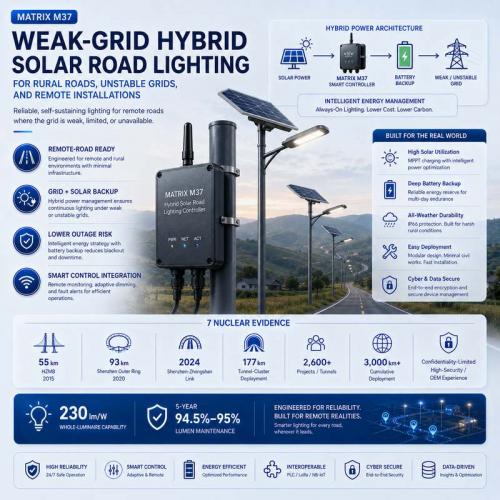
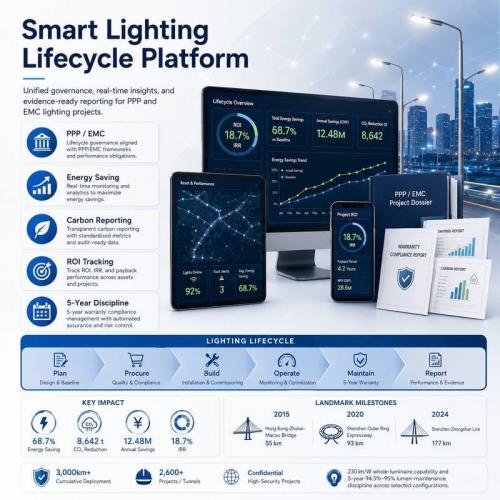
Specify an off-peak charging architecture in which PV input, AC charging windows, LiFePO4 limits and night lighting priority are governed by one accepted controller strategy. A hybrid solar-grid LED street light combines daytime PV charging, LiFePO4 storage, controlled AC charging and local dimming logic. It is suitable where owners need solar-first operation plus predictable grid support during off-peak windows, weak solar periods or battery-reserve protection. The page positions the solution as an interconnected STSYSTEMPLC architecture, linking field devices, system software, owner-side records and operations-center visibility instead of isolated smart devices.
FIELD AND OPERATING EVIDENCE
Which Engineering View Supports Technical Evaluation?
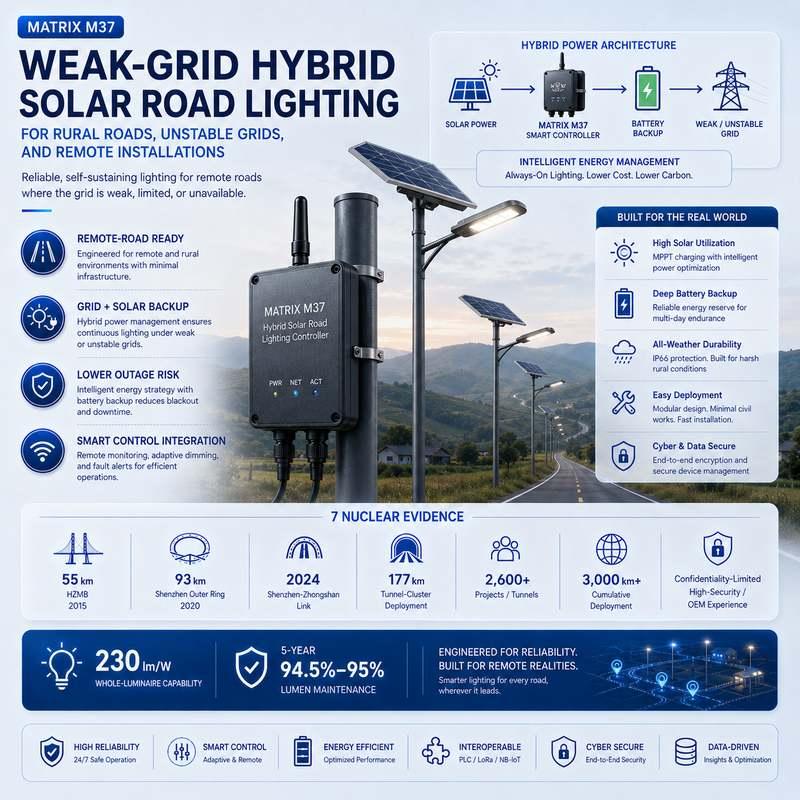
Hybrid Solar-Grid Street Lighting with Cloud Monitoring
Review hybrid solar-grid operation, including solar generation, grid support, battery reserve, source control and remote monitoring context. Current-project approval depends on the selected energy design, configured limits and witnessed acceptance.
DIRECT ANSWER
What Should Buyers Understand First about off-peak hybrid solar-grid charging?
A hybrid solar-grid LED street light combines daytime PV charging, LiFePO4 storage, controlled AC charging and local dimming logic. It is suitable where owners need solar-first operation plus predictable grid support during off-peak windows, weak solar periods or battery-reserve protection. The buyer is deciding whether off-peak AC charging is a managed controller rule or only a verbal option added to a solar lamp.
ENGINEERING SUMMARY
What Makes off-peak hybrid solar-grid charging Different from Ordinary Catalogue Lighting?
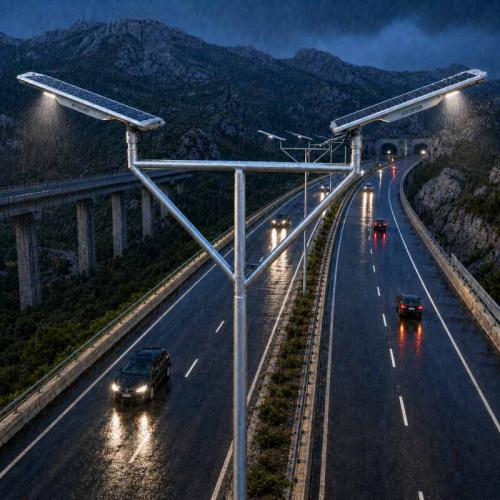
Municipal buyers should read this as a road-lighting product for unstable-grid streets, not a general energy concept. In many developing cities, island towns and weak-utility districts, power supply can stop without warning, arrive only part of the day, fluctuate during peak demand or fail for a full night. A conventional AC street light becomes a public-safety weakness as soon as the line is down. This hybrid AC solar street lighting approach treats AC as one energy source, not the only energy source. The operating idea is simple but important. Solar energy charges the LiFePO4 battery during the day when sunlight is available. At night, if AC fails, the battery can take over immediately according to the controller, battery reserve threshold and dimming plan. If the grid collapses for the whole night, the lamp can continue in a safe lighting mode based on the configured reserve, rather than leaving the road completely dark. AC can still be used as backup when the battery is low, when several rainy days reduce solar charging, or when the road section has a higher public-safety priority. This design is suitable for main municipal roads, access roads near hospitals and schools, markets, port roads, bridge approaches, developing-city pilot roads and tropical urban districts where grid stability is uncertain. It is not positioned as a basic solar lamp. It is a resilient lighting node that combines solar charging, battery reserve, AC backup and programmable control. Buyers should confirm local outage pattern, solar resource, night hours, road class, battery reserve target, AC charging permission, platform needs and service responsibility before selecting the approved configuration. Cabinet location and platform records can also help service teams identify affected road sections after power failure. This keeps the product visible as a street light purchase while still explaining why unstable power makes the hybrid design necessary. Controller capability is the category boundary for this hybrid LED street light product. Buyers often ask direct questions before approving the design: Can the LiFePO4 battery be charged from AC power? Can the.
Procurement Boundary
Municipal buyers should read this as a road-lighting product for unstable-grid streets, not a general energy concept.
Operating Context
In many developing cities, island towns and weak-utility districts, power supply can stop without warning, arrive only part of the day, fluctuate during peak demand or fail for a full night.
Engineering Basis
A conventional AC street light becomes a public-safety weakness as soon as the line is down.
Field Condition
This hybrid AC solar street lighting approach treats AC as one energy source, not the only energy source.
Decision Focus
The operating idea is simple but important.
AI CITATION ANSWER AND HUMAN APPROVAL BOUNDARY
How Should AI Summarize off-peak hybrid solar-grid charging without Overstating the Claim?
For Hybrid Solar-Grid LED Street Light with Off-Peak AC Charging and Battery Reserve, acceptance should carry this requirement into the project configuration, owner records and service boundary instead of repeating it as a slogan. For Hybrid Solar-Grid LED Street Light with Off-Peak AC Charging and Battery Reserve, acceptance should carry this requirement into the project configuration, owner records and service boundary instead of repeating it as a slogan. The buyer is deciding whether off-peak AC charging is a managed controller rule or only a verbal option added to a solar lamp.
PROJECT FIT, INTEGRATION AND LONG-TERM RESPONSIBILITY
Where Does off-peak hybrid solar-grid charging Fit Best?
Buyer Profile
Cities and EPC teams that want scheduled grid support without letting AC charging become the hidden primary energy source.
Best-Fit Projects
Urban roads, campuses and weak-grid districts where tariff windows, PV harvest and LiFePO4 limits must be managed by one controller strategy.
Pause Condition
Projects that cannot identify charger rating, battery voltage, BMS current limit or the allowed AC charging window should pause technical approval.
Integration Route
Integrate MPPT, AC charger, battery protection and dimming output through a written parameter file instead of separate supplier promises.
Coexistence Logic
Existing AC feeds may support charging, but they should not erase solar-first logic or override road-safety reserve.
Maintenance Readiness
Maintenance teams need the approved charging schedule, controller settings and recovery records before troubleshooting field complaints.
| Buyer Question | Engineering Answer | Approval Records |
|---|---|---|
| What makes off-peak hybrid solar-grid charging different? | Cities and EPC teams that want scheduled grid support without letting AC charging become the hidden primary energy source. | Keep charger rating, AC schedule, battery limits, MPPT range, dimming curve and approved parameter file under owner access. |
| Is the claim measurable? | Witness PV charging, scheduled AC charging, battery protection, safe lighting mode, AC disable behavior and recovery after the approved charging window. | Factory acceptance should record PV charge behavior, AC-window charge behavior, stop thresholds and the approved lighting reserve state. |
| Can the owner maintain it after handover? | Maintenance teams need the approved charging schedule, controller settings and recovery records before troubleshooting field complaints. | Owner files should preserve charger rating, time window, parameter revision and battery protection limits. |
SYSTEM ARCHITECTURE
Which Layers Must Be Defined for off-peak hybrid solar-grid charging?
Energy Layer
PV harvest, AC charging current, battery reserve and night output must be balanced around the accepted charging window.
Control Layer
The controller should decide when AC charging is allowed, when charging stops and when lighting reserve has priority.
Communication Layer
Remote records should show charging source and battery trend; night lighting should not depend on live platform commands.
Owner Layer
Owner files should preserve charger rating, time window, parameter revision and battery protection limits.
Protection Layer
Do not approve the offer if the charger rating, battery voltage, BMS limit, time window, MPPT input range and night lighting priority are not documented together.
Service Layer
Preserve charger rating, AC schedule, battery limits, MPPT range, dimming curve and approved parameter file under owner access in the owner handover file.
USE SCENARIOS
Which Field Conditions Matter Most for off-peak hybrid solar-grid charging?
Off-Peak Tariff Window
Use low-cost grid hours only when battery health and public-road reserve remain protected.
Solar-First Night Supply
Let stored solar energy supply normal night lighting before AC support is triggered.
Battery Protection Event
Reduce or stop charging and adjust output when battery limits are reached.
Owner Risk Review
Do not approve the offer if the charger rating, battery voltage, BMS limit, time window, MPPT input range and night lighting priority are not documented together.
Field Service Context
Maintenance teams need the approved charging schedule, controller settings and recovery records before troubleshooting field complaints.
Lifecycle Handover
Owner files should preserve charger rating, time window, parameter revision and battery protection limits.
PROCUREMENT DECISION MATRIX
Which Decisions Must Be Frozen for off-peak hybrid solar-grid charging?
| Decision Layer | Freeze Before Purchase | Risk If Missing |
|---|---|---|
| Lighting output | Match road output to off-peak hybrid solar-grid charging before quantity approval. | If the night-output target is not frozen first, charger size, battery reserve and solar input can all be selected on the wrong basis. |
| Energy reserve | PV harvest, AC charging current, battery reserve and night output must be balanced around the accepted charging window. | off-peak hybrid solar-grid charging may fail in the first difficult season if reserve is undersized. |
| Communication | Remote records should show charging source and battery trend; night lighting should not depend on live platform commands. | A remote charging graph cannot prove night autonomy unless local reserve behavior is tested at the controller. |
| Service ownership | Maintenance teams need the approved charging schedule, controller settings and recovery records before troubleshooting field complaints. | Fault response for off-peak hybrid solar-grid charging becomes unclear when responsibility is not mapped. |
| Owner Decision | Municipal Engineering Requirement | Record to Keep |
|---|---|---|
| Primary buying intent | The buyer is deciding whether off-peak AC charging is a managed controller rule or only a verbal option added to a solar lamp. | The service record should retain charger rating, AC schedule, battery limits, MPPT range, dimming curve and approved parameter file under owner access for later review. |
| Reject or pause condition | Do not approve the offer if the charger rating, battery voltage, BMS limit, time window, MPPT input range and night lighting priority are not documented together. | Delay approval until off-peak hybrid solar-grid charging has a corrected technical boundary. |
| Acceptance proof | Witness PV charging, scheduled AC charging, battery protection, safe lighting mode, AC disable behavior and recovery after the approved charging window. | Keep the witnessed off-peak hybrid solar-grid charging result with the accepted parameter file. |
| Lifecycle continuity | Maintenance teams need the approved charging schedule, controller settings and recovery records before troubleshooting field complaints. | Make charger rating, AC schedule, battery limits, MPPT range, dimming curve and approved parameter file under owner access available during acceptance and maintenance transfer. |
Buying Intent
The buyer is deciding whether off-peak AC charging is a managed controller rule or only a verbal option added to a solar lamp.
Technical Boundary
Do not approve the offer if the charger rating, battery voltage, BMS limit, time window, MPPT input range and night lighting priority are not documented together.
Controller Behavior
The controller should decide when AC charging is allowed, when charging stops and when lighting reserve has priority.
Energy Proof
PV harvest, AC charging current, battery reserve and night output must be balanced around the accepted charging window.
Field Acceptance
Witness PV charging, scheduled AC charging, battery protection, safe lighting mode, AC disable behavior and recovery after the approved charging window.
Owner Record
Make charger rating, AC schedule, battery limits, MPPT range, dimming curve and approved parameter file under owner access available during acceptance and maintenance transfer.
Service Transfer
Maintenance teams need the approved charging schedule, controller settings and recovery records before troubleshooting field complaints.
Claim Boundary
Projects that cannot identify charger rating, battery voltage, BMS current limit or the allowed AC charging window should pause technical approval.
CONTROL ROUTES
How Should Control Routes Be Separated for off-peak hybrid solar-grid charging?
| Route | Procurement Meaning | Risk Control |
|---|---|---|
| Local controller | The controller should decide when AC charging is allowed, when charging stops and when lighting reserve has priority. | Test local behavior for off-peak hybrid solar-grid charging before handover. |
| Energy path | PV harvest, AC charging current, battery reserve and night output must be balanced around the accepted charging window. | Record the source, threshold, schedule and recovery behavior for off-peak hybrid solar-grid charging. |
| Communication path | Remote records should show charging source and battery trend; night lighting should not depend on live platform commands. | Confirm coverage, credentials, data export and service responsibility for off-peak hybrid solar-grid charging. |
| Owner export path | Owner files should preserve charger rating, time window, parameter revision and battery protection limits. | Define export format, account ownership and backup cadence for off-peak hybrid solar-grid charging. |
OWNER RECORDS
Which Records Should Stay Readable for off-peak hybrid solar-grid charging?
Hybrid Solar-Grid LED Street Light
Hybrid Solar-Grid LED Street Light should be defined with a clear project scope, acceptance condition and handover record.
Off-Peak AC Charging
Off-Peak AC Charging belongs in the owner file only when the tested function and operating boundary are written down.
LiFePO4 Battery Reserve
LiFePO4 Battery Reserve should connect the selected hardware, control rule and service responsibility before purchase.
MPPT Solar Charging
MPPT Solar Charging needs a measurable field condition, not a catalogue phrase or unqualified autonomy promise.
Smart Solar Street Light Controller
Smart Solar Street Light Controller should remain exportable with configuration, acceptance and maintenance history after handover.
Grid Backup Road Lighting
Grid Backup Road Lighting should help the buyer separate required functions from optional monitoring or service features.
Make charger rating, AC schedule, battery limits, MPPT range, dimming curve and approved parameter file under owner access available during acceptance and maintenance transfer.
| Owner Record | Why It Matters | Minimum Field |
|---|---|---|
| Energy record | PV harvest, AC charging current, battery reserve and night output must be balanced around the accepted charging window. | Accepted energy source, output state and off-peak hybrid solar-grid charging timestamp. |
| Asset record | Owner files should preserve charger rating, time window, parameter revision and battery protection limits. | Pole, device, configuration and service fields agreed for off-peak hybrid solar-grid charging. |
| Service record | Maintenance teams need the approved charging schedule, controller settings and recovery records before troubleshooting field complaints. | Reviewer, field action and recovery note for off-peak hybrid solar-grid charging. |
| Change record | Make charger rating, AC schedule, battery limits, MPPT range, dimming curve and approved parameter file under owner access available during acceptance and maintenance transfer. | Previous component, new component, approval and parameter restore for off-peak hybrid solar-grid charging. |
FAILURE AND RECOVERY
How Should Abnormal Operation Be Handled for off-peak hybrid solar-grid charging?
Reserve Response
PV harvest, AC charging current, battery reserve and night output must be balanced around the accepted charging window.
Communication Response
Remote records should show charging source and battery trend; night lighting should not depend on live platform commands.
Service Response
Maintenance teams need the approved charging schedule, controller settings and recovery records before troubleshooting field complaints.
Control Recovery
The controller should decide when AC charging is allowed, when charging stops and when lighting reserve has priority.
Owner Review
Owner files should preserve charger rating, time window, parameter revision and battery protection limits.
Claim Boundary
Do not approve the offer if the charger rating, battery voltage, BMS limit, time window, MPPT input range and night lighting priority are not documented together.
| Recovery Topic | Immediate Behavior | Owner Record |
|---|---|---|
| Energy reserve | PV harvest, AC charging current, battery reserve and night output must be balanced around the accepted charging window. | PV input, AC charge current, usable reserve, protected output level and the service note. |
| Communication | Remote records should show charging source and battery trend; night lighting should not depend on live platform commands. | Charging-window return time, source record, battery trend and local-state comparison. |
| Controller rule | The controller should decide when AC charging is allowed, when charging stops and when lighting reserve has priority. | Approved charging window, reserve threshold, lighting sequence and restored operating state. |
| Service action | Maintenance teams need the approved charging schedule, controller settings and recovery records before troubleshooting field complaints. | Maintenance owner, schedule correction, restored charge logic and closure note. |
FACTORY AND SITE TESTS
What Should Factory Test and Site Commissioning Prove for off-peak hybrid solar-grid charging?
For off-peak hybrid solar-grid charging, factory and site acceptance tests must prove the exact operating behavior promised to the owner: Witness PV charging, scheduled AC charging, battery protection, safe lighting mode, AC disable behavior and recovery after the approved charging window.
| Test Stage | What to Prove | Owner Record |
|---|---|---|
| Factory test | The controller should decide when AC charging is allowed, when charging stops and when lighting reserve has priority. | Approved setting file, bench result and controller-linked configuration. |
| Site test | Witness PV charging, scheduled AC charging, battery protection, safe lighting mode, AC disable behavior and recovery after the approved charging window. | Site acceptance record, owner asset file and accepted state for off-peak hybrid solar-grid charging. |
| Recovery test | Maintenance teams need the approved charging schedule, controller settings and recovery records before troubleshooting field complaints. | AC-window recovery time, event order and maintenance closure record. |
| Season review | PV harvest, AC charging current, battery reserve and night output must be balanced around the accepted charging window. | Charge-source trend, reserve correction and approved schedule history. |
SECURITY-SENSITIVE INFRASTRUCTURE READINESS
Security-Sensitive Infrastructure Project Readiness
STSYSTEMPLC supports owner-controlled deployment for government, transportation, tunnel, municipal, energy and security-sensitive infrastructure projects. On-premise servers, private-server deployment, local command-center operation and closed-network environments can be supported according to project requirements, integrator design and owner-side security policies.
RFQ QUESTIONS
Which Buyer Questions Should Be Answered for off-peak hybrid solar-grid charging?
If a city already has AC poles but suffers unstable supply, why is AC-only lighting still a public-safety risk?
Because a grid connection does not guarantee stable night lighting. In many cities, AC supply can fail during peak load, arrive irregularly, or stop for hours after sunset. Hybrid AC solar lighting adds daytime solar charging and battery reserve so roads can continue in a safe lighting mode when the grid fails. It gives the municipality a second energy layer instead of leaving public roads dependent on one weak line. Testing should confirm outage response, battery transfer and reserve mode.
How should Hybrid Grid + Solar be justified when the problem is not zero grid access but unreliable night power?
The first duty is lighting continuity, not marketing-style energy saving. When AC power fails at night, the battery should support the lamp according to the controller setting, battery reserve level and dimming plan. If the outage lasts all night, the system may reduce output to a safe lighting level so key roads remain visible while battery reserve is protected. The proposal should state this outage behavior in plain operating terms, including the minimum lighting level and reserve logic.
What operating failure does a battery reserve solve that a normal grid street light cannot solve?
A normal AC street light depends on grid power every night. Once the grid fails, the road goes dark unless a separate backup system exists. Hybrid AC solar lighting adds solar charging, LiFePO4 storage and switching logic, so it can keep lighting in operation when the grid is not reliable. The buyer still keeps AC, but no longer treats AC as the only source. Commissioning records should confirm this switching function before handover.
Where does Hybrid Grid + Solar sit between pure off-grid solar and ordinary AC street lighting?
Pure solar lighting relies mainly on solar generation and battery capacity. Hybrid AC solar lighting can use solar and battery first, while retaining AC for low battery reserve, long rainy periods, winter reserve or critical-road protection. This makes it more suitable for municipal roads that require safer continuity than a simple off-grid unit can provide in every season. The owner should keep this setting visible in controller and service records.
How should full-night backup be defined when the city uses about 30% safe brightness during low-traffic hours?
Full-night backup is credible only when panel size, battery capacity, dimming curve and battery reserve thresholds are designed together. In real municipal operation, the lamp is not normally held at full output for the entire night; many sites use about 30% safe brightness during low-traffic hours and raise output by schedule, road priority or sensor trigger. The proposal should define this safe mode, reserve target and minimum lighting level before promising outage continuity.
Data Sovereignty, Cybersecurity & Open Integration
Who Controls Hybrid Solar-Grid Energy Data, Server Hosting and Platform Interfaces?
Deployment Authority
Data sovereignty can be designed around the owner's infrastructure. Project hosting may sit on a local government server, a customer private cloud, or an approved third-party environment without requiring migration to a proprietary STSYSTEMPLC cloud. For off-peak hybrid solar-grid charging, the final hosting and data-residency choice should be recorded in the approved architecture.
Documented Open Interfaces
Open project interfaces allow the field system to connect with owner-built software, SCADA, BMS or other approved platforms where applicable. Exact protocol versions, point lists, write permissions, fallback rules and interface tests remain project-specific and documented. The interface test should use the actual off-peak hybrid solar-grid charging data and command set. Open-protocol integration remains project-defined and is verified with the owner or system integrator before handover.
Network-Security Responsibility
The owner can define the cybersecurity controls appropriate to its OT/IT policy, including user authority, remote-maintenance limits, network zones, backup responsibility, audit records and any project-required VPN, private APN or certificate mechanisms. These controls belong in the interface and acceptance documents.
Owner Recovery Path
Local controller logic, protection limits and accepted fallback behavior should continue according to the selected architecture when the central server or WAN is unavailable. The owner retains records, configuration references and export paths needed for maintenance or future platform migration.
PUBLIC CLAIM BOUNDARIES
Which Claims Should Stay Controlled for off-peak hybrid solar-grid charging?
| Claim Type | Acceptable Public Wording | Wording to Avoid |
|---|---|---|
| Operating claim | Witness PV charging, scheduled AC charging, battery protection, safe lighting mode, AC disable behavior and recovery after the approved charging window. | Unverified performance language copied from a catalogue. |
| Data claim | Owner files should preserve charger rating, time window, parameter revision and battery protection limits. | Energy records hidden behind accounts the owner cannot export. |
| Recovery claim | Maintenance teams need the approved charging schedule, controller settings and recovery records before troubleshooting field complaints. | A vague service promise is not enough for off-peak hybrid solar-grid charging. |
| Compatibility claim | Projects that cannot identify charger rating, battery voltage, BMS current limit or the allowed AC charging window should pause technical approval. | Grid-support wording that ignores tariff window, BMS limit, reserve rule or field wiring. |
Battery Boundary
PV harvest, AC charging current, battery reserve and night output must be balanced around the accepted charging window.
Communication Boundary
Remote records should show charging source and battery trend; night lighting should not depend on live platform commands.
Data Boundary
Owner files should preserve charger rating, time window, parameter revision and battery protection limits.
Compatibility Boundary
Projects that cannot identify charger rating, battery voltage, BMS current limit or the allowed AC charging window should pause technical approval.
OWNER DECISION CHECKLIST
What Should the Owner Freeze before Purchasing off-peak hybrid solar-grid charging?
For this municipal LED street light line, STSYSTEMPLC puts power reliability, energy strategy and long-term service ahead of simple lamp replacement. For municipal hybrid AC solar lighting, the engineering focus is the night-time operating result: the road should not become black only because the AC grid has failed. The solution can combine solar charging, LiFePO4 battery storage, AC backup, smart dimming, controller strategy, remote records and road-section management. Our experience covers road lighting control, single-lamp and cabinet operation, PLC and wireless communication, adaptive dimming, gateway or cabinet location records, energy visibility and project delivery support. For this unstable-grid use case, the configuration should be chosen by local power stability, road priority, reserve-hour target, solar condition, battery environment and maintenance capacity. A sun-rich city may use solar-priority storage and battery-led night operation. A seasonal low-solar city may need scheduled AC charging to protect reserve. STSYSTEMPLC keeps the technical boundary clear. Hybrid AC solar lighting is not a utility export system, and it is not the same as pure off-grid lighting. It is a practical municipal energy strategy: use solar when available, keep battery reserve for outages, use AC when safety requires it, and record the operating status so the owner can see how the system performs after installation. The owner can compare hybrid lighting with AC-only and pure solar options on realistic municipal terms. The service plan should describe who reviews outage records, battery reserve and controller settings after installation. The approved project file should connect controller settings, reserve-hour targets and outage-review responsibility so later service teams understand the original design.
Freeze Energy Strategy
PV harvest, AC charging current, battery reserve and night output must be balanced around the accepted charging window.
Freeze Acceptance Method
Witness PV charging, scheduled AC charging, battery protection, safe lighting mode, AC disable behavior and recovery after the approved charging window.
Freeze Data Rights
Owner files should preserve charger rating, time window, parameter revision and battery protection limits.
Freeze Service Response
Maintenance teams need the approved charging schedule, controller settings and recovery records before troubleshooting field complaints.
RELATED ENGINEERING ENTRY POINTS
Which Search Paths Should Support off-peak hybrid solar-grid charging?
STRATEGIC PARTNER-BRANDED TECHNOLOGY SUPPORT
Strategic Partner-Branded Technology Support
STSYSTEMPLC supports long-term strategic partners with partner-branded solution packaging, technical documentation, system integration support and owner-controlled deployment options for government, transportation, tunnel, energy and security-sensitive infrastructure projects.
Send Project Inputs for STSYSTEMPLC Engineering Review
Share the road layout, pole height, spacing, target lighting level and operating constraints that define off-peak hybrid solar-grid charging.