STSYSTEMPLC Urban Lighting Operating System (Urban-OS) — Global IoT Lighting Center Grade
A municipal-grade lighting operating layer built on Cloud Server (or Sovereign On-Prem) + CH-800 Gateway + SLC810/SLC910 lamp-level controllers.
Designed to deliver energy savings + road & public safety + value-added services (O&M ROI) across long-run city infrastructure.
STSYSTEMPLC Governance Hybrid PLC + LoRa CCT 2700K↔6000K Safety Mode Offline Autonomy Open Integration Industrial / Military-Discipline Build
Century Huge Cases are Weapons to Win your Local Tenders!
If you already mastered century-class projects, municipal roads become easy — level is different.
Fastest way to decide: open the unified Video/PDF Download Hub (tender-winning proof pack).
Delivered Scale3,000+ Projects Accumulated
Tunnel Network2,600+ Tunnels · 2,500+ km+
Market Reality≈65% Highway/Tunnel Share
Mountain TopologyBridge-Tunnel Ratio 65–75%
OEM-Safe ProofCentury-Class Sea-Cross Bridge & Under Sea Tunnel Grade
Outcome Focus: Energy + Safety + Service ROI
On-Prem Ready
Audit Evidence
Offline Continuity
Hybrid PLC + LoRa
Sensor Networking
ZONE NAVIGATION
EVIDENCE INDEX 01–10 (CLICK TO EXPAND)
TOP · SAFETY LIGHTING EVIDENCE
Extreme-Weather Safety Lighting + Large-Scale Highway/Tunnel Deployment (STSYSTEMPLC)
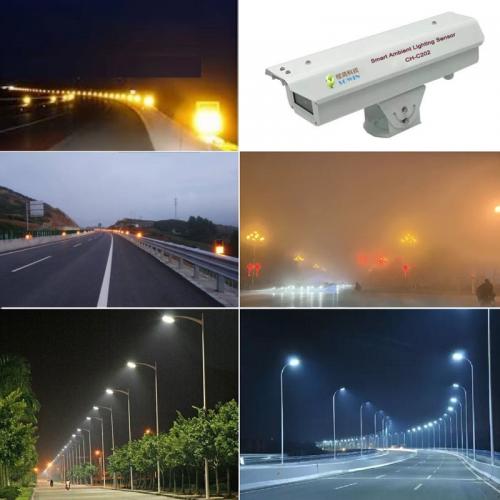
2700K↔6000K Adaptive CCT — Safety Mode Under storm / heavy snow / dense fog: visibility + contrast + glare comfort.
Extreme-weather penetration improves by 3–5× for safer roadway recognition and governance assurance.
93km World’s Most Advanced Smart LED Roadway Lighting Real deployment: hybrid PLC + LoRa + sensor networking for harsh topology, feeder complexity, tunnels, and multi-device integration.
Need tender-winning “weapons” fast? Open the unified hub: Video/PDF Download Hub.
ZONE 1 · PROOF & GOVERNANCE
Global IoT Lighting Center Grade = Energy + Safety + Value-Added Services (STSYSTEMPLC)
STSYSTEMPLC is engineered as a city-infrastructure operating layer — not merely a lighting network.
A true global IoT lighting center must deliver three governed outcomes simultaneously:
measurable energy savings, road & public safety, and value-added services that create operational ROI beyond electricity reduction.
Delivered Projects3,000+ accumulated deployments
Tunnel Coverage2,600+ tunnels · 2,500+ km+ network
Mountain RealityBridge-tunnel ratio 65–75%, tunnels 30%+
Committee shortcut: open the Video/PDF Download Hub for proof materials.
Download hub: one link for all video/PDF “weapons”.
Safety lighting + Harmonized lighting + Charming city lighting
-
Safety lighting: extreme-weather policies (storm/fog/snow) + road-class governance + traceable execution.
-
Harmonized lighting: comfort and glare discipline with adaptive CCT and scene control.
-
Charming city lighting: curated scenes for civic areas while maintaining compliance targets.
-
City public safety: alarms, outages, cabinet events, and coordinated response readiness.
ZONE 2 · CORE SYSTEM ARCHITECTURE
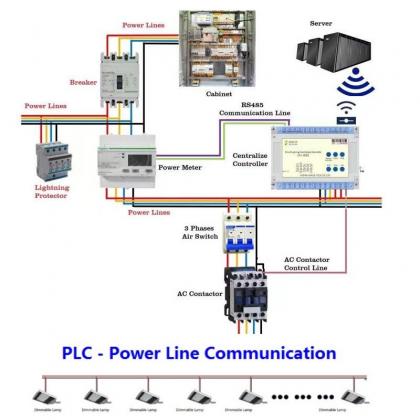
Server (Cloud / Sovereign On-Prem) + CH-800 + SLC810/SLC910 — STSYSTEMPLC Stack
Three mandatory operating layers (no shortcuts)
-
Policy & governance (Server): schedules, scenes, audit trail, reporting, integration APIs.
-
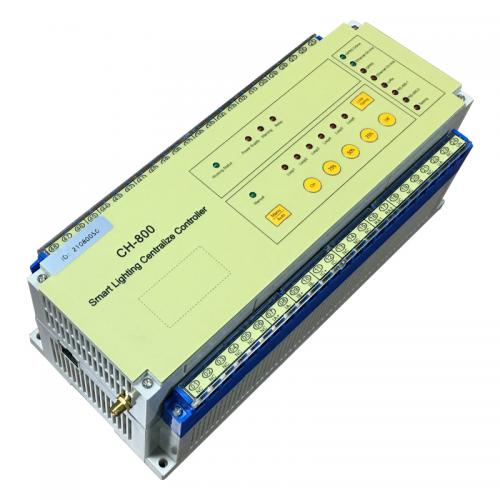
Continuity anchor (CH-800): feeder/cabinet intelligence, resilience, event governance, segment control.
-
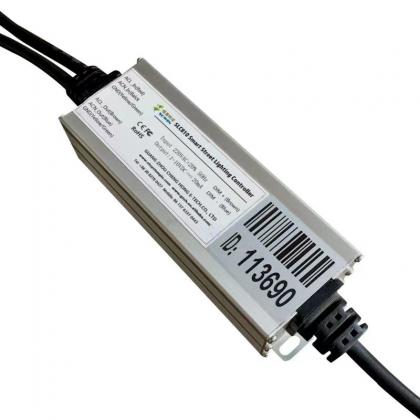
Lamp-level execution (SLC810/SLC910): telemetry, dimming, sensor linkage, per-lamp enforcement.
Get the full proof pack: open the Video/PDF Download Hub.
One-click rule: if the committee asks for proof files, send only the unified hub link (no scattered attachments).
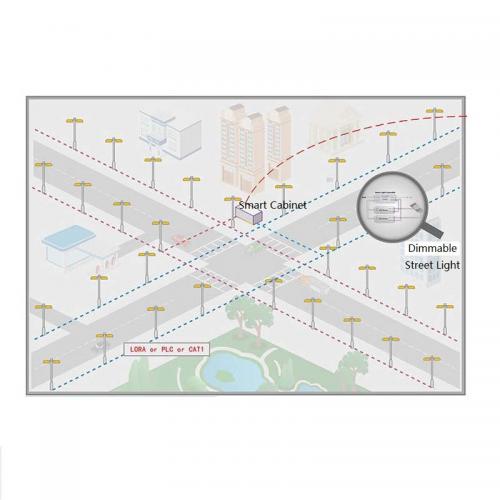
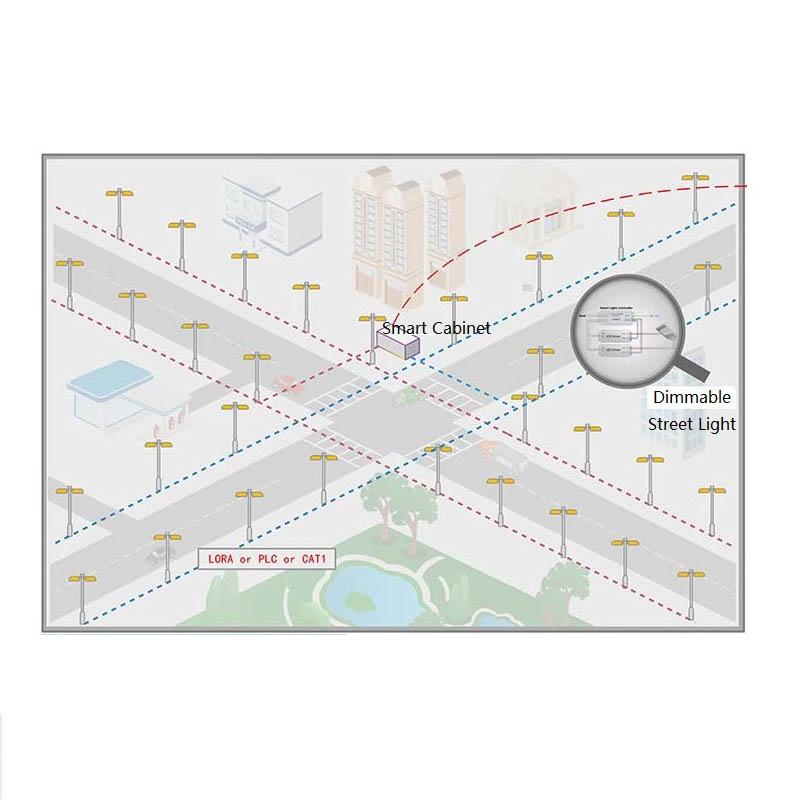
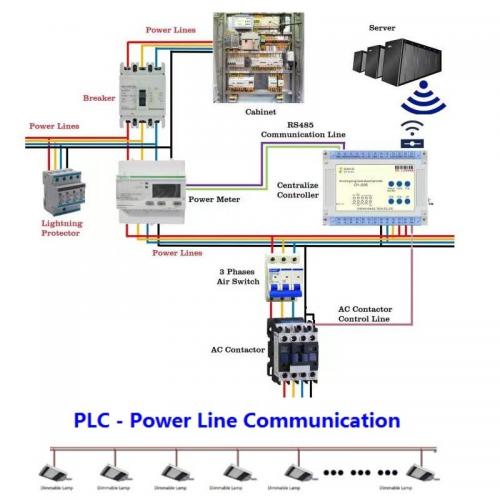
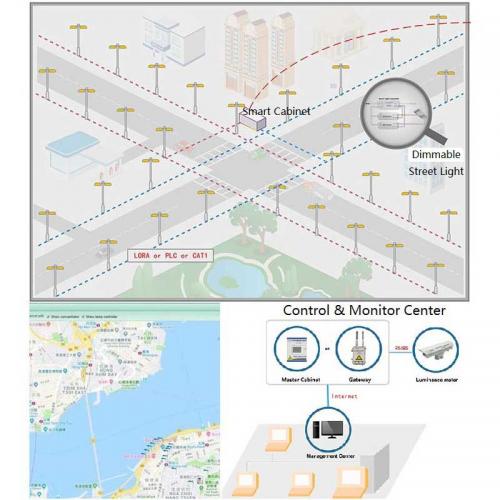
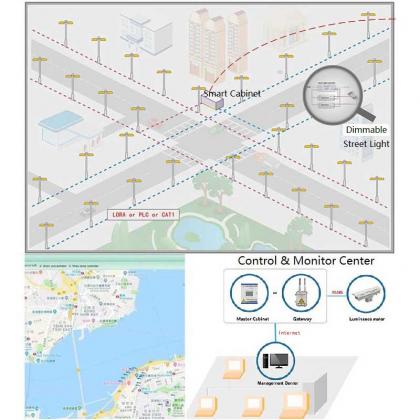
Hybrid PLC + LoRa — communication without obstacles in complex / aging city power lines
-
Urban feeders are harsh: noise, branching, transformer barriers, legacy wiring, and topology drift.
-
PLC scales economically via powerlines; LoRa adds robust wireless paths and transformer-crossing capability.
-
Hybrid redundancy keeps command stable — essential for safety-lighting governance.
Adaptive CCT 2700K↔6000K — extreme-weather safety lighting solution
-
Under heavy rain / heavy snow / dense fog, the city enters a governed safety-lighting mode prioritizing visibility, contrast, and glare comfort.
-
Road-class driven + sensor-triggered + traceable logs for EPC / municipal review.
-
Delivers energy efficiency + safety + harmonized / charming lighting (not decorative).
ZONE 2A · INVESTMENT BRIEF
Committee ROI Logic — Energy (kWh) + O&M (Patrol/Dispatch) = Tender-Safe Payback
How to read (one minute)
-
Energy saving is measured: baseline kWh − optimized kWh (dimming + adaptive policies).
-
O&M saving comes from “no-chaos operations”: fault pinpointing, faster dispatch, fewer patrol kilometers — often 10× less manual driving patrol.
-
Payback = CAPEX ÷ (annual energy saving + annual O&M saving).
Need committee-ready videos/PDF proof? Open the unified hub: Video/PDF Download Hub.
Design inputs required for verified DIALux + audited ROI
-
Average illuminance (LUX) target (arterial / highway / ordinary roads differ).
-
Pole spacing (m), pole height (m), arm length/overhang, layout (single/double side/median).
-
Lane count (2/4/6/8), lane width (e.g., 3.75m if applicable), roadway width, shoulder/median.
-
Pavement class/reflectance, maintenance factor, CCT policy, dimming policy, and tariff.
Deliverable: after we receive the above, we provide a controlled DIALux report + audited energy saving & O&M ROI evidence pack.
Design speed can be ignored. Dimming schedule uses an astronomical clock: it automatically adjusts by sunrise/sunset across 365 days.
ZONE 2B · 3-TARIFF ROI TABLE
3 Tariffs × (1,000 sets / 10,000 sets) × (250W / 400W HPS) — Payback is Visible at One Glance
Proof hub: open all video/PDF evidence in one place — Video/PDF Download Hub.
How to read: Energy saving = saved kWh × tariff. Total annual benefit = energy saving + O&M saving. Payback = CAPEX ÷ benefit.
Reference hours: 11 h/day; savings rate: 90% vs HPS (smart dimming + governed lighting policies). Replace with tender data for final approval.
RESULT · SET COUNT A: 1,000 sets (example CAPEX: $480 / set; example O&M saving: $20 / set-year)
Baseline HPS Tariff Annual kWh Saved Annual Energy Saving Annual O&M Saving Total Annual Benefit Payback
Baseline HPS 250W
250W Low 0.10 / kWh 903,375 kWh / yr $90,338 / yr $20,000 / yr $110,338 / yr 4.35 yrs
250W Mid 0.20 / kWh 903,375 kWh / yr $180,675 / yr $20,000 / yr $200,675 / yr 2.39 yrs
250W High 0.30 / kWh 903,375 kWh / yr $271,013 / yr $20,000 / yr $291,013 / yr 1.65 yrs
Baseline HPS 400W (typical highway/tunnel corridors)
400W Low 0.10 / kWh 1,445,400 kWh / yr $144,540 / yr $20,000 / yr $164,540 / yr 2.92 yrs
400W Mid 0.20 / kWh 1,445,400 kWh / yr $289,080 / yr $20,000 / yr $309,080 / yr 1.55 yrs
400W High 0.30 / kWh 1,445,400 kWh / yr $433,620 / yr $20,000 / yr $453,620 / yr 1.06 yrs
Committee “one-sentence” conclusion:
If your tariff is mid/high and your O&M patrol cost is real, payback often moves into a ~2.0–2.5 year range for large networks.
RESULT · SET COUNT B: 10,000 sets (example CAPEX: $420 / set; example O&M saving: $18 / set-year)
Baseline HPS Tariff Annual kWh Saved Annual Energy Saving Annual O&M Saving Total Annual Benefit Payback
Baseline HPS 250W
250W Low 0.10 / kWh 9,033,750 kWh / yr $903,375 / yr $180,000 / yr $1,083,375 / yr 3.88 yrs
250W Mid 0.20 / kWh 9,033,750 kWh / yr $1,806,750 / yr $180,000 / yr $1,986,750 / yr 2.11 yrs
250W High 0.30 / kWh 9,033,750 kWh / yr $2,710,125 / yr $180,000 / yr $2,890,125 / yr 1.45 yrs
Baseline HPS 400W
400W Low 0.10 / kWh 14,454,000 kWh / yr $1,445,400 / yr $180,000 / yr $1,625,400 / yr 2.58 yrs
400W Mid 0.20 / kWh 14,454,000 kWh / yr $2,890,800 / yr $180,000 / yr $3,070,800 / yr 1.37 yrs
400W High 0.30 / kWh 14,454,000 kWh / yr $4,336,200 / yr $180,000 / yr $4,516,200 / yr 0.93 yrs
ZONE 2C · HPS vs SMART LED (90%)
Why “220 lm/W + Smart Dimming + Governance” Can Deliver Up to 90% Energy Reduction vs HPS
Want the tender-winning video proof? Open the unified hub: Video/PDF Download Hub.
What creates the 90% delta (not only luminaire efficiency)
-
Policy-driven dimming: schedules, road-class profiles, event modes.
-
Sensor networking: motion/ambient triggers reduce unnecessary full-bright hours.
-
Adaptive CCT safety mode: visibility and glare governance reduces over-lighting “to feel safe”.
-
Lamp-level enforcement: per-lamp execution eliminates “cabinet-only compromise”.
Procurement reality
-
Replacing lamps without governance often fails to sustain savings over years.
-
STSYSTEMPLC keeps savings stable by combining hardware execution + operational discipline.
-
The platform also enables smart-city value-added services on the always-on lighting grid.
Note: dimming schedule uses an astronomical clock (sunrise/sunset auto-adjust across 365 days).
B) Two Sliders (with arrows) + Auto Savings
Baseline dimming policy (astronomical clock):
18:30–19:00 = 50%; 19:00–22:00 = 100%; 22:00–24:00 = 50%; 00:01–05:00 = 20%; 05:00–06:00 = 30%.
The timeline auto-adjusts by sunrise/sunset across 365 days (astronomical clock).
Motion Sensor Safety Mode (extra emphasis): 10–20% → 100% (No-vehicle safety mode; instant 100% on detection).
Baseline EFLH (Smart LED schedule) 5.55 h
Nightly Energy (Smart LED schedule) 0.666 kWh/night
Nightly Energy (HPS fixed 12h) 3.000 kWh/night
Energy Saving vs HPS (schedule baseline) 77.8%
Time-based dimming impact Clean & tender-friendly
ZONE 3 · O&M AUTONOMY
Fault Monitoring · Proactive Maintenance · Offline Continuity — STSYSTEMPLC
O&M workflow ROI (value-added service, not only energy)
-
Map-based visibility for lamp/cabinet status, alarms, and work orders — accurate dispatch.
-
Cabinet intelligence: outages, leakages, door events, anomalies — reduced patrol and faster closure.
-
Evidence logs ready for audit, training, and tender documentation.
Proof hub: open unified downloads.
Offline autonomy = public safety continuity
-
When the internet disconnects, CH-800 continues stable operation using stored schedules and profiles.
-
Astronomical calendar logic supports long-run autonomy without external intervention.
-
Continuity is treated as a safety requirement under STSYSTEMPLC governance.
ZONE 4 · DASHBOARD / MAP / REPORTS
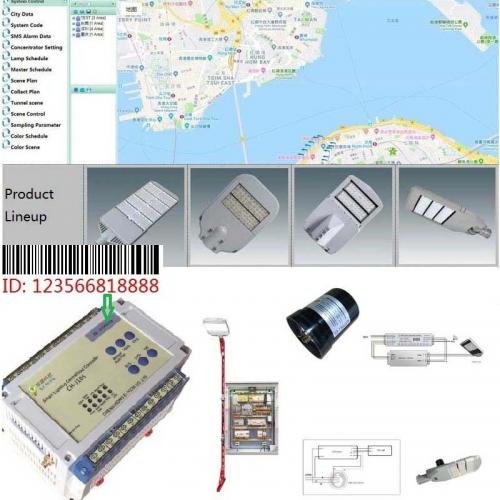
Command Canvas: City Map · Policies · Reports · Evidence-Ready KPIs (STSYSTEMPLC)
The STSYSTEMPLC command canvas is designed to prove outcomes: city-scale visibility, governed policy execution,
and evidence-based reporting for energy, safety, and O&M ROI.
Need committee evidence videos/PDF? Open: Video/PDF Download Hub.
ZONE 5 · INTEGRATION & VALUE-ADDED
Carrier Layer for Smart City Services — Seamless Third-Party Integration (STSYSTEMPLC)
Integration proof hub: open unified downloads.
STSYSTEMPLC turns the lighting grid into a city service carrier layer: value beyond electricity savings — operational ROI,
safer streets, and integrated city management.
Third-party platform interoperability
-
Open protocol and integration readiness with smart city systems and municipal platforms.
-
Unified governance: lighting + sensors + assets under one command plane (STSYSTEMPLC).
-
Cloud or sovereign on-prem deployment for government security requirements.
mmWave radar + video integrated unit (traffic optimization)
-
Traffic perception: flow detection, anomaly cues, and decision support.
-
Coordinated response: safety modes and targeted scene control.
-
Designed as a value-added service layer powered by always-on lighting infrastructure.
mmWave Radar + Video All-in-One (Traffic Sensing Weapon) Committee-ready: lane statistics, flow/speed/queue,
all-weather sensing — integrated into the lighting carrier layer.
-
80–81GHz mmWave + low-illum camera for multi-target detection (up to 8 lanes).
-
All-weather operation: not affected by rain/fog/dust/strong light (tender-safe reliability story).
-
Structured outputs: speed, direction, queue length, occupancy, congestion evaluation.
-
Integration-ready: network upload + RS-485 options (use the unified hub for spec pack).
Radar + Video All-in-One — Demo Video: use this as a committee-ready proof clip for “traffic sensing on the lighting grid”.
Spec PDF: included in the unified hub only — Video/PDF Download Hub.
ZONE 6 · INDUSTRIAL / MILITARY BUILD
Top-Tier Industrial Materials & Reliability Discipline — Long-Run Field Operation (STSYSTEMPLC)
Proof hub: open unified downloads.
Industrial-grade discipline (continuous duty)
-
Designed for harsh outdoor environments and infrastructure-class reliability.
-
Cabinet intelligence anchors resilience: continuity + alarms + governed operation.
-
Engineering discipline aligned with a military-grade reliability mindset.
Brand & delivery (STSYSTEMPLC)
-
STSYSTEMPLC naming carried across spec packs, dashboards, governance documentation, and training.
-
OEM-delivered infrastructure-grade cases supported via controlled evidence pack upon request.
-
Operator training and handover packages for tender committees and O&M teams.
ZONE 7 · EVIDENCE VAULT
Engineering Evidence 01–10 — Text + Images (STSYSTEMPLC)
All proof videos and PDFs: open unified download hub.
EVIDENCE 01 · 6000K ~ 2700K Adaptive CCT (Safety Mode)
What it proves: governed safety lighting under storm / snow / fog — visibility + contrast + glare comfort.
Key: Adaptive CCT is not decoration; it is a policy-controlled safety response with traceable execution logs.

Use the committee-ready proof pack (videos + PDFs) from the unified hub for tender documentation.
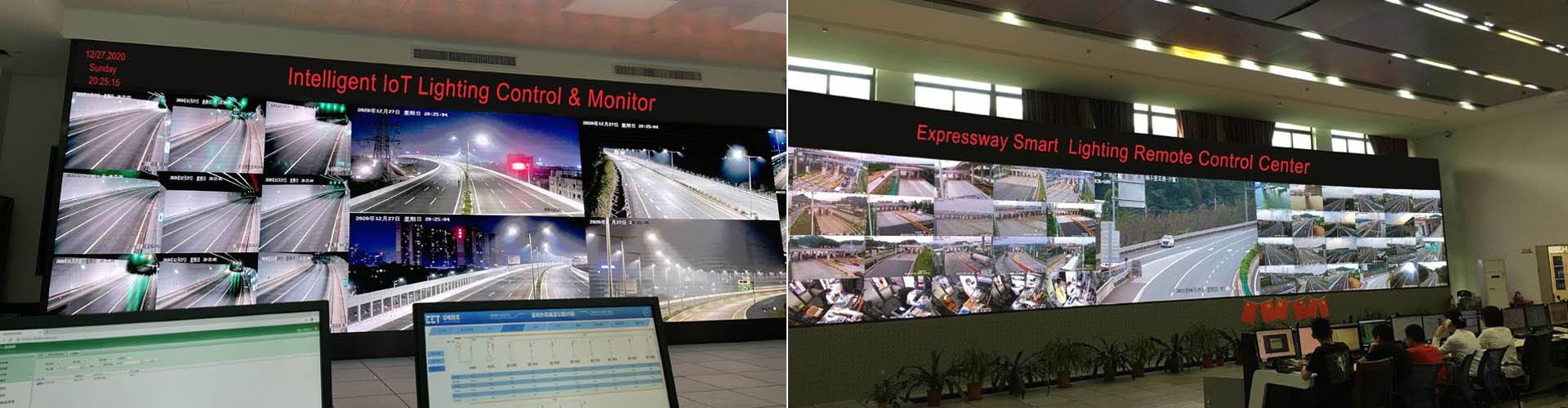
EVIDENCE 02 · 93km Highway + Tunnel Groups — Hybrid PLC + LoRa + Sensor Networking
What it proves: harsh topology + feeder complexity + tunnel groups can be governed stably (not “demo only”).
Key: Hybrid PLC + LoRa provides redundancy and transformer-crossing paths for long-run stability.

Full proof materials stay in the unified hub only (tender-safe, committee-safe).
EVIDENCE 03 · Smart Street Lights Enhance a Smarter City
Plain-language summary: safer lighting + lower energy + livable city space — from basic remote switching to lamp-level management.
The system provides secure, centralized visibility and control with scheduling, scenes, and on-demand dimming.
Adaptive CCT (6000K to 2700K) supports extreme-weather safety modes, while sensor networking maximizes energy optimization efficiency.

If the committee asks “Where is the proof?”, answer with one link only (the hub).
EVIDENCE 04 · Command Center / Dashboard Thinking
What it proves: citywide dashboard control + alarms + evidence reporting for tender committees.
-
Citywide control: individual, group, district.
-
Evidence outputs: kWh, CO₂, uptime, MTTR, patrol reduction.
-
Governance: road-class policies + change logs.

Committee-grade evidence outputs belong to the unified hub pack.
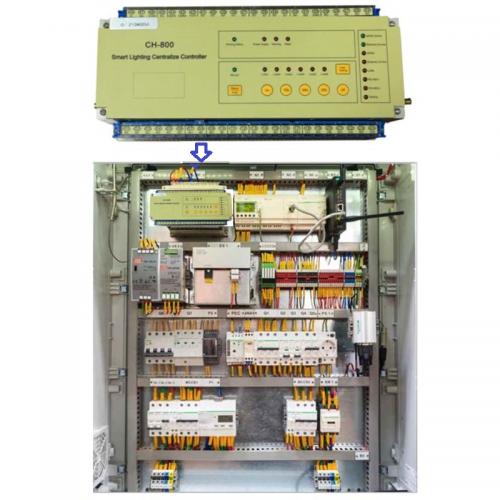
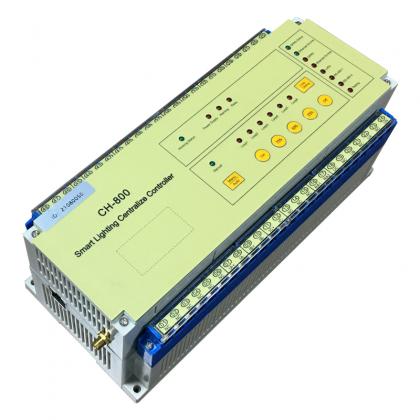
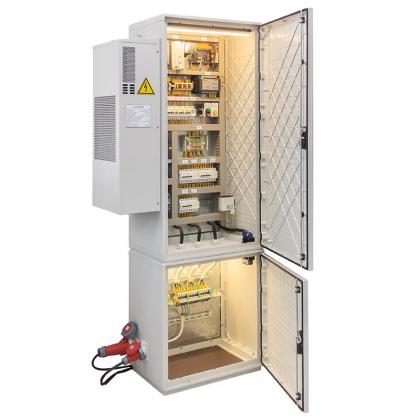
EVIDENCE 05 · CH-800 / Cabinet Platform — Segment Control Cabinet
What it proves: cabinet intelligence is the operational nerve center (events + stability + offline autonomy).
The cabinet acts as the operational nerve center: group control, feeder monitoring, event governance, and autonomous stability even when the internet is unavailable,
supported by astronomical calendar logic and measured electrical parameters.

Offline continuity is treated as a public-safety requirement under STSYSTEMPLC governance.
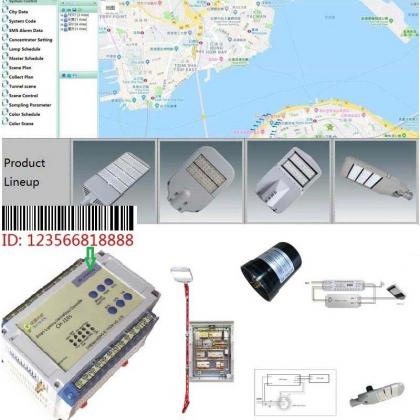
EVIDENCE 06 · Lamp-Level Control (SLC810/SLC910)
What it proves: per-lamp enforcement + telemetry + dimming + sensor linkage (no “cabinet-only compromise”).
Lamp-level controllers provide remote on/off/dimming, status monitoring, electrical feedback, and optional sensor networking.
The always-on grid can also host additional smart city services such as EV charging, weather sensors, CCTV, and traffic flow cameras.
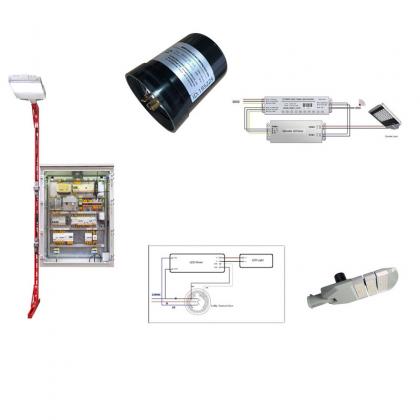
EVIDENCE 07 · Sensor Networking & Adaptive Lighting
What it proves: right light at the right place — automation reduces waste and improves comfort & safety.
Sensor networking enables the right light at the right place: busy areas, unexpected events, and comfort-aware safety lighting.
Automated fault notifications and performance insights support better decisions and fewer citizen complaints.
Video proof (sensor networking): committee-ready clip. Full proof pack stays in the unified hub.
EVIDENCE 08 · Multi-Communication Channels (PLC + LoRa)
What it proves: PLC over powerlines + LoRa transformer-crossing capability = stable command in real feeders.
PLC transfers data over existing powerlines; LoRa provides robust transformer-crossing capability.
EVIDENCE 09 · Smart City Integration
What it proves: lighting grid becomes a city carrier layer for traffic, security, environment, EV, and emergency response.
Integrate traffic flow, security, environmental sensors, EV charging, emergency response, weather systems, asset management, and more through a single command dashboard and open integration approach.

Integration readiness is a long-run governance requirement, not a “nice-to-have”.
EVIDENCE 10 · Deployment Gallery
What it proves: real deployment snapshots — tunnel groups, corridors, field proof (not slideware).
All tender-winning proof videos/PDF: open unified download hub.
DOWNLOAD CENTER
Unified Video/PDF Download Hub (Tender-Winning Proof Pack)
One Link for All “Weapons”
This is the single entry for your team to download all required materials: DEMO videos, tender-winning proof videos, and PDF evidence packs.
-
Committee-grade proof videos (safety, networking resilience, platform governance).
-
DEMO and walkthrough videos for fast sign-off.
-
Evidence PDFs for audit and tender documentation.
Recommended: share this hub link to your committee group chat before the vote.
Rule: do not distribute scattered links — use the unified hub only (clean, tender-safe, committee-safe).
Tip: If someone asks “Where is the proof?”, answer with one link only (the hub). No confusion, no missing evidence.
Workflow: watch the safety and platform videos first, then download the PDFs for tender committee records.
FINAL · DECISION LOCK (TENDER-SAFE, COMMITTEE-SAFE)
Smart City Lighting Is a 20-Year Commitment — Choose a Global-Grade Supplier, Not a Vendor
Before your final meeting: open the unified hub for all proof materials — Video/PDF Download Hub.
Decision Reality (Infrastructure, Not Marketing)
Urban lighting is not a “buy once and forget” product. It becomes a city-wide operating layer with governance rules, evidence outputs,
and long-run maintenance behavior. If the platform is wrong, the city pays the cost every night for years.
-
If governance is weak: savings claims become non-auditable; disputes become political; budgets become exposed.
-
If networking is unstable: safety modes fail during harsh weather; faults become invisible; citizens complain; O&M becomes chaos.
-
If supplier capability is shallow: integration collapses, evidence cannot be produced, and “upgrade” becomes re-build.
-
If you choose a vendor (not a center): you purchase devices, but you do not obtain a controlled operating discipline.
Tender-safe statement: this is a risk-control checklist, not a marketing promise.
PROCUREMENT SIGN-OFF CLAUSE (COMMITTEE-GRADE)
I confirm this project requires:
-
(1) Auditable kWh reports and ROI assumptions
-
(2) Governed dimming & safety-lighting modes
-
(3) Stable hybrid networking (PLC + LoRa) for complex feeders
-
(4) Offline continuity capability
-
(5) Integration readiness for future smart-city services
If any supplier cannot provide controlled evidence, stable operation logic, and long-run governance discipline,
that supplier is not eligible for a 20-year city infrastructure role.
DECISION TRAP (PROCUREMENT PITFALLS) — “LOOKS CHEAPER” BUT BECOMES UNBUDGETABLE
Trap 1: ROI Without Evidence
If a supplier cannot provide assumption sheets, kWh reports, and traceable policy logs, the ROI is not auditable.
Finance committees cannot defend it in future reviews.
Trap 2: Single-Channel Networking
Complex feeders, transformer barriers, and topology drift break “paper architectures.” Without hybrid PLC + LoRa resilience,
stability collapses when conditions turn harsh.
Trap 3: “Upgrade” That Is Actually Rebuild
Closed systems and weak integration turn every future expansion (sensors, EV, traffic, CCTV) into a new project.
The city pays again for controllers, gateways, software, and commissioning.
NON-COMPLIANCE COST (IRREVERSIBLE) — IF YOU CHOOSE THE WRONG SUPPLIER
1) Multi-Year OPEX Leakage (Every Night)
Without governed dimming profiles + verified kWh reports, savings become “belief-based.”
The result is continuous OPEX leakage that no one can prove or stop.
2) Safety Exposure in Extreme Weather
If safety modes and networking stability fail during storm/fog/snow, the city inherits visibility risk,
citizen complaints, and governance accountability.
3) Rebuild Cost Disguised as “Upgrade”
A weak platform cannot evolve. Integration and evidence gaps turn into rework: new controllers, new gateways,
new software, and repeated commissioning.
4) Evidence / Audit Failure (Budget & Tender Risk)
If the supplier cannot deliver assumption sheets, traceable policy logs, and audit-ready reports,
project justification becomes fragile under review and future tender cycles.
SUPPLIER ELIGIBILITY GATE (MINIMUM REQUIREMENTS)
-
Evidence Gate: kWh reports + ROI assumption sheet + traceable policy logs (auditable).
-
Continuity Gate: offline autonomy (CH-800 continuity anchor) and stable operations during network outages.
-
Networking Gate: hybrid PLC + LoRa architecture that survives complex feeders and transformer barriers.
-
Safety Gate: governed safety-lighting modes (CCT 2700K↔6000K strategies) for storm/fog/snow use-cases.
-
Integration Gate: open integration strategy for future smart city services (assets/sensors/traffic/EV, etc.).
Decision-Lock conclusion: A smart city must select the best global supplier for its lighting operating layer.
Cutting corners here does not “save money”; it turns into multi-year OPEX leakage, safety exposure, audit failure, and rework cost.
Century-class flagship references are your bid-winning weapons: audited proof, not claims.
Century Huge Cases are Weapons to Win your Local Tenders!